





Uncategorized
Motorola Multi-Pin Connector Earpiece: The Professional Buying Guide 2026
Sep
A Motorola multi-pin connector earpiece is the single most critical link in your security chain; yet it’s often the most misunderstood piece of kit in a professional’s arsenal. Choosing the wrong accessory leads to more than just a wasted budget. It results in critical audio failure when silence or clarity matters most. You’ve likely felt the frustration of an earpiece that physically fits the socket but fails to transmit, or the confusion of choosing between 1-wire and 3-wire setups for your specific Motorola series.
We understand that in high-pressure environments, your gear must work the first time, every time. This guide simplifies the technical jargon to ensure you secure the perfect match for your radio fleet, whether you’re using the DP4000 series or the latest R7 models. We’ll break down the wiring configurations, durability standards, and compatibility secrets you need to keep your team connected and covert throughout 2026. Prepare to master your hardware requirements with specialist precision and total confidence.
Key Takeaways
- Learn how to identify the correct Motorola multi-pin connector earpiece for your specific radio series to avoid hardware mismatches and connection failures.
- Understand the critical role of the side-attachment locking screw in preventing accidental disconnections during active security operations.
- Determine whether a 1-wire, 2-wire, or 3-wire configuration best suits your professional environment and covert requirements.
- Discover expert maintenance tips for acoustic tubes and transducers to ensure long-lasting audio clarity in high-noise surroundings.
Understanding the Motorola Multi-Pin Connection
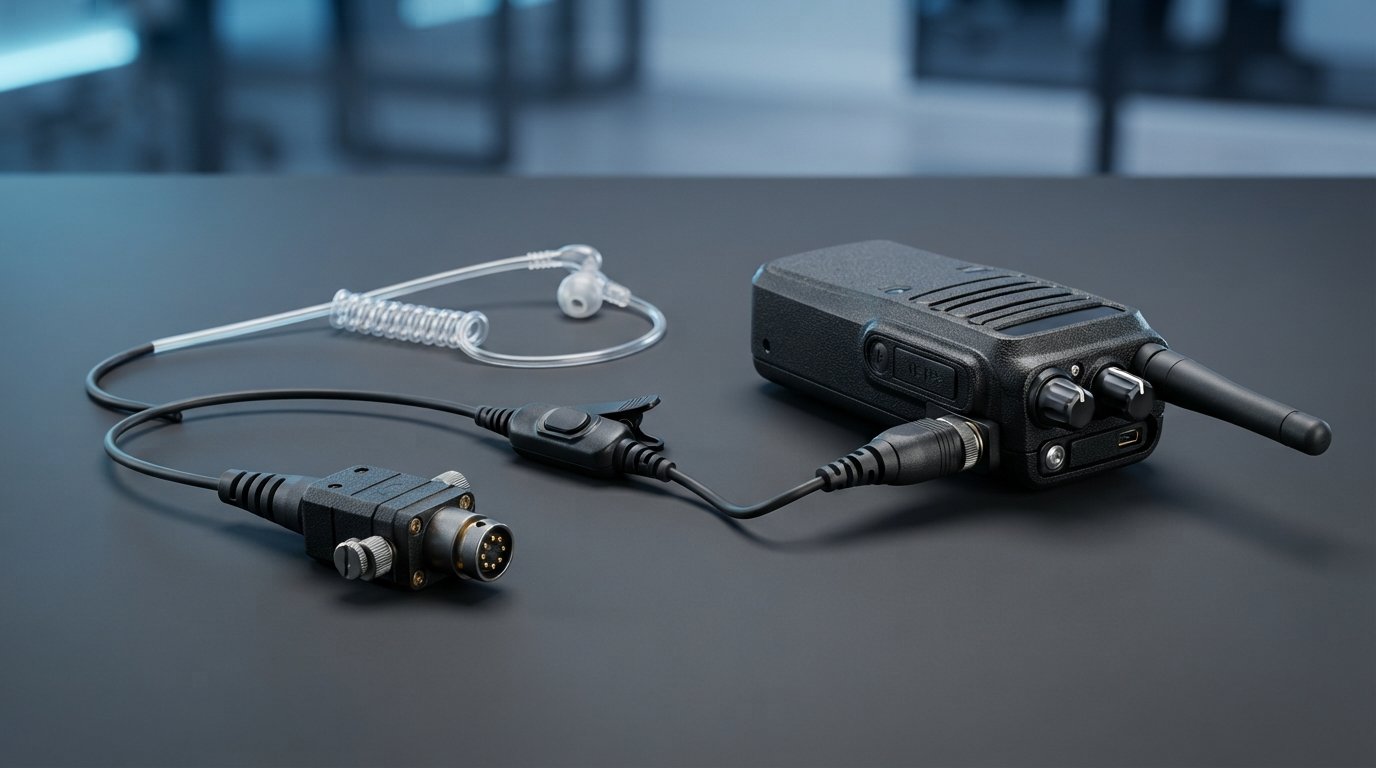
The Motorola multi-pin connector earpiece represents the gold standard for high-tier radio communication. Unlike consumer-grade 2-pin or 3.5mm jacks, this professional interface uses a series of precision-engineered contact points to facilitate complex data and audio exchange. It’s the primary connection type for the MOTOTRBO range, designed to handle the rigours of front-line security and industrial environments. Central to this design is the side-attachment locking screw. This mechanical bolt ensures the accessory remains physically anchored to the radio chassis, preventing the communication blackouts that occur when a standard jack doesn’t stay seated.
Beyond physical security, multi-pin hardware provides superior weather sealing and audio fidelity. The larger surface area allows for robust gaskets that protect internal circuitry from moisture and dust. These connectors also support advanced digital features like Intelligent Audio, which adjusts volume based on background noise, and GPS data passthrough. This complexity is essential for efficient push-to-talk operation, where clear, instantaneous transmission is non-negotiable for team safety.
The Security Advantage of Multi-Pin Hardware
Mechanical durability is where the Motorola multi-pin connector earpiece truly outperforms its smaller counterparts. In crowded event spaces or during physical interventions, standard plugs frequently snag and pull out, leaving the user isolated. The multi-pin’s bolt-on design removes this risk entirely. The use of gold-plated pins ensures consistent conductivity over thousands of connection cycles, providing a massive advantage over standard nickel-plated plugs. This ensures your audio remains crisp even after months of daily use in harsh British weather.
- Prevents “snagging” failures in high-pressure security zones.
- Corrosion-resistant gold plating maintains signal integrity in damp environments.
- Eliminates the “crackle” and audio drops associated with loose 3.5mm connections.
- Provides a dust-tight seal that extends the operational life of the radio’s side port.
Compatibility Guide: Identifying Your Radio’s Multi-Pin Type
Identifying the correct Motorola multi-pin connector earpiece requires more than just looking for a side port. Motorola has updated its interface several times across different generations. Whilst the legacy GP series dominated the UK market for decades, the shift to digital MOTOTRBO units introduced slimmer, more complex pin arrays. It’s a common mistake to assume all multi-pin accessories are interchangeable. For example, a DP3400 earpiece won’t fit a DP4400. The older DP3000 series uses a bulkier connector that won’t seat flush against the DP4000’s refined side-port.
Technical standards for these devices often align with global classifications like FCC Private Land Mobile Radio Services, ensuring hardware meets professional-grade transmission requirements. Always check your radio model number before you buy to ensure a guaranteed fit.
Legacy Multi-Pin: The GP340 and GP380 Series
These units use the “Waris” connector, which is significantly wider than modern digital versions. You’ll still find these robust systems in UK manufacturing, construction, and heavy industry. They remain popular because of their legendary durability, but they require a specific legacy Motorola multi-pin connector earpiece. These connectors are physically too large for modern digital handsets, so check for the characteristic wide mounting plate before ordering.
Modern MOTOTRBO: DP4000 and R7 Series Connectors
The DP4400, DP4600, and DP4800 use a compact, slimline multi-pin connector. The latest Motorola R7 series further refines this design, though it fortunately maintains compatibility with most DP4000 series accessories. If you’re unsure about your specific model, you can browse our specialist range to find a guaranteed match. Always ensure the connector sits flush against the radio body; any gap suggests a model mismatch that will eventually lead to audio failure or port damage.

Choosing Your Configuration: 1-Wire, 2-Wire, or 3-Wire?
Selecting the right Motorola multi-pin connector earpiece depends entirely on your operational environment. In the radio industry, “wire count” refers to the number of individual cables branching from the main connector to your earpiece, microphone, and push-to-talk (PTT) switch. Your specific role dictates whether you prioritise streamlined cable management or tactical accessibility. Whilst all configurations provide clear audio, the physical layout determines how easily you can move and communicate under pressure.
1-Wire Kits: The Standard for Retail and Hospitality
A 1-wire kit uses a single cable that runs from the radio to a combined PTT and microphone unit, with a final lead extending to the ear. They’re the most popular choice for retail and hospitality staff who need reliable communication during long shifts. These kits are lightweight and easy to hide under a uniform collar, making them ideal for low-threat environments where comfort is the primary concern.
2-Wire and 3-Wire Kits: Tactical and Covert Security
For high-stakes security, 2-wire and 3-wire setups are essential. A 2-wire earpiece separates the PTT/microphone from the earpiece lead, allowing for “cuff-mic” operations where the microphone is threaded down a sleeve. The 3-wire configuration goes further by providing three distinct leads, which is the ultimate choice for covert surveillance. These professional-grade kits often align with the reliability found in Project 25 public safety communications standards, ensuring they survive the rigours of mission-critical tasks.
If you’re ready to upgrade your fleet, buy professional Motorola multi-pin connector earpieces to secure your team’s communication. Our Acoustic Tube Earpiece for Motorola Radios ensures your communications remain discreet whilst providing the audio clarity required for professional protection.
Investing in Professional Audio Quality and Reliability
Professional audio clarity starts with the transducer. A high-quality Motorola multi-pin connector earpiece uses precision components to ensure messages cut through heavy background noise in busy UK venues or industrial sites. If your audio sounds muffled, the issue is often condensation or moisture build-up inside the acoustic tube rather than a total hardware failure. Regularly inspect your kit. Stocking Replacement Acoustic Tubes and Ear Tips is a smart, cost-effective strategy for any professional fleet. It extends the life of your investment whilst ensuring your team never misses a critical command.
Choosing a UK specialist for your peripherals provides a significant operational advantage. You gain access to expert technical support and next-day shipping, ensuring your gear is always operational when you need it most. This reliability is essential for security teams who cannot afford downtime due to faulty accessories or slow delivery times. Investing in the right hardware today prevents the costly audio failures that compromise safety tomorrow.
Maintenance Tips for Multi-Pin Connectors
Consistent electrical contact is vital for advanced digital radio features. You should periodically clean the gold-plated pins on your Motorola multi-pin connector earpiece with a dry, lint-free cloth to remove pocket lint, dust, or minor oxidation. Storage also plays a massive role in hardware longevity. Avoid wrapping the cables tightly around the radio body. This habit creates internal wire fractures that lead to intermittent audio drops. Instead, coil the wires loosely and store them in a cool, dry place to prevent the acoustic tubing from discolouring.
Why Earpiece Hub is the Professional Choice
Since 2015, Earpiece Hub has operated as a dedicated UK specialist for professional radio peripherals. We understand the high-stakes nature of security and emergency communication. Our inventory is comprehensive, providing everything from Remote Speaker Microphones to Six-Way Multi-Unit Chargers. We focus on delivering durable, high-performance equipment that survives daily use in the most demanding environments. View our full range of Motorola Multi-Pin Earpieces to find the reliable, specialist hardware your professional team deserves.
Equip Your Fleet for Mission-Critical Success
Mastering the technical details of your Motorola multi-pin connector earpiece is the difference between a seamless operation and a communication breakdown. You now understand how to distinguish between legacy Waris connectors and modern MOTOTRBO slimline interfaces; ensuring a flush, secure fit every time. Whether you’ve selected a 1-wire kit for hospitality or a tactical 3-wire setup for covert surveillance, the focus remains on audio fidelity and physical durability. Investing in professional-grade hardware ensures your team stays connected when it matters most.
As a UK specialist since 2015, Earpiece Hub provides the expert support and national reach your radio fleet requires. We offer next-day delivery across the UK to keep your team operational without delay. Don’t leave your security to chance with generic accessories that fail under pressure. Shop Professional Motorola Multi-Pin Earpieces at Earpiece Hub to secure the high-performance hardware your professional environment demands. Your team’s safety relies on clear, uninterrupted audio, and we’re here to provide exactly that.
Frequently Asked Questions
What is a Motorola multi-pin connector earpiece and how does it work?
This professional interface is designed for high-tier radios, using a series of precision pins to transmit audio and data whilst remaining securely anchored by a side-attachment locking screw. This design prevents accidental disconnections and provides a superior weather-sealed connection compared to standard jacks. It facilitates advanced digital features, ensuring your communication remains clear and reliable in the most demanding environments where silence or clarity is non-negotiable.
Will a GP340 multi-pin earpiece fit a Motorola DP4400 radio?
No, a legacy GP340 earpiece won’t fit a Motorola DP4400 radio. The GP340 uses the wider Waris connector, whilst the DP4400 features a more compact, slimline MOTOTRBO interface. These connectors are physically different in size and pin alignment. You must ensure you purchase the correct Motorola multi-pin connector earpiece for your specific radio series to avoid port damage and ensure guaranteed audio compatibility across your professional fleet.
What is the difference between a 1-wire and a 2-wire Motorola earpiece?
The difference is defined by the number of cables running from the radio. A 1-wire earpiece features a single lead housing both the earpiece and the combined microphone and push-to-talk button. A 2-wire version separates these components into two distinct cables. This allows you to thread the microphone down a sleeve for discreet cuff-mic use, providing a significant tactical advantage for security teams requiring covert communication.
Are Motorola multi-pin earpieces compatible with Hytera or Kenwood radios?
No, Motorola multi-pin connectors are proprietary and won’t fit Hytera or Kenwood radios without assistance. Each manufacturer employs a unique pin configuration and physical housing. Earpiece Hub stocks specific D-shape earpieces for Hytera and G-shape earpieces for Kenwood to solve this. If you need to use your existing kit across different brands, we also provide a specialist earpiece adapter for any radios to ensure seamless cross-brand hardware compatibility.
How do I clean the pins on my Motorola radio earpiece connector?
You should clean the gold-plated pins using a dry, lint-free cloth or a soft-bristled brush to remove dust and pocket lint. Avoid using water or harsh chemicals that might cause corrosion. Regular cleaning ensures consistent electrical contact and prevents the oxidation that leads to audio crackle or transmission failure. This simple maintenance routine keeps your Motorola multi-pin connector earpiece performing at its peak during high-pressure security or surveillance operations.
