





Uncategorized
Construction Site Radio Headsets UK: 2026 Buying Guide
Oct
The toughest-looking headset isn’t automatically the right choice for your site. Your radio model, connector and daily wear time all matter. A mismatch can leave you with equipment that’s uncomfortable or won’t connect as expected. Choosing a construction site radio headset UK teams can use confidently starts with the radio setup, not the product photo.
You need clear communication without overlooking comfort or hearing protection. This guide compares the headset features that matter on site, explains how to check radio and connector compatibility, and helps you weigh different styles against the demands of the job. It also explains why a communications headset shouldn’t automatically be treated as a substitute for hearing protection selected for site risks. Earpiece Hub stocks radio accessories for Motorola, Hytera and Kenwood radios, including overhead headsets, earpieces and adapters.
Key Takeaways
- Match your headset to the radio model and connector to avoid choosing an incompatible accessory.
- Compare overhead headsets, earpieces and remote speaker microphones against your task and preferred wearing style.
- Choose a construction site radio headset UK workers can wear comfortably for the expected shift, while treating hearing protection as a separate requirement.
- Use the final buying checks to narrow down suitable options, including accessories for Motorola, Hytera and Kenwood radios.
Construction site radio headsets UK: what the job demands
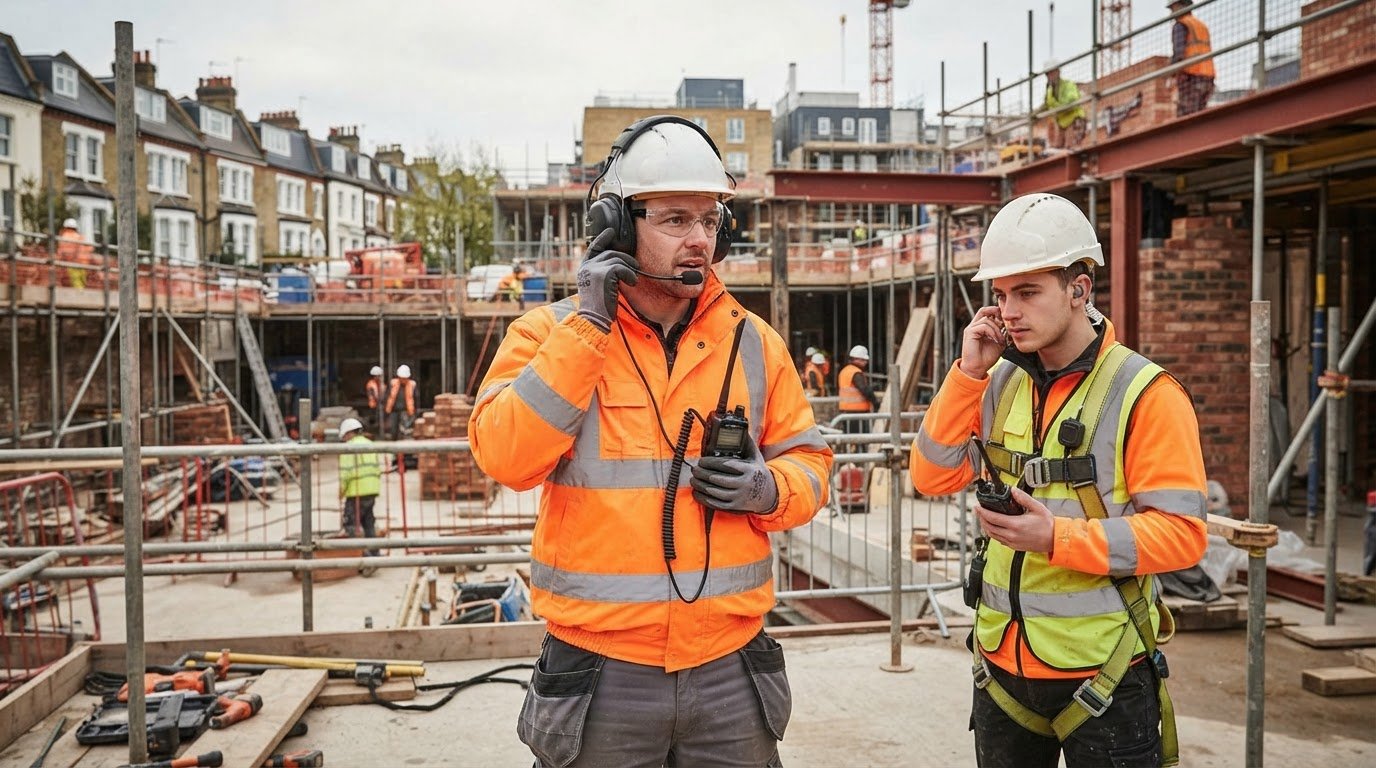
A construction site radio headset connects to a compatible two-way radio so a worker can send and hear radio messages through a microphone and earpiece or headset speakers. On site, this can make it easier to communicate while carrying out tasks or working around machinery. It’s one part of a wider approach to construction site safety, not a substitute for safe working procedures.
Choose for the work as well as the radio. Someone coordinating deliveries may prioritise quick access to radio messages, while a worker in a noisy area may need the site’s hearing risks assessed separately. The term “noise-cancelling” describes an audio feature. By itself, it doesn’t establish that a headset is certified hearing protection.
Communication headset or hearing protection: what does each do?
A communications headset helps you hear and transmit radio messages; hearing protection is selected to reduce exposure to harmful noise. A microphone carries your voice to the radio, while an earpiece or speaker delivers incoming messages. Neither function proves that the accessory provides a particular level of hearing protection.
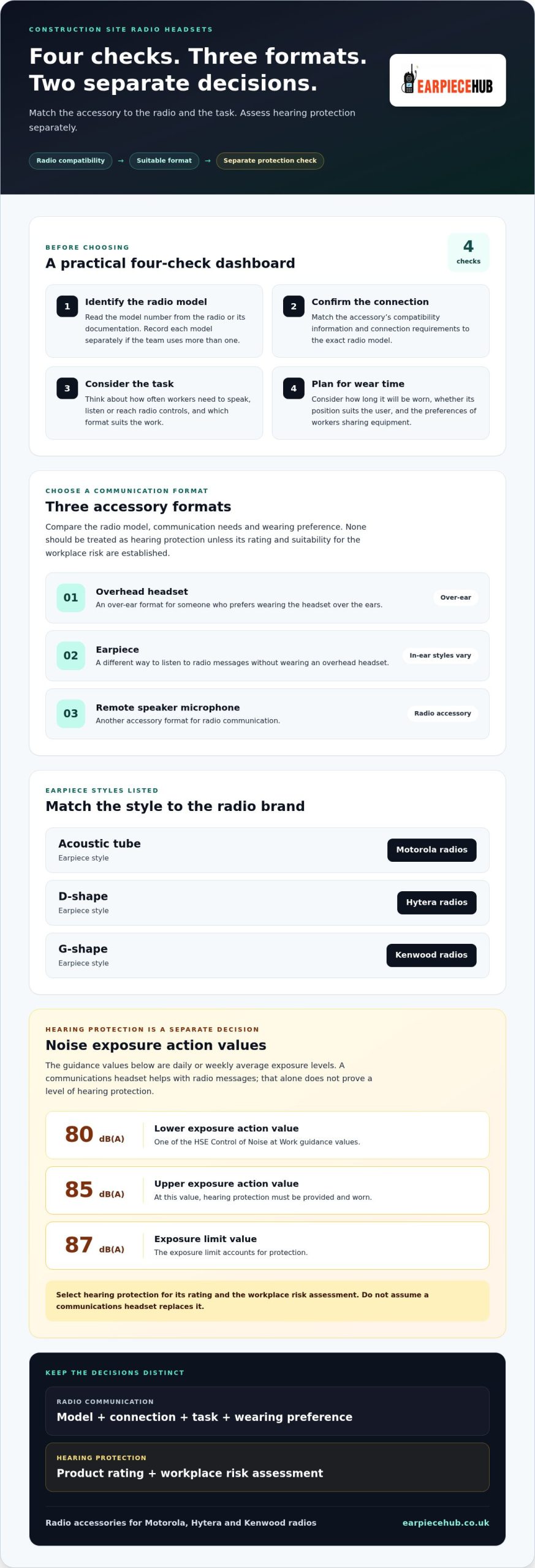
Hearing protection must be suitable for the product’s rating and the workplace risk assessment. The Health and Safety Executive’s Control of Noise at Work guidance sets an 80 dB(A) lower exposure action value and an 85 dB(A) upper action value, measured as daily or weekly average exposure. At the upper value, hearing protection must be provided and worn; the 87 dB(A) exposure limit accounts for protection. Select communication equipment and protective equipment for their respective purposes, and don’t assume one replaces the other.
How to choose a construction radio headset: a practical checklist
Work through these checks before selecting a construction site radio headset UK teams can use on shift. A familiar brand name alone doesn’t establish compatibility: the radio model and accessory connection both matter.
- Identify the radio model. Read the model number from the radio itself or its documentation. If a team uses different models, record each one separately rather than assuming a single accessory will fit them all.
- Confirm the connection type. Compare the accessory’s compatibility information with the radio model and its connection requirements. Compatibility rule: match the accessory to the exact radio model before purchase.
- Consider the task. Think about how often workers need to speak, listen or access radio controls. Decide which format fits those communication needs and the way the work is carried out.
- Plan for expected wear time. Consider how long the accessory will be worn and whether its style and position suit the user across a typical shift. If several workers share equipment, take their wearing preferences into account.
Which headset style suits different site tasks?
An overhead headset may suit someone who prefers an over-ear format. An earpiece offers a different way to listen to radio messages without wearing an overhead headset. Earpiece styles also vary: Earpiece Hub stocks acoustic tube earpieces for Motorola radios, D-shape earpieces for Hytera radios and G-shape earpieces for Kenwood radios. A remote speaker microphone provides another accessory format for radio communication. Compare the options against the radio model, communication needs and wearing preference. None should be treated as hearing protection unless its rating and suitability for the workplace risk are established.
Once you know the radio model, connection and preferred format, browse radio headset and accessory options from Earpiece Hub, including noise-cancelling overhead headsets, earpieces and remote speaker microphones.
Buying a construction radio headset from a UK specialist
Before ordering a construction site radio headset UK teams can use, bring the radio details and job requirements together. The model number and accessory connection help narrow down compatible options; the task, expected wear time and separately assessed hearing-protection needs help identify a practical format. Earpiece Hub is a UK specialist retailer of two-way radio accessories, with noise-cancelling overhead headsets, earpieces, adapters and remote speaker microphones.
What to check before ordering a radio headset
- Radio model: Note the exact model used on site, especially if the team has more than one type of radio.
- Accessory connection: Match the accessory’s compatibility information to that model before choosing.
- Format and task: Consider whether an overhead headset, earpiece or remote speaker microphone suits the communication needs and wearing preference.
- Wear time and protection: Think about how long the accessory will be worn, and assess hearing protection separately against the workplace risk.
Final check: confirm compatibility, consider comfort for the task and wear time, and assess hearing protection separately. These are distinct decisions, even when you’re choosing equipment for the same shift.
Earpiece Hub brings together radio communication accessories for Motorola, Hytera and Kenwood radios, including acoustic tube, D-shape and G-shape earpieces, as well as adapters and overhead headsets. Use the details above to focus your search, then shop radio headsets and accessories at Earpiece Hub.
Make your next headset choice with confidence
Turn the site’s communication needs into a clear shortlist. Keep the radio model and connection details to hand, then consider which format suits the tasks and expected wear time. Treat hearing protection as its own decision, based on the workplace assessment and the protection required. This gives you a practical basis for choosing a construction site radio headset UK teams can use as part of their radio setup, without assuming one accessory suits every worker or task.
Earpiece Hub stocks noise-cancelling overhead headsets, earpieces and remote speaker microphones, alongside radio accessories for Motorola, Hytera and Kenwood. Compare the available formats with your radio details and team requirements.
Shop radio headsets and accessories at Earpiece Hub. Use your radio model and connection details to find a suitable accessory for your setup.
Frequently Asked Questions
Can I use any radio headset on a construction site?
No. A construction site radio headset UK teams choose must match the specific two-way radio and its connection. Check the model label on the radio rather than relying on its appearance or brand alone. If equipment is shared between workers or used with different radios, note each model before ordering. Assess hearing protection separately against the site’s risks and current HSE guidance.
Are noise-cancelling radio headsets the same as hearing protection?
No, noise-cancelling and hearing protection aren’t interchangeable terms. Noise-cancelling may describe an audio feature intended to help with communication, but it doesn’t confirm a protective rating. For example, a headset that makes radio speech easier to hear in a noisy work area isn’t automatically suitable for reducing noise exposure. Check its stated protection information and follow the workplace risk assessment and current HSE guidance.
How do I know which radio headset connector I need?
Use the exact radio model to identify the accessory connection, then compare it with the headset’s product information. A brand name on its own may not be enough: models within one brand can use different connections. If a team has radios from different ranges, record each model separately and match accessories accordingly before placing an order.
Can I wear a radio headset with a hard hat?
Possibly, but compatibility depends on the headset design, the helmet and the other PPE worn at the same time. Don’t assume an overhead style will fit beneath or around every hard hat. Assess the complete combination workers will use, and follow the relevant equipment information and workplace requirements. If the fit interferes with the helmet or other protective equipment, don’t treat it as suitable.
