





Uncategorized
Justifying New Communications Equipment to Management
Oct
Is the cheapest communication equipment really the lowest-cost choice? If radios, earpieces or batteries don’t meet operational needs, the consequences can include delays, avoidable replacement and increased risk. That’s why justifying cost of new communication gear to management means showing more than a purchase price.
Decision-makers are more likely to assess a replacement request when it connects equipment to a clear business need. Build the case around where current kit falls short, which options meet the team’s requirements and how their whole-life costs compare. This guide explains how to gather evidence, assess user fit and lifecycle needs, and set review measures without overstating the benefits. It also covers practical steps for evaluating suitable equipment and planning a rollout.
Key Takeaways
- Build your case around a specific communication problem, the roles affected and evidence from incidents or recurring workarounds.
- When justifying cost of new communication gear to management, compare suitable options against operational needs and lifecycle costs, using actual internal figures.
- Set clear review measures so you can assess whether the proposed equipment addresses the documented need.
- Plan a proportionate evaluation with representative users, agreed criteria and provision for familiarisation and accessory replacement.
Why the Cost of New Communication Gear Belongs in an Operational Business Case
A radio user misses a message in a noisy work area. A colleague repeats it, coordination pauses and the task takes longer. If similar situations occur in your team, show management the operational effect, not just a request to replace equipment. Justifying cost of new communication gear to management starts with defining the problem the equipment is intended to address.
A business case sets out the need, options and expected value of a proposed decision. The What is a Business Case? overview provides a useful foundation, but a radio equipment proposal should also connect its evidence to frontline tasks. A newer model alone is not a reason to spend. Show whether current equipment suits the way staff communicate and what happens when it falls short.
Which communication problems should the proposal document?
Build a clear record before recommending a solution. Gather relevant user feedback and internal records, such as fault reports, maintenance notes or incident logs. Note recurring workarounds too: users may repeat messages, reposition themselves to hear or rely on a colleague to pass information on. These details are evidence to investigate, not proof of a cause on their own.
- Describe the issue: Record what happened, when it happened and which roles or tasks were affected.
- State the practical effect: Explain whether coordination was interrupted, a message was difficult to hear or a task had to be repeated.
- Separate fact from assumption: Label recorded faults and reported experiences clearly. Identify unverified concerns as questions to address during evaluation.
This gives decision-makers a basis for assessing operational suitability. It also makes the next step more precise: compare equipment against the documented requirement rather than treating replacement as an upgrade for its own sake.
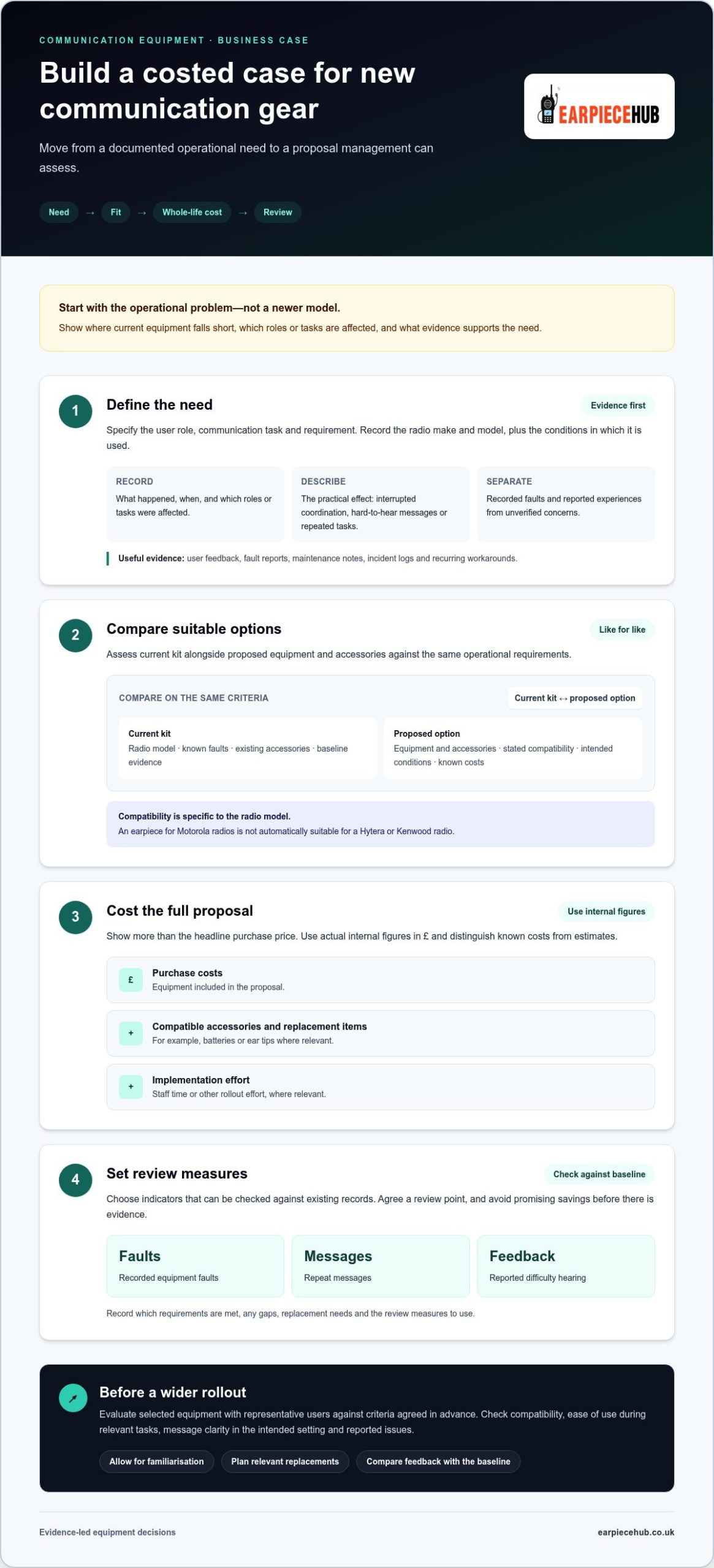
How to Build a Costed Case for New Communication Gear
A like-for-like comparison makes a request easier to assess. Move from a documented need to a decision-ready proposal by using the same operational requirements to compare each option. When justifying cost of new communication gear to management, show how each option meets those requirements, not just its headline purchase cost.
- Define the need. Specify the user role, communication task and requirement identified in your records. Note the radio make and model, plus the conditions in which the equipment will be used.
- Compare suitable options. Assess current kit alongside proposed equipment and accessories against the same requirements. Check stated compatibility: an earpiece for Motorola radios is not automatically suitable for a Hytera or Kenwood radio.
- Cost the full proposal. Use actual internal figures in £. Include purchase costs, compatible accessories, replacement items such as batteries or ear tips, and staff time or other implementation effort where relevant. Separate known costs from estimates.
- Set review measures. Choose indicators that can be checked against a baseline, such as recorded faults, repeat messages or reported difficulty hearing. Set a review point and avoid promising savings before there is evidence.
Which evidence makes the equipment proposal easier to assess?
Use a simple option comparison and apply the same criteria to every entry. This helps management see the trade-offs without comparing unlike options.
Current kit: Record the radio model, known faults, existing accessories and baseline evidence.
Proposed option: List the equipment and accessories, stated radio compatibility, intended operating conditions and known costs.
Assessment: Note which requirements are met, any gaps, replacement needs and the review measures you will use.
This format separates verified facts from assumptions and brings lifecycle needs into view before approval. For a team proposal, radio earpieces and accessories can form part of the comparison. Match each item to the radio model and the requirements recorded in your case.
How to Present a Practical Communication Gear Rollout
Approval is the start, not the finish. A proportionate evaluation lets representative radio users assess selected equipment against agreed criteria before a wider purchase. Choose users whose roles reflect the documented need, then record their feedback against the same questions. This gives management practical evidence for the next decision and can highlight familiarisation or accessory replacement needs early.
Agree the evaluation criteria in advance. They could cover compatibility with the team’s radios, ease of use during relevant tasks, whether messages are heard clearly in the intended setting, and any issues users report. Compare the results with the baseline records used in the proposal. Don’t claim savings or improved performance unless the evaluation provides evidence for those conclusions.
How can teams evaluate suitable earpieces and accessories?
Start with the radio model and use case, then select an accessory with matching stated compatibility. An acoustic tube earpiece for Motorola radios, a D-shape earpiece for Hytera radios or a G-shape earpiece for Kenwood radios may suit different requirements. A noise-cancelling headset or replacement battery addresses a different equipment need. Don’t assume an accessory designed for one radio brand fits another.
- Familiarisation: Give users time to learn how to use the selected equipment and report practical issues.
- Replacement planning: Include relevant items such as acoustic tubes, ear tips or batteries in the rollout plan where needed.
- Review: Gather feedback against the agreed criteria before deciding whether to extend the purchase.
For team or business orders, use the REQUEST TRADE PRICING option to support bulk purchasing discussions. A staged rollout, supported by user feedback and a clear review, helps turn the business case into a controlled operational decision. That’s a practical final step in justifying cost of new communication gear to management.
Make the Next Equipment Decision Count
Use the approval process to establish a clearer approach to future equipment decisions. Record what management agreed, who will oversee the purchase and when the team will review how the selected equipment fits its work. This creates a practical reference for future planning rather than treating each request as an isolated expense. It also keeps future proposals focused on operational needs.
Explore Earpiece Hub’s range of radio earpieces, headsets, microphones and maintenance accessories. Match options to the radio model and team requirement, then include compatible items in your purchasing plan. For team or business bulk purchasing, use REQUEST TRADE PRICING.
Explore radio communication accessories and take the next step in planning your equipment purchase.
