





Uncategorized
Professional Guide to Single-Pin Radio Earpieces for 2026

Aug
Why does a single millimetre of difference often dictate whether your security team stays connected or falls into total silence? It’s a common frustration for professionals who discover, too late, that their new single-pin radio earpiece uses a 2.5mm jack when their hardware requires a 3.5mm connection. You already know that in high-stakes environments, thin wires that snap or muffled audio aren’t just inconveniences; they’re operational risks. You need equipment that’s as resilient as your team and discreet enough for covert operations.
We’ll help you master the technical specifications of these connectors so you can choose the perfect, reliable earpiece for your professional radio fleet. This guide provides a clear blueprint for selecting hardware that’s guaranteed to work with Motorola or Cobra radios. We’ll explore the most durable 1-wire and 2-wire configurations for 2026, ensuring your communication remains crystal clear even in the most demanding, noisy environments. From acoustic tubes to G-shape designs, we’ll ensure your fleet is equipped for maximum reliability and professional performance.
Key Takeaways
- Identify the technical specifications of 2.5mm and 3.5mm connectors to prevent buying incompatible equipment for your radio fleet.
- Discover how to select a high-performance single-pin radio earpiece that guarantees crystal clear audio for Motorola TLKR and Cobra models.
- Compare the benefits of acoustic tube, G-shape, and D-shape designs to find the best fit for covert security or high-street hospitality roles.
- Understand why professional-grade materials are vital for preventing wire snaps and ensuring equipment reliability during demanding physical activity.
What is a Single-Pin Radio Earpiece?
A single-pin radio earpiece uses one jack plug to handle both audio output and microphone input simultaneously. This streamlined design is the standard for most licence-free (PMR446) radios, including the popular Motorola TLKR series and various Cobra models. By integrating these functions into one connection point, the hardware remains compact and user-friendly for staff who aren’t radio specialists. The single-pin earpiece is the primary interface for consumer-grade professional radios.
The evolution of headset technology has made these peripherals essential for modern workflows. They’re specifically designed for environments where simplicity and compactness are paramount, such as high-street retail, busy hospitality venues, and light security details. Because the connection is straightforward, there’s less risk of pins bending or misaligning during a busy shift. It’s a “plug and play” solution that allows teams to focus on their tasks rather than technical troubleshooting.
Why Professionals Choose Single-Pin Connections
Discreet communication is often a requirement for front-of-house staff or event coordinators. A single-pin radio earpiece offers significantly reduced bulk compared to heavy-duty multi-pin connectors, making it the preferred choice for covert operations where a low profile is necessary. Whether you’re using a 1-wire or 2-wire configuration, the lack of bulky housing ensures the wire can be easily concealed under a uniform or suit jacket.
<h2 id=
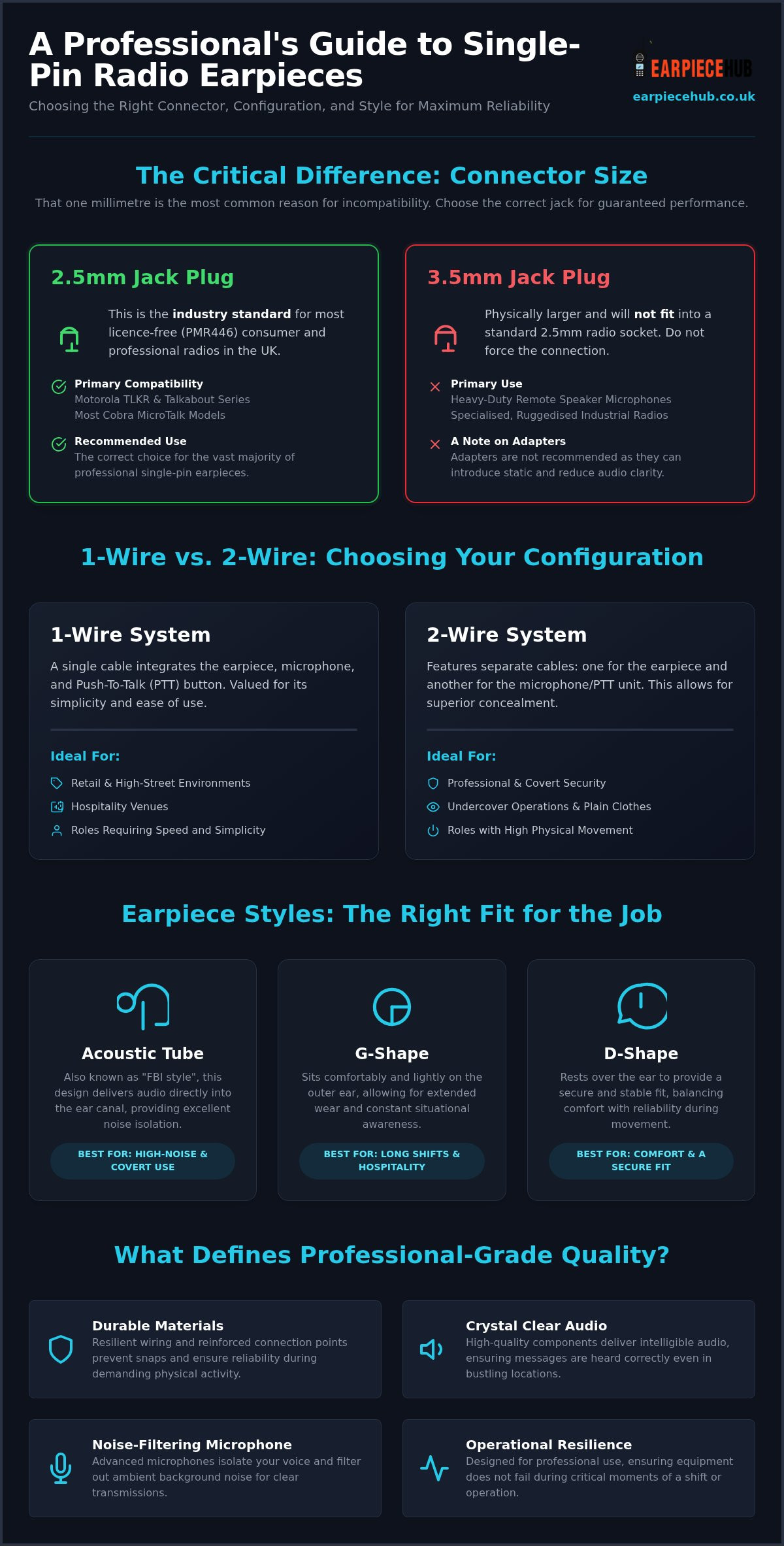
The most critical factor when choosing a single-pin radio earpiece is the diameter of the jack plug. In the UK, the 2.5mm jack is the established industry standard for the Motorola TLKR series and the majority of Cobra walkie-talkies. Conversely, the larger 3.5mm jack is typically reserved for heavy-duty remote speaker microphones or specialised ruggedised radios. It’s a common mistake to assume these are interchangeable. A 3.5mm plug simply won’t fit into a 2.5mm socket. Whilst adapters exist, we generally advise against them as they often introduce static and reduce overall audio clarity.
Compatibility is a science, not a guessing game. Motorola TLKR and Talkabout models almost exclusively utilise the 2.5mm connection for their licence-free range. Cobra MicroTalk units follow the same standard. However, some industrial-grade handhelds use the 3.5mm port to ensure a more secure mechanical lock. If you’re managing a mixed fleet, using an earpiece adapter for any radios can provide flexibility, but matching the native pin size is always the superior choice for long-term reliability and sound precision. Getting this right ensures your single-pin radio earpiece delivers the performance your team expects.
1-Wire vs 2-Wire Single-Pin Configurations
Beyond the pin size, you must consider the wiring layout to suit your operational needs. A 1-wire configuration features the microphone and Push To Talk (PTT) button on a single lead. This is the most popular choice for retail environments where simplicity and speed are favoured. A 2-wire setup uses separate leads for the earphone and the mic/PTT unit. This allows for more discreet cable management, as you can run the microphone down a sleeve whilst keeping the earpiece cord hidden behind the neck. Choose a 1-wire model for light activity or a 2-wire version if your role involves high physical movement or requires a covert appearance in a professional security setting.
Selecting the Right Style for Your Environment
Choosing a single-pin radio earpiece requires matching the hardware to the specific demands of your workspace. Acoustic tube earpieces, often called “FBI style” units, are the gold standard for covert security and high-noise environments. The clear tube delivers audio directly into the ear canal, providing passive noise isolation that’s essential for UK nightclubs or large-scale outdoor events. In contrast, G-shape and D-shape earpieces are preferred for hospitality roles. These styles sit on the outer ear, making them more comfortable for twelve-hour shifts where constant situational awareness is just as important as radio traffic.
Noise-cancelling performance in a single-pin radio earpiece is vital when working amongst loud crowds. High-quality microphones are designed to filter out ambient background chatter, ensuring your voice remains intelligible even in a bustling retail centre. If you manage a large team, you should also consider the maintenance requirements of each style. You can easily buy replacement acoustic tubes and ear tips to keep your equipment in peak condition and maintain high hygiene standards across your fleet.
Comfort and Hygiene for Long-Term Use
Hygiene is a major factor for multi-user radio fleets. Whilst G-shape earpieces are easier to clean between shifts, acoustic tubes provide a significantly more secure fit for active roles like door supervision or event response. To maximise the lifespan of your gear, focus on proper cable routing. Running the wire under a shirt or blazer prevents it from snagging on equipment or clothing, which is the leading cause of internal wire damage. Organising your kit this way also maintains a professional, covert appearance that suits high-end security environments. Always ensure your team has access to fresh ear tips to prevent ear infections and ensure long-term comfort.
Why Source Your Single-Pin Earpieces from Earpiece Hub?
Earpiece Hub has operated as a UK-based specialist retailer since 2015. We focus exclusively on professional-grade communication peripherals. Unlike generalist AV providers, we understand the specific mechanical requirements of a single-pin radio earpiece. Every product in our inventory is designed to withstand the rigours of professional security, retail, and hospitality work. We don’t just sell equipment; we provide the technical foundation for your team’s safety and operational efficiency.
Reliability is our core character trait. We know that equipment downtime isn’t an option for a professional fleet. Our Next Day Shipping ensures you receive your gear exactly when you need it, avoiding costly delays. If you’re unsure about compatibility, our 24/7 professional support team is available to confirm the correct pin size for your specific radio model. This specialist approach ensures your single-pin radio earpiece delivers immediate out-of-the-box performance.
The Hub Advantage for Professional Fleets
Our position as a central resource for the UK community allows us to offer maximum fleet flexibility. We provide access to a wide range of universal earpieces and adapters that facilitate cross-brand compatibility. This is particularly useful for organisations managing diverse hardware. To extend the service life of your investment, we also stock essential replacement parts, including acoustic tubes and ear tips. Shop our full range of single-pin earpieces now to secure your communication infrastructure with a partner that values your time and professional standards.
Equip Your Team for Reliable Communication
Selecting the correct single-pin radio earpiece shouldn’t be a matter of guesswork. You’ve learnt that identifying the exact pin size, whether it’s the 2.5mm standard for Motorola TLKR or a specialised 3.5mm connector, is the first step toward operational reliability. Matching your equipment to your environment, such as opting for covert acoustic tubes in high-noise zones or comfortable G-shape designs for hospitality, ensures your team remains effective throughout every shift. Don’t let thin wires or poor audio clarity compromise your security standards.
At Earpiece Hub, we provide the specialist expertise you need to support your Motorola, Hytera, and Kenwood fleets. With our focus on noise-cancelling tech and covert designs, you’re guaranteed professional-grade performance. Take advantage of our Next Day Shipping across the UK to eliminate downtime and keep your communication infrastructure resilient. View our specialist range of single-pin radio earpieces and equip your professionals with the best tools available. We’re here to ensure you stay connected with total confidence.
Frequently Asked Questions
Is a 2.5mm earpiece the same as a 3.5mm earpiece?
No, these connectors are not interchangeable due to their physical diameter. A 2.5mm jack is significantly smaller than a 3.5mm version and is the standard for most licence-free radios. Attempting to force a 3.5mm plug into a 2.5mm socket will damage your equipment. Always check your radio’s technical specifications before purchasing a single-pin radio earpiece to ensure a perfect mechanical fit and reliable audio transmission.
Will a single-pin earpiece work with my Motorola TLKR radio?
Yes, provided you select the 2.5mm connector size. The Motorola TLKR series, including popular models like the T62 and T82 Extreme, almost exclusively uses a 2.5mm port. It’s the industry standard for these licence-free devices. Using a high-quality single-pin radio earpiece ensures your team stays connected during busy shifts. Check your specific model’s manual or contact our support team if you’re unsure about the exact port requirements for your fleet.
What is the difference between a 1-wire and 2-wire earpiece?
The main difference lies in how the cables are organised for your role. A 1-wire configuration places the microphone and Push To Talk button on the same lead as the earphone. This is ideal for straightforward retail work. A 2-wire setup uses separate leads for the earphone and the mic unit. This allows you to run the microphone down a sleeve for more discreet, covert communication in professional security environments.
Can I use a standard mobile phone earphone with my two-way radio?
You shouldn’t use standard mobile phone earphones with professional two-way radios. Whilst the 3.5mm jack might physically fit some rugged models, the internal wiring and impedance levels are often incompatible. Most importantly, consumer earphones lack the essential Push To Talk button required for radio transmissions. Using incorrect peripherals can lead to muffled audio or even permanent damage to the radio’s internal circuitry. Stick to specialist equipment for guaranteed performance.
How do I clean my acoustic tube earpiece to maintain audio clarity?
To maintain crystal clear audio, you should regularly detach the clear acoustic tube from the transducer. Use a can of compressed air to blow out any moisture or debris trapped inside the coil. If wax has built up, soak the plastic tube in warm, soapy water and allow it to dry completely before reattaching. Keeping the tube clear prevents muffled sound and ensures the longevity of your professional communication peripherals.
