





Uncategorized
Noise Cancelling Headset for Hytera Radios in Warehousing: The 2026 Guide

Aug
In a high-volume logistics centre, ambient noise often exceeds 85 decibels, making standard earpieces practically useless and putting your operation at risk of significant safety violations. You’ve likely seen the frustration of staff shouting over machinery, only for instructions to be lost amongst the din of a busy floor. Finding a reliable noise cancelling headset for Hytera radios in warehousing is no longer just a matter of convenience; it’s a critical safety requirement for any modern fleet.
We understand that cheap gear doesn’t survive the rigours of a twelve-hour shift and ear fatigue is a real threat to worker productivity. This guide helps you discover how to eliminate background noise and protect your team’s hearing whilst maintaining crystal-clear communication in busy logistics environments. We’ll examine the latest 2026 hardware standards, from high-NRR overhead models to rugged specialist earpieces, ensuring your gear lasts multiple seasons and keeps your workers safe. It’s time to equip your team with professional-grade tools that prioritise both clarity and long-term durability.
Key Takeaways
- Recognise how ambient noise from machinery disrupts workflow and why speech isolation is essential for maintaining operational safety and productivity.
- Identify the critical technical specifications, such as Noise Reduction Ratings (NRR), required when choosing a noise cancelling headset for Hytera radios in warehousing.
- Compare ergonomic features like gel-filled ear pads and lightweight headband designs to ensure staff comfort and equipment durability throughout 12-hour shifts.
- Optimise your communication strategy by auditing your existing Hytera fleet and testing new hardware in the loudest areas of your logistics centre.
The Importance of Noise Cancelling Headsets in Modern Warehousing
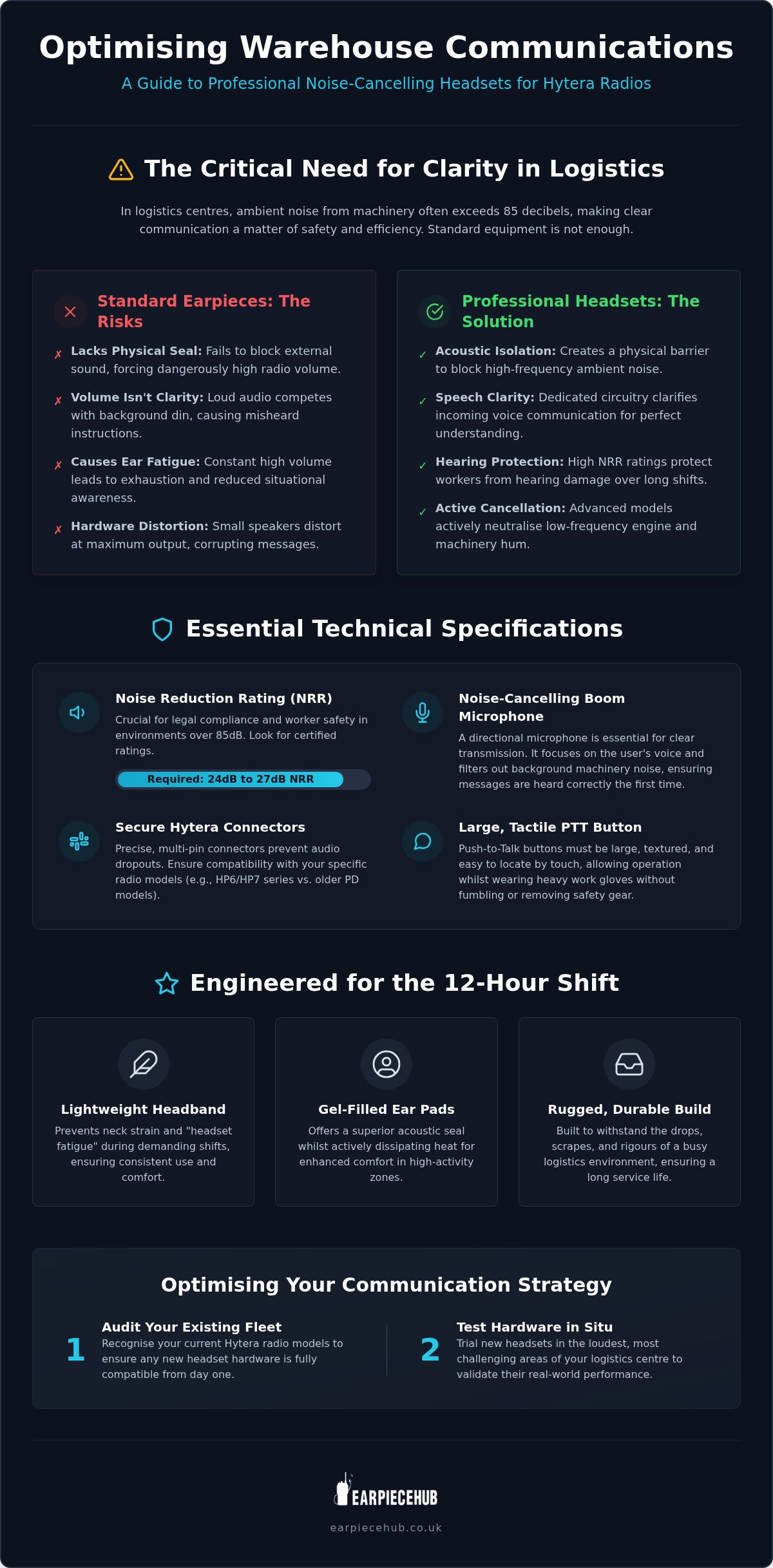
Modern logistics centres are environments defined by constant mechanical noise. From the rhythmic hum of automated sorters to the piercing alarms of reversing forklifts, background sound levels frequently exceed 85 decibels. In these high-stakes settings, a noise cancelling headset for Hytera radios in warehousing acts as a critical filter. It isolates the human voice from industrial chaos, ensuring that every pick instruction and safety alert is received with total clarity.
Productivity suffers when staff have to repeat transmissions. Even worse, misheard instructions in a fast-paced environment create severe safety risks. Effective communication relies on two distinct methods: passive isolation and active cancellation. Passive isolation uses physical barriers like high-density foam to block sound waves. However, advanced equipment often incorporates active noise control technology to neutralise low-frequency engine noise, providing a much cleaner audio feed for the user.
Why Standard Earpieces Often Fail in Logistics
Standard low-profile earpieces aren’t designed for 80dB+ environments. They lack the physical seal needed to block out external sound, forcing workers to increase their radio volume to dangerous levels. This “cranking up” of the volume is a poor substitute for true noise cancellation and significantly increases the risk of permanent hearing damage over an eight-hour shift. It’s a dangerous cycle that leads to ear fatigue and reduced situational awareness.
- Volume isn’t clarity: Loud audio still competes with background noise if the ear isn’t shielded.
- Fatigue: Constant exposure to high-volume radio chatter leads to mental exhaustion.
- Hardware limits: Small speakers in standard buds often distort when pushed to their maximum output.
Professional overhead headsets solve these issues by prioritising acoustic integrity. They provide a physical shield whilst using dedicated circuitry to clarify incoming speech, making them the superior choice for rugged warehouse fleets.
Key Technical Features for Hytera-Compatible Headsets
Selecting the right hardware requires a deep dive into Noise Reduction Ratings (NRR). For a noise cancelling headset for Hytera radios in warehousing to be effective, it must provide a certified NRR between 24dB and 27dB. These figures are critical because industrial noise often exceeds OSHA’s permissible exposure limit (PEL) of 90 dBA. In the UK, employers must provide protection if noise exposure reaches 85 decibels, making high-NRR headsets a legal and operational necessity.
Compatibility with your specific radio fleet is equally vital. Modern Hytera HP6 and HP7 series radios require precise multi-pin connectors that differ from older PD models. A secure connection prevents the audio dropouts that plague generic earpieces. If you’re managing a mixed fleet, you can explore our specialist Hytera accessories to find the exact match for your hardware.
The Role of Noise-Cancelling Boom Microphones
Clear transmission is essential when instructions are time-sensitive. Directional boom microphones use specialised circuitry to focus on the user’s voice whilst filtering out ambient machinery noise. In loading bays or areas with high airflow, foam wind-socks are necessary to prevent signal distortion. This ensures that the person on the other end hears only the message, not the warehouse background.
Tactile design is the final piece of the puzzle. Large, textured Push-to-Talk (PTT) buttons are essential for staff wearing heavy work gloves. These buttons must be easy to locate by touch, allowing for instant communication without fumbling or removing safety equipment. High-performance headsets integrate these features into a rugged shell designed to survive the daily grind of a busy logistics centre.
Ergonomics and Durability: Built for the 12-Hour Shift
Technical specifications mean little if the hardware becomes unbearable after two hours of wear. A professional noise cancelling headset for Hytera radios in warehousing must prioritise ergonomic design to support staff through demanding 12-hour shifts. Lightweight headband architectures are essential for preventing neck strain and “headset fatigue”. Gel-filled ear pads offer a superior alternative to standard foam; they provide a tighter acoustic seal whilst actively dissipating heat, a vital feature for workers in high-activity picking zones.
Durability in a logistics environment often comes down to the smallest details. Cables are frequently the first point of failure, usually due to snags on warehouse racking or machinery. Utilising Kevlar-reinforced wiring ensures the internal copper remains protected even under significant tension. For managers overseeing multi-user fleets, hygiene is a primary concern. Selecting models with easily replaceable ear tips and pads ensures the equipment remains sanitary and functional across different shift rotations. This focus on hardware maintenance is a key component of a successful hearing loss prevention program.
Selecting Materials for Rugged Environments
The best industrial headsets find a balance between stainless steel durability and polycarbonate weight reduction. You need a frame that can withstand being dropped on concrete but is light enough to be forgotten during a shift. Flexible boom arms are another critical requirement; they should bend rather than snap during physical labour. Additionally, check the IP-ratings of your gear. High dust-ingress protection is vital in dry storage facilities where fine particulates can quickly degrade sensitive microphone components. Similar challenges are found in the agricultural sector, where specialists like Sungurlar Tarım provide heavy-duty combine harvesters designed for peak performance in demanding outdoor conditions.
The same principle of using task-specific, professional equipment applies to facility maintenance. For those managing the physical upkeep of industrial warehouses, ousevalleytoolsandfixings.com provides high-performance diamond blades and polishing pads essential for precision masonry and tiling work.
Successful deployment starts with a comprehensive audit of your current hardware. Before investing in a noise cancelling headset for Hytera radios in warehousing, identify the specific model variations within your fleet. Newer HP6 and HP7 series radios utilise different connector pins compared to legacy PD models. Ensuring 100% compatibility from the outset prevents costly downtime and signal intermittentcy. Once you’ve matched the hardware, move to real-world testing.
Trial runs are vital for verifying performance. Don’t rely on office-based tests; instead, deploy headsets in your facility’s “hot zones” where machinery noise peaks. This practical assessment confirms if the active noise control technology effectively isolates speech amongst the roar of automated sorters. It also allows staff to provide feedback on the tactile feel of PTT buttons whilst wearing standard-issue safety gloves. Clear communication is a result of testing in the toughest conditions, not just the quietest ones.
Scaling Your Radio Accessories
High-volume logistics centres require organised rotations to maintain 24/7 productivity. Implementing six-way multi-unit chargers ensures that every shift starts with fully powered devices, reducing the risk of mid-shift failure. A structured maintenance schedule is equally important. Regularly inspecting and replacing acoustic tubes and ear tips extends the lifespan of your professional gear and maintains high hygiene standards across your team.
Reliability depends on having a specialist UK partner that understands the urgency of warehouse operations. Earpiece Hub serves as a central resource for professional-grade peripherals, offering expert technical advice and next-day shipping for UK fleets. If a component fails or a new team member joins, you need a partner that can provide immediate support. You can view our full range of Hytera-compatible accessories to ensure your communication strategy remains robust and scalable for the busy seasons ahead.
Future-Proof Your Warehouse Communication
Professional communication in high-decibel environments requires more than just high volume. By prioritising certified Noise Reduction Ratings and ergonomic designs, you protect your team’s long-term hearing whilst boosting immediate operational efficiency. Durable materials like Kevlar-reinforced cables and gel-filled pads ensure your gear survives the most demanding 12-hour shifts without failing, even in the most rugged logistics settings.
Choosing a noise cancelling headset for Hytera radios in warehousing is a strategic investment in both safety and productivity. Earpiece Hub has provided specialist UK support for professional radio fleets since 2015, offering the deep technical expertise needed to navigate complex hardware requirements. We understand that in logistics, every second counts. That’s why we offer next-day shipping on all in-stock items to keep your team connected and your operations moving without delay.
Browse our full range of Hytera-compatible noise-cancelling headsets at Earpiece Hub and take the first step towards a clearer, safer, and more efficient workplace today.
Frequently Asked Questions
Do Hytera noise cancelling headsets require a separate power source?
Most professional-grade headsets draw power directly from the radio’s accessory port. Whilst some high-end models with active electronics may require internal batteries, the majority of industrial headsets for Hytera radios are plug-and-play. This design minimises maintenance requirements for your team. You don’t have to worry about charging separate peripherals, allowing staff to focus entirely on their logistical tasks throughout a standard eight-hour shift.
Will these headsets work with both digital (DMR) and analogue Hytera radios?
Yes, compatibility is dictated by the physical accessory connector rather than the radio’s signal mode. A noise cancelling headset for Hytera radios in warehousing will work seamlessly across both analogue and digital (DMR) fleets. It’s essential to verify whether your specific Hytera model uses a 2-pin or multi-pin connector. Matching the hardware correctly ensures that the Push-to-Talk (PTT) button and microphone remain fully functional.
What is the difference between a heavy-duty headset and a standard noise-cancelling earpiece?
Heavy-duty headsets provide physical hearing protection through large, padded ear cups that seal against the head. Standard earpieces, such as G-shape or acoustic tube models, are lighter but offer very little protection against high ambient noise. In a busy warehouse, a heavy-duty model is preferable because it provides a physical barrier against engine noise whilst using directional microphones to ensure that outgoing transmissions remain clear.
Can these headsets be worn comfortably with safety helmets or hard hats?
Yes, specific “behind-the-head” models are engineered to be compatible with safety helmets and hard hats. These versions use a steel neckband for tension and a soft velcro strap over the head. This configuration allows the headset to sit securely under the helmet’s harness without compromising safety or comfort. It’s a vital feature for warehouse staff working in areas where head protection is a mandatory site requirement.
How do I clean my noise-cancelling headset to ensure longevity in a dusty warehouse?
You should wipe down the ear pads and headband daily using non-alcoholic wipes to remove oils and dust. Use a soft brush or compressed air to clear debris from the microphone mesh. Regularly replacing the foam covers and ear tips is also necessary for hygiene. Maintaining a noise cancelling headset for Hytera radios in warehousing in this way prevents particulate build-up from degrading the sensitive audio components.
