





Uncategorized
Covert Earpieces for Private Security: 2026 UK Guide

Aug
Imagine you’re managing a VIP arrival at a high-profile event when your earpiece emits a piercing screech of static, or worse, a visible wire gives away your position to a hostile observer. It’s a nightmare scenario every professional in the UK’s £9 billion security sector works to avoid. You need gear that’s as reliable as your team, yet discreet enough to remain unnoticed during high-stakes operations. Finding a high-performance D-shape earpiece for Motorola radios isn’t just about connector compatibility; it’s about ensuring operational integrity when every second counts.
You’ve likely dealt with the frustration of audio failure or the physical discomfort of poorly designed kits during a 12-hour shift. This 2026 guide will help you master the technicalities of covert communication, from understanding 1-wire and 2-wire setups to selecting the right hardware for the Motorola DP1400 and beyond. We’ll explore how to balance crystal-clear audio with a professional appearance to keep your fleet connected and secure.
Key Takeaways
- Understand why discrete communication is a vital safety requirement for avoiding public interference during surveillance or crowd control.
- Differentiate between 1-wire and 2-wire architectures to find the most efficient wiring setup for your specific security role.
- Identify the correct D-shape earpiece for Motorola radios by verifying connector types to ensure seamless integration with your existing fleet.
- Master essential maintenance and sanitisation protocols to eliminate the primary causes of audio failure and extend the life of your equipment.
The Vital Role of Covert Earpieces in Modern Private Security
A covert earpiece serves as a discrete audio interface, allowing security professionals to maintain constant contact without drawing unwanted attention. Unlike standard headsets, these devices prioritise low-profile aesthetics to ensure that radio traffic remains private. In high-stakes environments like crowd control or covert surveillance, discretion isn’t just a preference; it’s a safety requirement. Visible communication equipment can inadvertently alter public behaviour or alert suspects, compromising the integrity of an operation.
Modern security relies on sophisticated two-way radio technology to coordinate movements in real time. Choosing a professional-grade D-shape earpiece for Motorola radios ensures that your team remains connected whilst keeping their hands free. Professional gear differs significantly from consumer alternatives, particularly in the durability of the Push-to-Talk (PTT) housing. High-impact plastics and reinforced cabling are essential for 12-hour shifts where equipment is subjected to constant movement and physical stress.
The Balance Between Discretion and Performance
Opting for a covert solution shouldn’t mean sacrificing audio quality. A high-quality D-shape earpiece for Motorola radios provides excellent volume and microphone sensitivity, even in loud nightclub or event settings. This technical performance is crucial for situational awareness. You must be able to hear your environment clearly whilst receiving crystal-clear instructions from the control room.
Technical Breakdown: Acoustic Tubes, D-Shape, and Wiring Architecture
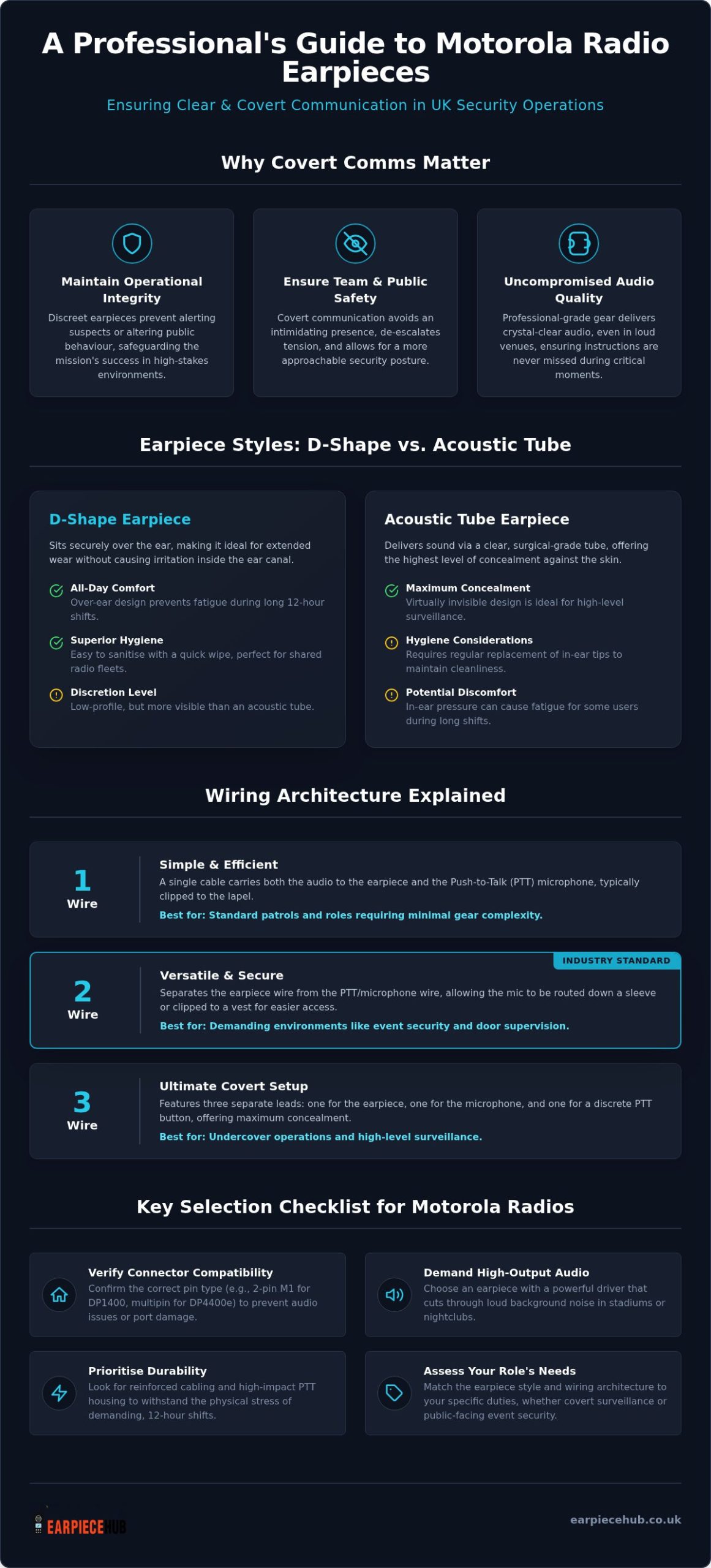
Professional radio communication relies on two primary physical designs: the acoustic tube and the D-shape loop. Acoustic tubes utilise surgical-grade clear tubing to deliver sound via air pressure, making them virtually invisible against the skin. However, many UK security professionals prefer a D-shape earpiece for Motorola radios because it sits securely over the ear rather than inside the canal. This over-ear architecture is essential for 12-hour shifts where in-ear pressure often leads to fatigue or irritation.
Choosing Between D-Shape and Acoustic Tube Styles
The choice often comes down to personal comfort and hygiene. Whilst acoustic tubes offer the highest level of concealment, they require regular ear tip replacements to maintain cleanliness. In contrast, the D-shape style features a soft rubber loop that is easy to sanitise with a quick wipe. This makes it the superior option for shared radio fleets amongst door supervisors and event staff who need to pass equipment between team members safely.
1-Wire vs 2-Wire vs 3-Wire: Which Setup Wins?
Wiring architecture dictates how you move on the job. A 1-wire system is the simplest setup, featuring a single cable that carries both the audio and the PTT microphone to your lapel. For more demanding environments, the 2-wire system is the industry standard. It separates the earpiece from the PTT and microphone, allowing you to route the mic down a jacket sleeve or clip it more securely to a tactical vest. The 3-wire system is the ultimate choice for undercover or high-level surveillance, featuring separate leads for the earpiece, microphone, and a discrete PTT button that can be hidden in a sleeve. Whether you need a 1-wire or 2-wire D-shape earpiece for Motorola radios, matching the architecture to your movement is vital. You can find the ideal technical wiring setup for your specific Motorola model at Earpiece Hub.
Choosing the Right D-Shape Earpiece for Motorola Radios
Selecting a D-shape earpiece for Motorola radios begins with a critical compatibility check. Motorola utilises several connector types, ranging from the standard 2-pin (M1) interface found on the DP1400 to proprietary multipin connectors on the DP4400e series. Using a mismatched adapter can lead to intermittent audio dropouts or permanent damage to the radio’s accessory port. For door supervisors, the priority remains audio clarity and PTT accessibility. In loud nightclub or stadium environments, you require a high-output driver that cuts through background noise without distortion, ensuring instructions are received clearly during critical incidents.
Event security roles require a more nuanced balance. You must monitor radio traffic whilst remaining fully aware of ambient crowd noise and potential verbal threats. A D-shape loop is the superior choice here as it sits over the ear rather than sealing the canal, allowing for better situational awareness than deep-insertion acoustic tubes.
Close Protection vs Door Supervision Requirements
Close Protection (CP) operatives demand absolute discretion and tailored wire routing. This typically involves “down-the-sleeve” microphone placement, where the mic lead is routed through clothing to the cuff for silent transmission. Because CP work involves unpredictable levels of physical movement, cable durability is a non-negotiable feature. We recommend choosing earpieces with Kevlar-reinforced wiring to prevent internal strands from snapping during physical interventions or rapid movement. Conversely, senior supervisors may opt for “Receive Only” earpieces. These specialised tools allow leaders to monitor multiple channels without the added bulk of a microphone, focusing purely on tactical oversight and team coordination.
Ensuring your equipment matches your specific operational role is the difference between success and failure in the field. Shop our professional range of D-shape earpiece for Motorola radios and upgrade your comms fleet today.
Maximising Longevity: Maintenance and Troubleshooting for Professionals
Maintaining a D-shape earpiece for Motorola radios ensures operational reliability and saves costs on frequent replacements. Moisture and earwax build-up within the audio path are the leading causes of equipment failure in the UK security sector. Unlike acoustic tubes, the D-shape style is remarkably easy to sanitise. Use a disinfectant wipe daily to clean the rubber loop and speaker housing. This simple routine prevents ear infections amongst team members, which is particularly vital in shared fleet environments where gear is swapped between shifts.
Perform this four-step daily checklist before every shift to ensure your comms are mission-ready:
- Inspect the connector pins for debris, dust, or oxidation.
- Check the entire cable length for kinks, knots, or exposed wiring.
- Test the PTT responsiveness with a quick, clear radio check.
- Verify audio clarity at maximum volume to detect any muffled sound.
Muffled audio often results from debris blocking the speaker port. Use a small, dry brush to clear any obstructions gently. If the PTT button feels “stuck,” it’s usually due to dirt ingress; a quick blast of compressed air often restores movement. Don’t wait for a total blackout during a critical incident to upgrade your kit. Explore our range of professional D-shape earpieces for Motorola radios to ensure your communication remains uninterrupted and your team stays safe.
Securing Your Operational Success
Operational integrity in the UK security sector relies on more than just high-performance radios; it demands the right peripheral gear. By matching your specific Motorola connector to a robust wiring architecture, you ensure your team remains connected during high-pressure incidents. Whether you’re managing a busy venue or providing close protection, selecting a D-shape earpiece for Motorola radios provides the hygiene and comfort needed for demanding 12-hour shifts. Remember that regular sanitisation and proactive cable checks are the simplest ways to prevent audio failure in the field.
Earpiece Hub has served as a specialist UK retailer since 2015, providing the technical expertise required to kit out entire security fleets. We understand that equipment failure isn’t an option when safety is on the line. Our team offers dedicated technical support from industry experts and next-day delivery for those urgent kit replacements. Shop the full Earpiece Hub range for professional security and equip your team with the reliability they deserve. Stay safe and stay connected.
Frequently Asked Questions
How do I clean my D-shape earpiece to prevent audio failure?
Clean your equipment daily using a non-alcoholic disinfectant wipe to remove wax and moisture from the speaker housing. These contaminants are the primary cause of muffled audio and hardware failure. Unlike acoustic tubes, the soft rubber loop of a D-shape earpiece for Motorola radios can be sanitised in seconds. Ensure the device is fully dry before reconnecting it to your handheld to avoid port corrosion or short circuits.
What is the difference between a 1-wire and 2-wire covert earpiece?
A 1-wire system uses a single cable running from the radio to the earpiece, with an inline microphone and PTT button. It’s best for light duties with minimal physical movement. A 2-wire system features two separate leads; one for the earpiece and another for the PTT. This allows you to route the microphone more effectively, such as clipping it to a tactical vest or hiding it under a lapel.
Are these earpieces compatible with the Motorola DP1400 radio?
Yes, the Motorola DP1400 typically uses a standard 2-pin M1 side connector, making it compatible with most universal 2-pin kits. However, you must always verify the specific connector type before purchase, as some newer digital fleets may require multipin adapters. Using the correct D-shape earpiece for Motorola radios ensures a secure physical connection, preventing the intermittent transmission issues that often plague low-quality, generic alternatives found on consumer marketplaces.
Can I use a covert earpiece for high-noise environments like a nightclub?
Covert earpieces are highly effective in loud environments if they feature high-output drivers designed for clarity. The D-shape style is particularly useful for door supervisors because it doesn’t block the ear canal entirely. This allows you to monitor radio traffic whilst maintaining situational awareness of the crowd and verbal cues. For extreme noise, ensure your PTT microphone is positioned close to your mouth to filter out background music.
How do I discreetly route a 3-wire earpiece for close protection work?
Discreet routing involves running the microphone lead down your jacket sleeve to the cuff and the earpiece lead up your back under your shirt. The third wire, containing the PTT button, is typically held in the palm or pinned inside a sleeve for silent operation. This setup is the gold standard for close protection, allowing operatives to communicate without making visible movements that might compromise their covert status during surveillance.
