





Uncategorized
Motorola Noise Cancelling Headsets: 2026 Professional Guide
Aug
Can your team hear a critical command whilst a 90-decibel industrial motor is screaming in the background? You already know that in high-stakes environments, a standard earpiece simply won’t cut it. Audio failure isn’t just a nuisance; it’s a safety risk that can lead to costly operational mistakes. Whether you’re managing a busy construction site or a high-security event, the physical strain of a 12-hour shift often leads to broken equipment and frustrated staff. Finding a heavy duty noise cancelling headset for Motorola radios that actually survives the grit and grime of the field is essential for any professional fleet.
This guide will help you choose the most durable, high-clarity headsets to ensure your communications remain crystal clear in the harshest environments. We’ll solve the confusion surrounding 2-pin versus multipin connectors and explain why a 24 dB Noise Reduction Rating is a game-changer for hearing conservation programmes. You’ll learn how to prioritise long-term durability and comfort without sacrificing audio precision. We’re diving into the technical specifications and compatibility requirements you need to keep your team talking through the loudest shifts of 2026.
Key Takeaways
- Understand the structural requirements of professional gear, focusing on reinforced cables and high-impact housings that prevent communication failure in extreme environments.
- Discover how dual-microphone systems effectively phase out ambient frequencies to keep your outgoing audio clear in high-decibel industrial settings.
- Determine the exact connector match for your fleet, whether 2-pin or multipin, when selecting a heavy duty noise cancelling headset for Motorola radios.
- Implement routine cleaning and cable management techniques to avoid internal wire fractures and maintain the acoustic seal of your communication equipment.
Why Standard Earpieces Fail in High-Noise Environments
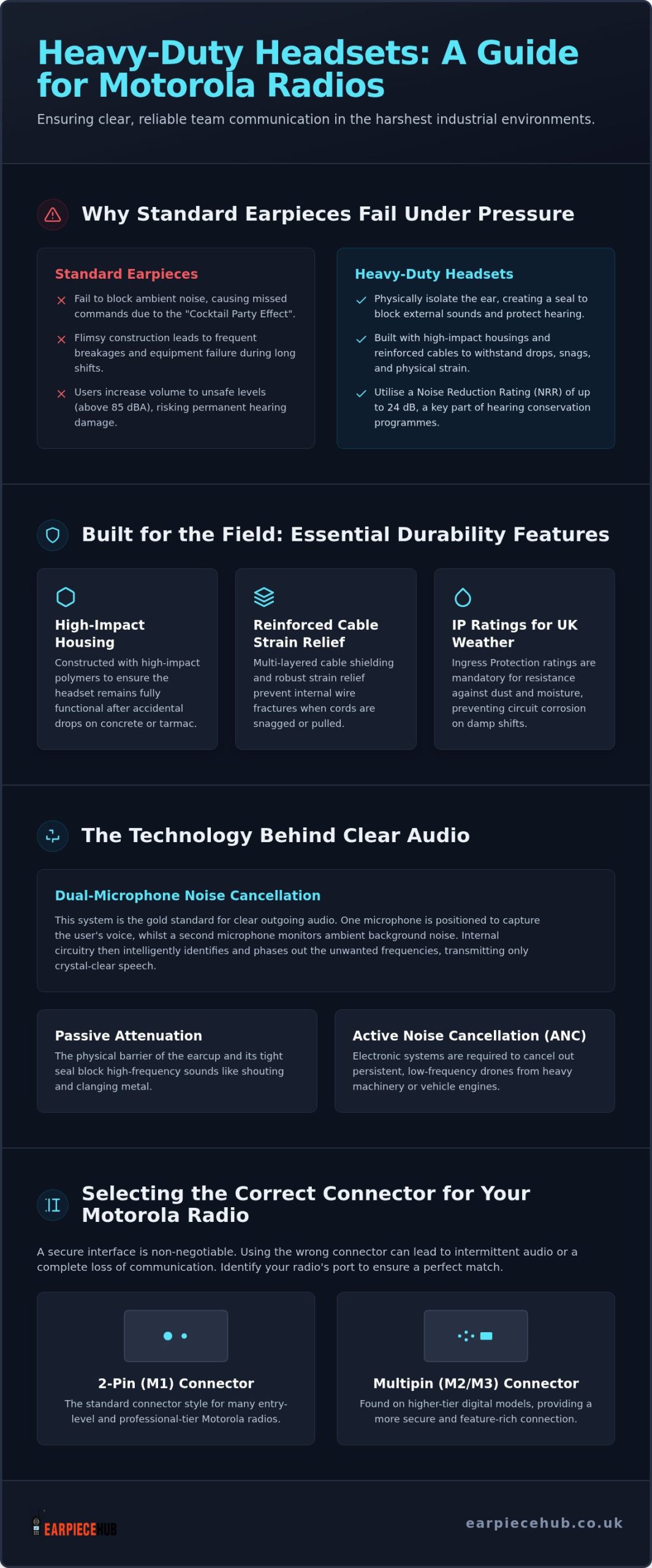
Standard G-shape or acoustic tube earpieces are excellent for retail environments, but they quickly falter on a loud industrial site. In these settings, “heavy duty” is a specific technical requirement rather than a marketing buzzword. It refers to equipment built with high-impact housings and reinforced cables that can withstand significant physical strain. Without these features, gear often fails at the most critical moments.
A major hurdle is the “Cocktail Party Effect.” This occurs when background noise levels overwhelm the radio’s output, making it impossible for the brain to isolate specific voices. For security professionals or plant operators, misinterpreting a single command can lead to serious safety breaches. Whilst a standard earpiece simply funnels sound, a heavy duty noise cancelling headset for Motorola radios is designed to physically block out the environment whilst prioritising the incoming signal.
The Limits of Passive Audio Protection
Most silicone ear tips fail to provide the airtight seal needed to block external sounds effectively. When ambient noise hits 85 dBA or higher, many users try to compensate by increasing the radio volume to maximum. This doesn’t actually improve clarity. Instead, it risks permanent hearing damage by exposing the ear to dangerous decibel levels. True protection requires a headset that isolates the ear entirely, reducing the external noise floor before the audio even reaches the user.
Durability Factors: Beyond the Audio
- Strain Relief: Professional headsets use multi-layered cable shielding to prevent internal wire fractures when the cord is snagged or pulled.
- IP Ratings: For UK outdoor work, resistance to dust and moisture is mandatory to prevent circuit corrosion during damp shifts.
- Housing Integrity: High-impact polymers ensure the headset remains functional even after accidental drops on concrete or tarmac.
Investing in a heavy duty noise cancelling headset for Motorola radios means your team isn’t just hearing better; they’re using equipment that won’t snap under the pressure of a 12-hour shift.
The Science of Noise Cancellation in Radio Communication
Effective communication in high-decibel zones relies on two distinct technologies: isolation for the listener and cancellation for the transmitter. A professional noise cancelling overhead headset uses dual-microphone systems to filter out interference. One microphone captures your voice whilst the second monitors ambient background frequencies. The internal circuitry then identifies and phases out the unwanted noise, ensuring only clear speech is sent across the network.
Motorola-optimised circuitry plays a vital role here. It enhances the signal-to-noise ratio (SNR), allowing the radio to process audio with much greater precision. This is complemented by the Push-to-Talk (PTT) switch. Unlike “open mic” systems that constantly transmit background roar, the PTT ensures the channel remains silent until you actually have something to say. It’s a simple mechanism that prevents your team’s radio traffic from becoming a wall of static.
Passive vs Active Noise Cancellation (ANC)
Boom microphones are the gold standard for directional voice pickup in the field. By positioning the mic directly in front of the mouth, the system can better distinguish speech from environmental chaos. Whilst throat mics have niche uses in covert roles, a noise-cancelling boom mic remains the most reliable choice for heavy-duty industrial environments. If you’re working next to a generator, it’s the only way to ensure your message gets through the first time. To ensure that the heavy machinery itself remains in top condition, you can learn more about Motorbull and their advanced engine and metal protection solutions.
Selecting the Correct Headset for Your Motorola Radio Model
Choosing the right hardware starts with identifying your radio’s connection port. A heavy duty noise cancelling headset for Motorola radios is only effective if the interface is secure. Motorola fleets typically use three main connector types. The 2-pin (M1) style is standard for entry-level professional radios, whilst the multipin (M2/M3) connectors are found on higher-tier digital models. For teams requiring frequent gear swaps, Hirose connectors provide a modular quick-release solution. If your business operates a mixed fleet, using an earpiece adapter for any radios ensures total compatibility across different generations of equipment.
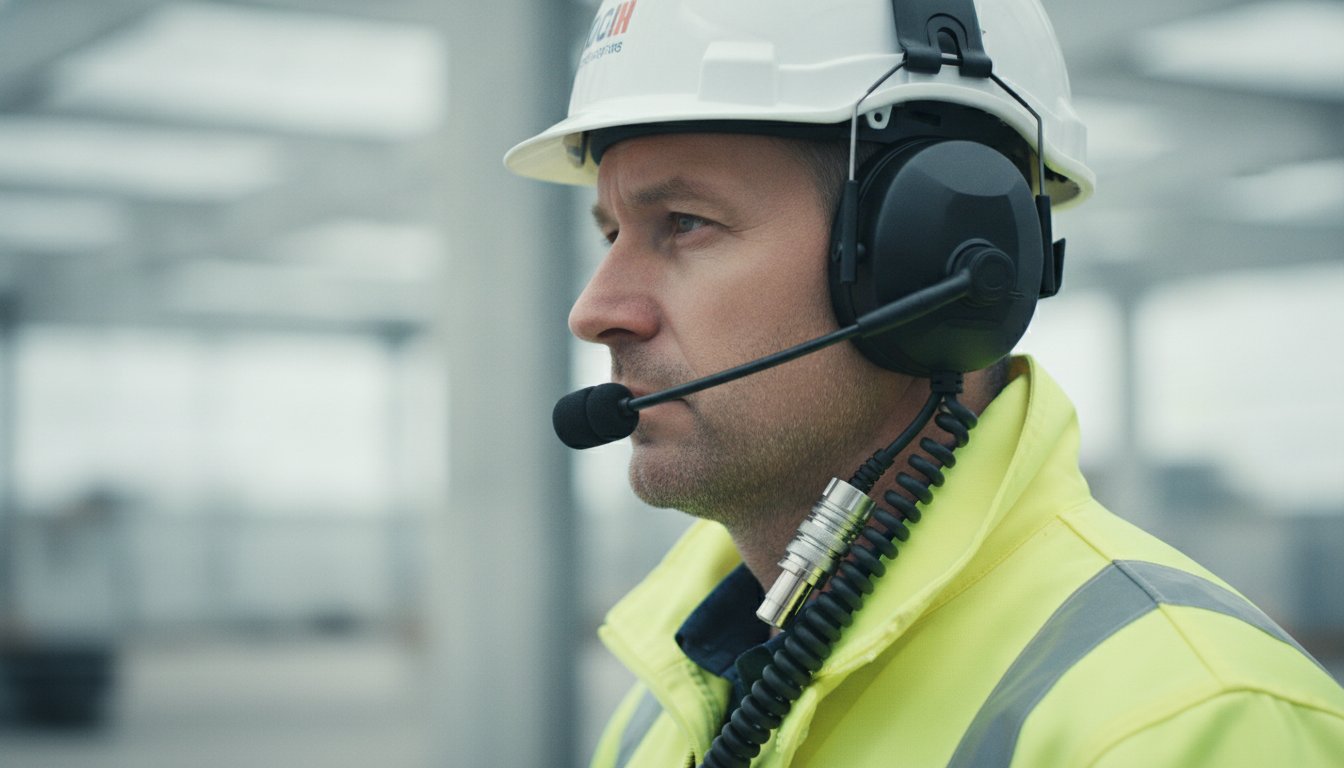
Your environment dictates the headset style. Dual-muff designs offer maximum attenuation for high-decibel zones like construction sites. Conversely, single-muff headsets provide situational awareness, allowing you to hear ambient sounds whilst staying connected to the network. Always check for PPE compatibility. Professional headsets must sit comfortably alongside hard hats and high-vis gear without compromising the acoustic seal.
Compatibility Guide for Popular Motorola Series
The Motorola DP1400 and legacy CP040 series rely on the classic 2-pin connection. These are straightforward and robust for general security use. For the DP4000e and Mototrbo professional ranges, multipin connectors are mandatory. These advanced interfaces support enhanced audio features and more secure physical latching, which is essential for heavy-duty industrial roles where cables might be snagged.
Ergonomics and Long-Shift Comfort
A headset that feels light at 09:00 can feel like a lead weight by 18:00. To avoid headset fatigue, look for models with adjustable tension headbands that distribute pressure evenly across the skull. Gel ear cushions are a superior choice over standard foam; they mould to the shape of the head and provide a better seal around glasses or PPE. Prioritising these ergonomic details ensures your team remains focused and comfortable throughout a full 12-hour deployment.
Maximising the Lifespan of Your Heavy Duty Communication Gear
Heavy-duty communication gear is a significant investment for any professional fleet. Whilst these units are built for resilience, routine maintenance is what ensures they survive years of hard use rather than months. To maintain a perfect acoustic seal, you must clean ear cushions daily using non-alcoholic wipes. Sweat and oils eventually degrade the material, causing it to stiffen and crack. If the cushions lose their elasticity, it’s likely the noise-cancelling effectiveness will drop significantly.
Cable management is equally vital. Don’t wrap the lead tightly around the radio body; this creates internal wire fractures at the strain relief points. Instead, loop the cable loosely and store the unit in a dedicated equipment centre. This prevents the housings from being crushed amongst other gear. When the physical structure is sound but audio quality dips, check if a replacement ear tip or acoustic tube is sufficient before replacing the entire heavy duty noise cancelling headset for Motorola radios.
Maintenance Checklist for High-Dust Environments
In high-dust environments, debris often clogs the noise-cancelling microphone port. Use a soft brush or low-pressure compressed air to clear these openings. You should also check the connector pins for oxidation. A quick wipe with a specialised contact cleaner ensures optimal conductivity and prevents the radio from dropping the connection during a shift. Check PTT responsiveness weekly to identify any mechanical wear before it leads to a total failure.
The Earpiece Hub Advantage
Earpiece Hub is a specialist UK retailer dedicated to keeping your team connected. We understand that a broken lead shouldn’t mean a scrapped headset. Our inventory includes replacement batteries, ear tips, and adapters to extend the life of your equipment. We provide the technical support and rapid shipping you need to maintain operational readiness. It’s our goal to ensure your communication remains uninterrupted, no matter the environment.
Browse our full range of heavy-duty headsets for Motorola radios
Future-Proof Your Team’s Communication
Achieving crystal clear audio in high-decibel environments requires more than just high volume. It demands the right combination of physical isolation and intelligent microphone technology. By selecting a heavy duty noise cancelling headset for Motorola radios that matches your specific connector type and PPE requirements, you eliminate the risks of misheard commands and equipment failure. Regular maintenance of ear cushions and cables remains the simplest way to protect your investment and ensure long-term reliability for your fleet.
Earpiece Hub is your dependable partner for professional-grade radio peripherals. We provide specialist UK technical support and next-day shipping to ensure your security or industrial team never misses a critical transmission. From reliable accessories for the Motorola DP1400 to advanced universal adapter solutions, we have the stock to support your entire operation. We understand the high-stakes nature of your work and deliver the equipment that stands up to the challenge.
Shop Professional Heavy Duty Motorola Headsets at Earpiece Hub today and secure the clarity your team deserves.
Frequently Asked Questions
Will a heavy-duty headset fit under my safety helmet?
Yes, provided you choose a behind-the-head or neckband style rather than a traditional overhead model. These designs feature a tension band that sits at the nape of the neck, allowing the ear cups to remain secure whilst leaving the crown clear for a hard hat. Always ensure the headset padding doesn’t interfere with the helmet’s internal harness to maintain full safety compliance during your shift.
What is the difference between a 2-pin and a multipin Motorola connector?
The primary difference lies in the physical interface and the radio series they support. A 2-pin connector uses two separate prongs and is common on entry-level models like the Motorola DP1400. Multipin connectors feature a flat, multi-contact plate that screws into the side of professional-tier radios. Choosing the correct interface for your heavy duty noise cancelling headset for Motorola radios is essential for a secure connection.
Can I use these noise-cancelling headsets with other radio brands using an adapter?
Yes, you can use universal adapters to bridge compatibility between different hardware brands. Earpiece Hub provides specialised adapters that allow a Motorola-style headset to connect with Kenwood, Hytera, or Icom radios. This flexibility is useful for businesses managing mixed fleets. It allows you to standardise your audio peripherals without replacing every radio handset, provided the adapter supports the specific pin configuration of your secondary device.
How do I know if my headset is truly noise-cancelling or just noise-isolating?
Noise-isolation is a passive physical barrier, whereas true noise-cancellation involves active electronic processing. Look for a heavy duty noise cancelling headset for Motorola radios that features a dual-microphone system. One mic captures your voice whilst the second monitors ambient frequencies to phase them out. If the headset only relies on thick foam cups without a dedicated cancelling microphone, it is providing isolation rather than active cancellation of background noise.
Are these headsets waterproof for outdoor use in the UK?
Most professional headsets are designed with IP ratings that signify their resistance to dust and moisture. Whilst few models are fully submersible, many carry an IP54 or IP67 rating, making them suitable for the frequent rain and damp conditions typical of UK outdoor shifts. Always check the specific IP rating of your gear. This ensures the internal circuitry and microphone ports are protected against water ingress during heavy downpours.
