





Uncategorized
Acoustic Tube vs D-Shape Earpiece: The Professional Comparison
Aug
Could the wrong choice of earpiece be the silent reason your security team is missing critical radio calls by the tenth hour of their shift? Most team leads agree that clear communication is the backbone of site safety, yet staff often battle ear fatigue, muffled audio, and moisture build-up in their equipment. Choosing between an acoustic tube vs d-shape earpiece isn’t just about the initial cost; it’s about operational efficiency and hygiene for your workforce.
We promise to help you settle the acoustic tube vs d-shape earpiece debate so your team stays connected during high-pressure situations. You’ll discover which design handles noisy environments best and which offers the durability needed to last multiple seasons. We will break down the technical specifications, comfort levels for 12-hour shifts, and the maintenance requirements for both styles. From covert security needs to high-turnover retail environments, this comparison ensures you invest in equipment your staff actually want to wear whilst maintaining peak performance and site-wide reliability.
Key Takeaways
- Master the acoustic tube vs d-shape earpiece distinction to select the most effective audio delivery method for your specific operational environment.
- Identify which design minimises ear fatigue during 12-hour shifts whilst providing the “easy-on, easy-off” convenience required for customer-facing roles.
- Learn why acoustic tubes remain the industry standard for covert security and how D-shape models excel in high-turnover retail or hospitality settings.
- Discover essential cleaning protocols and maintenance tips to prevent moisture build-up and extend the lifespan of your professional communication gear.
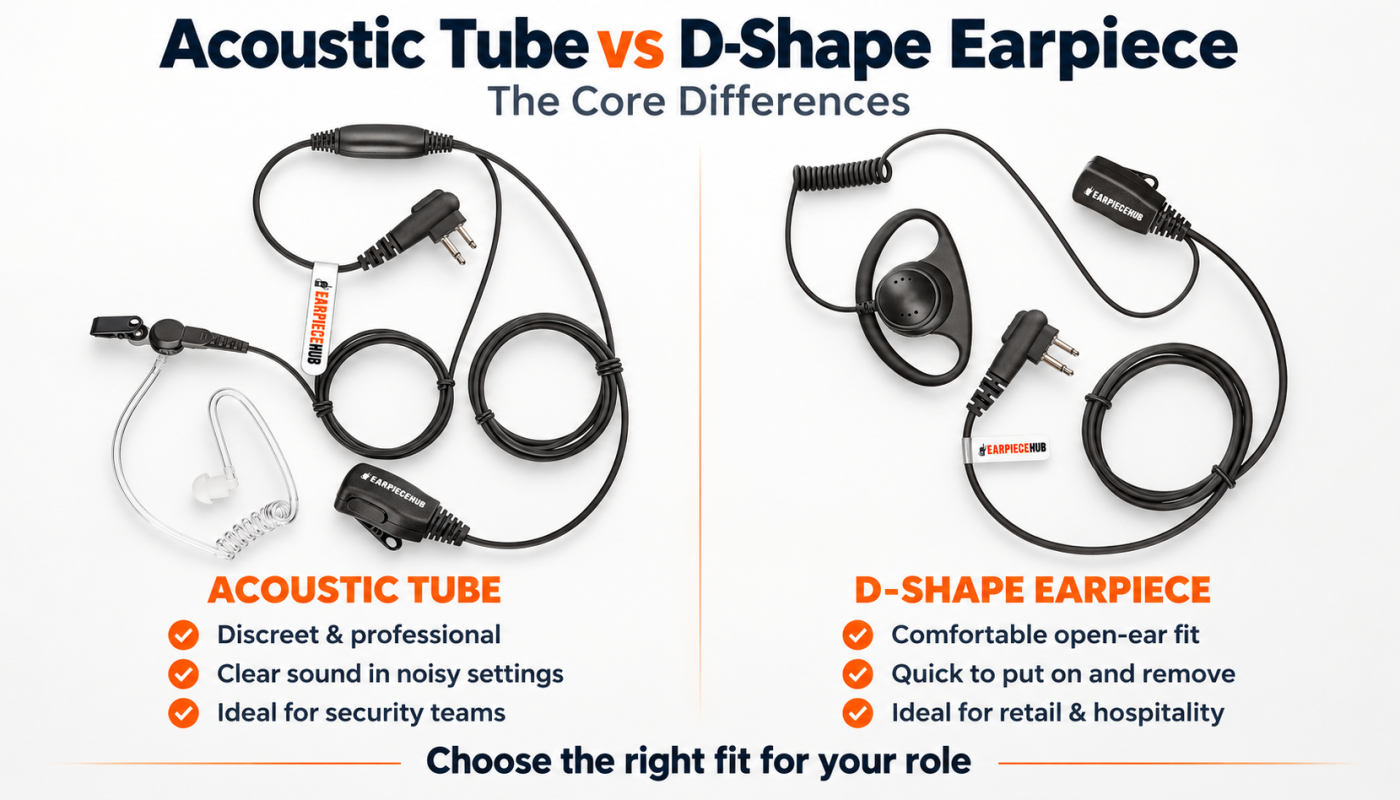
Acoustic Tube vs D-Shape Earpiece: The Core Differences
Choosing between an acoustic tube vs d-shape earpiece often comes down to how you need to receive audio. The acoustic tube uses a clear plastic tube to deliver sound via air pressure, making it the preferred choice for covert operations. In contrast, the D-shape earpiece features a traditional speaker housed within a plastic loop that rests securely around the outer ear. While the acoustic tube provides an in-ear seal for better isolation, the D-shape offers an over-ear placement that keeps the ear canal open. Both styles are fully compatible with industry staples like the Motorola DP1400 and Kenwood 2-pin radios.
How the Acoustic Tube Works
This design relies on a transducer principle. Electrical signals from the radio travel to a small speaker housing, where they are converted into air vibrations. These vibrations then travel up the clear tube into the ear. Acoustic tube headphones are favoured because they minimise electronic interference near the head. Since the speaker is located further down the wire, there’s less risk of radio frequency hum affecting the user. It’s a clean, crisp way to receive instructions without a bulky speaker pressing against the ear.
The Mechanics of the D-Shape Loop
The D-shape prioritises external audio delivery through a speaker that sits just outside the ear canal. The plastic loop provides excellent stability during physical movement, ensuring the device doesn’t slip during a busy shift. It’s the ideal solution for staff who dislike the sensation of objects inside their ear. Because it doesn’t create a vacuum seal, users can maintain better situational awareness of their immediate surroundings. This makes it a functional tool for retail environments where hearing a customer is as vital as hearing the radio.
Comfort and Practicality: Comparing the User Experience
User experience often dictates which hardware stays in the kit bag and which gets left in the locker. When evaluating the acoustic tube vs d-shape earpiece, shift duration is the primary factor. Retail staff working 12-hour shifts frequently prefer the D-shape because it rests on the outer ear, preventing the internal pressure and “plugged” sensation that causes ear fatigue. Conversely, security professionals on shorter, high-intensity stints value the acoustic tube for its discreet profile. The clear tube remains nearly invisible to the public, whereas the D-shape is an overt, professional signal of radio use.
The Hygiene Advantage of D-Shape Designs
In environments like warehouses or hospitality venues where radios are shared amongst staff, hygiene is a critical concern. The non-invasive nature of the D-shape design significantly reduces the risk of ear infections compared to in-ear alternatives that sit inside the ear canal. These units are exceptionally easy to wipe down with alcohol-free wipes during shift handovers. If your team operates a pool of equipment, choosing a D-shape earpiece for Hytera radios or similar models ensures a more sanitary workflow for every user.
Noise Isolation and Clarity with Acoustic Tubes
Audio performance varies greatly depending on ambient noise levels. Acoustic tubes excel in high-decibel environments like nightclubs or festivals because the silicone ear tip creates a physical seal. This seal provides passive noise isolation, blocking out external clamour so that users can keep their radio volume at a safer, lower level. This passive cancellation protects the user’s hearing whilst ensuring that every transmission remains intelligible amidst the chaos of a crowded venue. When comparing the acoustic tube vs d-shape earpiece for loud settings, the tube is the definitive choice for those who cannot afford to miss a single word of a transmission.

Operational Suitability: Matching Earpieces to Your Industry
Matching your hardware to your sector is the fastest way to improve team efficiency. For door supervisors and close protection, the acoustic tube is the undisputed industry standard. Its discreet appearance prevents situational escalation by keeping radio traffic private and wires hidden. When assessing the acoustic tube vs d-shape earpiece for security, the covert nature of the tube provides a distinct professional advantage.
Best for Security: The Covert Kit
Covert kits offer a psychological benefit in crowd control. Visible earpieces can sometimes draw unwanted attention or be grabbed during an altercation. Using a 2-wire or 3-wire setup allows for maximum discretion, with wires easily concealed under a suit or uniform. This keeps the focus on the task, not the technology.
In contrast, retail and hospitality environments favour the D-shape. Staff frequently move between private radio updates and customer-facing interactions. The “easy-on, easy-off” nature of the loop makes it the practical choice for floor managers and front-of-house teams. Construction and warehousing also benefit from this design, as workers must hear safety warnings or moving vehicles whilst remaining connected.
Best for Fast-Paced Environments: The D-Shape
The D-shape loop is a universal, one-size-fits-all solution. It eliminates the logistical headache of individual ear-tip sizing for large, rotating workforces. Because the speaker sits outside the ear, users maintain full situational awareness of ambient sounds. This is vital for safety in noisy depots or busy shop floors.
Earpiece Hub maintains a deep stock of both styles for Motorola, Hytera, and Kenwood radios to support any UK business. Shop our full range of professional earpieces today for next-day shipping and specialist support.
Longevity and Care: Getting the Most from Your Communication Gear
Professional hardware requires professional care. When managing an acoustic tube vs d-shape earpiece fleet, the maintenance protocols differ based on their mechanical design. Acoustic tubes are susceptible to condensation, which creates a physical barrier to sound. D-shape models are more resilient but require surface sanitisation with alcohol-free wipes to prevent wax buildup on the speaker mesh. To maintain peak performance, ensure your team uses a high-quality replacement battery for Motorola DP1400 units; low voltage often results in weak, distorted audio regardless of earpiece quality.
Maintaining Your Acoustic Tube
Moisture is the primary cause of muffled audio in covert kits. If you notice a drop in volume, follow these steps to restore clarity:
- Detach the clear tube from the transducer by giving it a half-turn.
- Wipe the transducer nipple with a dry cloth to remove debris or moisture.
- Clear the tube using a puff of compressed air or by hanging it to dry.
If the plastic shows signs of yellow discolouration or becomes stiff, it’s time for a change. Earpiece Hub stocks replacement acoustic tubes and ear tips so you don’t have to replace the entire loom when only the tube is worn.
Cable Management and Storage
Internal wire breakage is the most common reason for earpiece failure. Avoid wrapping the cable tightly around the radio body, as this causes significant strain at the connector pin. Instead, use the “over-under” coiling method to maintain the wire’s natural memory and prevent tangles. Store your gear in a cool, dry environment away from direct sunlight. UV exposure and extreme heat make the plastic housing brittle, leading to cracks and exposed wiring. Proper storage ensures your acoustic tube vs d-shape earpiece investment lasts through multiple busy seasons without failing mid-shift.
Equip Your Team with the Right Audio Solution
Selecting the ideal acoustic tube vs d-shape earpiece depends entirely on your operational environment. If your team manages high-decibel crowds or requires covert discretion, the acoustic tube’s passive noise isolation and low profile are unmatched. For retail or warehouse staff working 12-hour shifts, the D-shape loop provides the hygiene and comfort needed amongst teams to keep them focused throughout the day.
Remember that regular maintenance, such as clearing moisture from tubes or using alcohol-free wipes on speakers, will significantly extend the life of your equipment. As a specialist UK provider of Motorola and Hytera accessories, we ensure your communications never fail when it matters most. We provide 24/7 customer support and offer next day UK shipping to keep your operations running smoothly and efficiently.
Don’t let poor audio quality compromise your site safety or team coordination. Browse our full range of professional earpieces at Earpiece Hub and find the perfect match for your radio fleet. Stay connected, stay professional, and stay safe on every shift.
Frequently Asked Questions
Which earpiece is better for loud environments, acoustic tube or D-shape?
The acoustic tube is significantly better for loud environments because the silicone ear tip creates a physical seal within the ear canal. This seal provides passive noise isolation, which blocks out ambient sound from nightclubs or festival sites. In the acoustic tube vs d-shape earpiece comparison, the D-shape falls short here as its open design allows external noise to compete with your radio transmissions, often forcing users to unsafely increase volume.
Can I use a D-shape earpiece with my Motorola DP1400 radio?
Yes, you can use a D-shape earpiece with a Motorola DP1400 as long as it features the standard Motorola 2-pin M1 connector. While many associate this radio with covert acoustic kits, D-shape models offer a robust alternative for warehouse or retail settings. Always verify the connector type before purchase to ensure a secure fit and clear audio transmission. We stock these specifically for Motorola fleets to guarantee full compatibility.
How often should I replace the plastic tube on my acoustic earpiece?
You should replace the plastic tube every three to six months to maintain hygiene and audio clarity. Over time, the clear plastic becomes brittle, yellowed, or clogged with moisture and debris. If you work in high-humidity environments or during intense shifts, you might need to change it more frequently. Keeping a stock of replacement tubes ensures your kit remains functional without needing to buy a completely new earpiece assembly.
Is a D-shape earpiece more hygienic for teams sharing radios?
A D-shape earpiece is the most hygienic choice for teams that share radio equipment. Because the speaker sits on the outer ear rather than inside the canal, there’s a much lower risk of transferring bacteria or ear infections between staff members. They are exceptionally easy to sanitise between shifts using alcohol-free wipes. This makes them the preferred standard for hospitality and retail sectors where equipment turnover is frequent and rapid.
Why has the audio in my acoustic tube earpiece become muffled?
Muffled audio is usually caused by moisture build-up or earwax blocking the tube or the transducer nipple. In the acoustic tube vs d-shape earpiece debate, this is the most common maintenance issue for tube users. Small droplets of condensation can act as a physical plug, stopping sound waves from reaching your ear. Removing the tube and clearing it with compressed air or replacing the silicone ear tip typically resolves the problem immediately.
