





Uncategorized
Choosing a Radio Earpiece: The 2026 Professional Guide
Aug
What if the only thing standing between a successful operation and a total security breach is a single millimetre of frayed plastic or a poorly seated connector? You understand that in high-stakes environments, choosing the right radio earpiece is about securing a critical lifeline. Yet, professionals often endure ear fatigue from poorly fitted plastic or the embarrassment of audio failure during transmissions. Cables snag on clothing. Connector confusion leads to equipment being discarded after one season.
This 2026 guide helps you master the technical nuances required to ensure your team maintains crystal-clear audio in noisy environments. We will examine the differences between 1-wire, 2-wire, and 3-wire configurations whilst comparing the ergonomics of D-shape, G-shape, and acoustic tube designs for Motorola, Hytera, and Kenwood radios. You’ll learn how to match hardware to specific roles and ensure your gear survives the rigours of professional use.
Key Takeaways
- Learn to distinguish between covert Acoustic Tubes and ergonomic D-Shape or G-Shape designs to balance hygiene with professional stability.
- Master the technical complexities of choosing the right radio earpiece by understanding how 1 Wire, 2 Wire, and 3 Wire configurations impact team mobility.
- Optimise audio performance in challenging environments by selecting specialised noise-cancelling headsets or Remote Speaker Microphones for high-decibel zones.
- Protect your investment by identifying exact connector compatibility for Motorola, Hytera, and Kenwood hardware to avoid equipment failure and cable snags.
Understanding Earpiece Shapes: Acoustic Tube vs D-Shape vs G-Shape
Professional communication relies on hardware that matches your physical environment. When choosing the right radio earpiece, the primary decision involves how the device interacts with your ear. High-stakes roles often require discreet profiles, whilst fast-paced retail environments prioritise hygiene and comfort for long shifts. Understanding the mechanics of two-way radio technology helps professionals select the correct interface for their specific operational needs.
The Covert Advantage of Acoustic Tubes
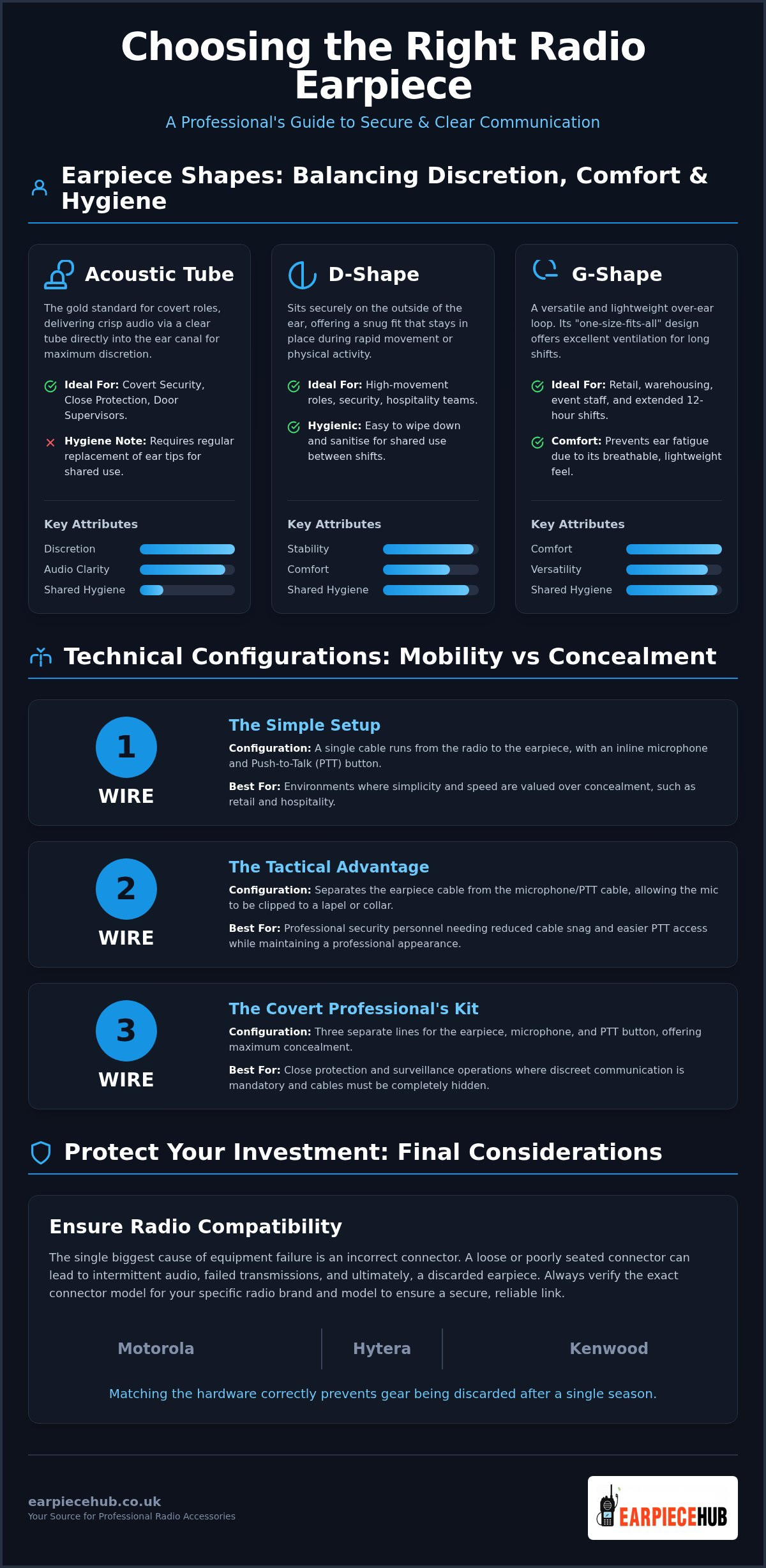
The acoustic tube remains the gold standard for door supervisors and close protection teams. It utilises a clear plastic tube to carry sound from a transducer hidden under clothing directly into the ear canal. This setup provides a discreet appearance and delivers crisp audio even in high-decibel environments. It’s the ultimate tool for covert security, though users should regularly replace ear tips to maintain audio clarity and comfort.
D-Shape and G-Shape for Shared Environments
Unlike acoustic tubes, D-shape and G-shape earpieces sit on the outside of the ear. This over-ear design is a critical advantage for teams sharing equipment. Because no part enters the ear canal, these units are significantly easier to sanitise between shifts. This makes them a favourite for hospitality environments where headsets might be swapped amongst staff members.
- D-Shape: Offers a secure, snug fit that stays in place during rapid movement or physical interventions.
- G-Shape: A versatile, one-size-fits-all loop that is popular amongst retail teams for its lightweight feel.
Choosing the right radio earpiece often comes down to personal preference between in-ear precision and over-ear breathability. If your team works 12-hour shifts, the G-shape provides the ventilation needed to prevent ear fatigue. Conversely, for high-movement security roles, the D-shape ensures the earpiece won’t dislodge during a pursuit.
Technical Configurations: 1-Wire, 2-Wire, and 3-Wire Systems
Technical configurations define how your team interacts with their equipment throughout a shift. When choosing the right radio earpiece, the wire count determines how easily you can hide cables and where the microphone sits. A 1 Wire system is the simplest setup, featuring a single line from the radio to the ear with an inline microphone. These are perfect for retail environments where speed and simplicity are valued over total concealment.
When to Choose a 2-Wire Setup
For security personnel, a 2 Wire configuration offers a significant tactical advantage. It separates the earpiece cable from the Push-to-Talk (PTT) and microphone line. This allows you to route the PTT button down a sleeve or clip it to a lapel for easier access. According to The Professional Security Officer Magazine, these kits are essential for reducing cable snags in physical environments. If you’re managing a door team, a high-quality Acoustic Tube Earpiece for Motorola Radios in a 2 Wire format ensures your gear remains operational whilst providing a professional appearance.
The 3-Wire Professional Surveillance Kit
The 3 Wire system provides the highest level of concealment for covert operations. It features three distinct lines: one for the ear, one for the microphone, and a separate PTT button. Bodyguards often thread the PTT through their sleeve into the palm, allowing for transmissions without any visible movement towards the chest. This setup is the standard for close protection where discreet behaviour is mandatory. It ensures you stay connected without alerting others to your radio use.
Choosing the right radio earpiece ultimately depends on whether your role requires overt efficiency or covert silence. Always match the wire count to your uniform; 1 Wire works well with polo shirts, whilst 3 Wire kits require a jacket to hide the extra cabling. Selecting the correct configuration prevents equipment being discarded after a single season due to snagging or discomfort.
Matching Your Earpiece to the Working Environment
Operational success depends on hardware that survives its surroundings. When choosing the right radio earpiece, you must account for the specific background noise and physical demands of your site. In customer-facing retail roles, a lightweight G-Shape Earpiece for Kenwood Radios is the preferred choice. It balances a professional, non-aggressive appearance with the clarity needed for shop-floor coordination. These over-ear loops allow staff to hear both their radio and the customer simultaneously, which is vital for maintaining high service standards.
The Impact of Ambient Noise on Audio Clarity
Standard ear tips often fail in the high-decibel chaos of the UK night-time economy. In loud clubs or music festivals, ambient noise levels can easily exceed 100dB, rendering basic earpieces useless. Door supervisors and event security require specialised gear to cut through the din. A Noise Cancelling Overhead Headset provides physical hearing protection whilst ensuring every transmission remains audible. Alternatively, a Remote Speaker Microphone (RSM) allows a guard to bring the audio source directly to their ear during a crowd intervention, bypassing the need for a permanent ear-insert.
Physical durability is just as critical as audio quality in high-friction environments. Security teams and industrial workers should prioritise equipment with Kevlar-reinforced cabling. This internal braiding prevents the copper wires from snapping when snagged on door handles or clothing. Rugged earpieces built for these conditions will comfortably last more than one season, reducing the long-term cost of fleet maintenance. By matching the technical build to the environmental stress, you ensure your team remains connected during critical incidents. Choosing the right radio earpiece for your specific zone prevents communication blackouts when they are most dangerous.
Ensuring Radio Compatibility and Equipment Longevity
Technical durability is only half the battle; pin compatibility is the final hurdle. Choosing the right radio earpiece requires precise identification of your radio’s connector port. Motorola often utilises a 2-pin configuration, whilst Kenwood and Hytera have their own distinct multi-pin layouts. Misidentifying these leads to bent pins or poor audio transmissions. If you manage a mixed fleet, consider using universal earpieces or an earpiece adapter for any radios. This strategy allows you to standardise your stock even if your radio brands vary across departments.
Pin Compatibility and Universal Connectors
Before ordering, verify your specific radio model number against technical compatibility charts. A Motorola DP1400 requires a different connection than a Kenwood TK-series. Using the wrong plug can damage the radio’s internal socket, leading to costly repairs.
- 2-Pin Motorola: The industry standard for many entry-level professional radios.
- Multi-pin Hytera: Offers a more secure, screwed-in connection for heavy-duty security use.
- Universal Adapters: Save money during fleet upgrades by adapting high-quality headsets to new radio hardware.
Hygiene and Maintenance for Fleet Managers
Hygiene is often overlooked but remains critical for audio clarity. You should replace acoustic tubes and ear tips every 3 to 6 months. Over time, moisture and wax build-up within the tube, muffling sound and creating a health risk for staff. For large teams, organise your equipment using a six-way multi-unit charger. This doesn’t just centralise your gear; it also manages battery health more effectively than individual charging leads.
Power reliability is the backbone of clear communication. Ensure your fleet is ready for 12-hour shifts by stocking a replacement battery for Motorola DP1400 units. Fresh batteries prevent the mid-shift audio drops that compromise team safety. By focusing on these technical details, you ensure choosing the right radio earpiece results in a system that performs under pressure and lasts for multiple seasons. Shop our range of maintenance parts to keep your comms crystal clear.
Secure Your Team’s Communication Strategy
Securing your team’s communication requires more than just a functional radio; it demands the correct interface for the environment. By matching the ergonomics of acoustic tubes or G-shape loops to your specific shift requirements, you eliminate ear fatigue and hygiene concerns. Selecting the appropriate wire configuration ensures your team remains mobile and discreet, whilst proactive maintenance of acoustic tubes and batteries prevents audio failure during critical moments. Equipment that survives the rigours of your site is an investment in safety.
Choosing the right radio earpiece is a technical decision that impacts both safety and operational efficiency. At Earpiece Hub, we provide specialist UK support for all Motorola, Hytera, and Kenwood accessories to help you make the correct choice. Don’t let poor equipment compromise your security protocols or team coordination.
Shop our full range of professional radio earpieces today and benefit from Next Day Shipping on all essential comms gear. Equip your team with the reliability they deserve.
Frequently Asked Questions
How do I know if an earpiece will fit my Motorola radio?
You must identify the specific pin configuration on your radio’s accessory port to ensure a secure fit. Motorola devices commonly use either 2-pin or multi-pin connectors depending on the model series. Choosing the right radio earpiece involves cross-referencing your model number, like the DP1400, with the connector type. If your fleet uses various brands, an earpiece adapter for any radios can provide a universal solution for your team.
What is the difference between an acoustic tube and a D-shape earpiece?
The main difference is the physical fit and the level of discretion provided. Acoustic tubes use a clear pipe to deliver audio directly into the ear canal, providing a covert look for security operatives. Conversely, a D-shape earpiece loops over the outside of the ear. This makes the D-shape more stable during physical activity and more hygienic for shared use, as no part of the device enters the ear canal itself.
Can I share my radio earpiece with another colleague for hygiene reasons?
Sharing in-ear equipment is unhygienic, but over-ear designs like the G-shape or D-shape make shared use safer. Because these styles don’t enter the ear canal, they are significantly easier to sanitise between shifts. If your team uses acoustic tubes, ensure every operative has their own set of replacement ear tips. This simple step protects staff health whilst maintaining the professional standard of your communication equipment.
Why has my earpiece audio become muffled or quiet over time?
Muffled audio typically indicates a blockage or moisture build-up inside the clear plastic pipe. Sound waves cannot travel effectively through wax or condensation, which naturally accumulates during long shifts. To fix this, you should install replacement acoustic tubes and ear tips every 3 to 6 months. This routine maintenance is essential for choosing the right radio earpiece setup that delivers consistent, crystal-clear audio throughout the entire year.
What are the benefits of a 2-wire earpiece over a 1-wire setup?
A 2-wire system offers superior cable management by separating the earpiece from the microphone and PTT button. This configuration allows you to thread the PTT line through a jacket sleeve for discreet transmissions. Whilst a 1-wire setup is simpler for retail, the 2-wire kit is the professional standard for security. It prevents the “hanging cable” look and reduces the risk of the earpiece being pulled out during movement.
