





Uncategorized
Cross-Brand Radio Earpiece Compatibility Guide
Jul
Buying a new fleet of radios doesn’t have to mean binning your entire inventory of expensive earpieces. Many security professionals assume that switching brands requires a complete, budget-draining overhaul of their audio gear. This misconception leads to wasted spend and the risk of critical audio failure when mismatched pins fail during an operation. Mastering cross-brand radio earpiece compatibility is about more than just making a plug fit into a socket; it’s about ensuring technical reliability and clear communication across your entire team.
We know the frustration of staring at a drawer full of earpieces that won’t connect to your newest handsets. You need equipment that works every time, regardless of the logo on the radio. This guide will show you how to successfully mix and match accessories without compromising on sound quality or safety. You’ll learn which brands share pin configurations, how to use adapters safely, and why universal earpieces are the smartest choice for cost-effective fleet maintenance. From Hirose connectors to UKCA compliance, we provide the technical clarity you need to keep your communications seamless and your budget intact.
Key Takeaways
- Break brand-specific silos by understanding how proprietary connectors and wiring logic impact your communication reliability.
- Identify the critical differences between Motorola M1, Kenwood K1, and Hytera H-series standards to avoid equipment failure.
- Evaluate the most reliable methods for cross-brand radio earpiece compatibility, specifically comparing the use of adapters versus universal modular systems.
- Protect your investment in specialist equipment whilst ensuring seamless audio performance across different radio handsets.
- Organise your fleet maintenance more effectively with a technical approach that simplifies earpiece procurement for diverse teams.
The Challenge of Cross-Brand Radio Earpiece Compatibility
Managing a fleet of radios often involves a mix of legacy equipment and newer models. Manufacturers design proprietary connectors to create a “lock-in” effect, forcing organisations to buy brand-specific accessories. This creates a significant hurdle for security teams merging operations or companies integrating hire-fleets for large events. When you switch from Motorola to Kenwood or Hytera, the assumption is usually that you’ll need a completely new set of earpieces. This isn’t always the case.
Why One Plug Does Not Fit All
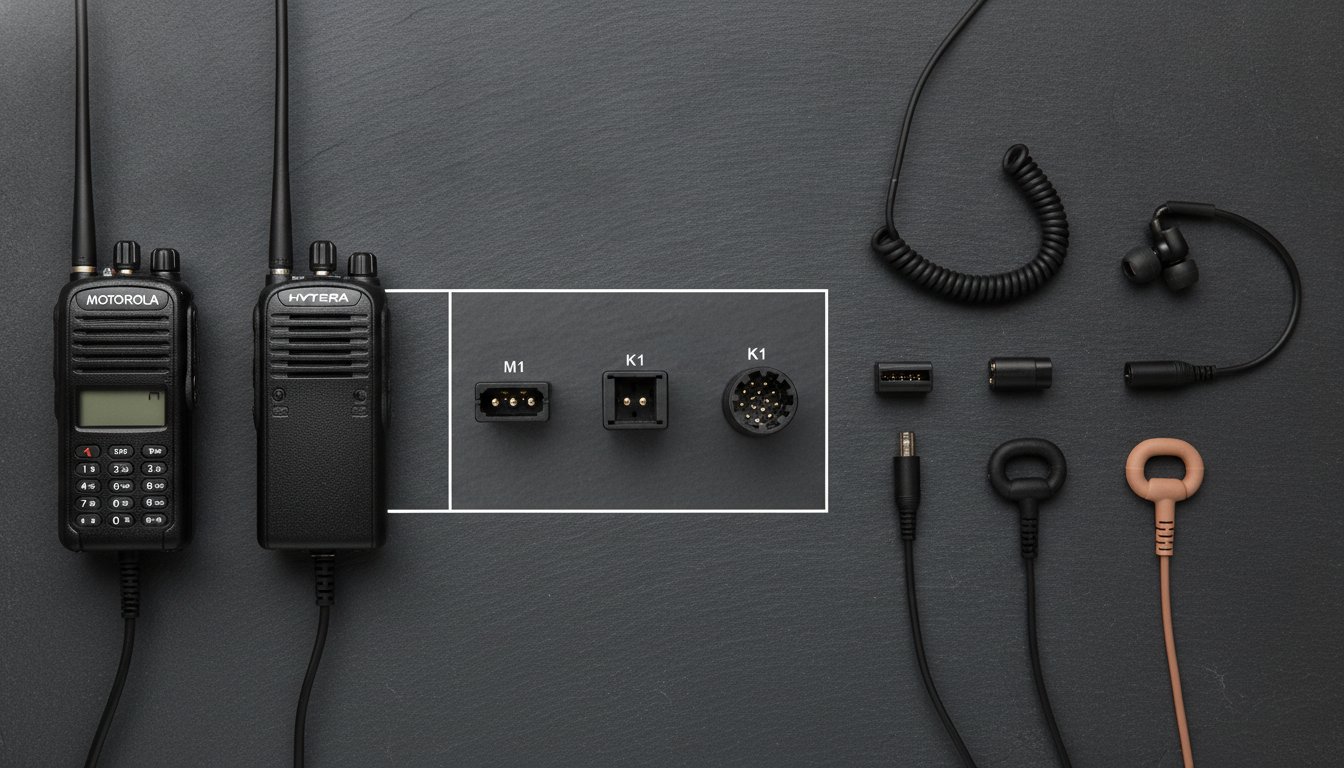
The barriers to compatibility are both physical and technical. Physically, connectors vary from the standard 2-pin M1 or K1 styles to complex multi-pin and threaded designs used on high-end digital handsets. Even if a plug fits, the internal wiring logic might differ. A Kenwood 2-pin earpiece might look identical to a Baofeng version, but the pin spacing or the diameter of the jacks can vary by fractions of a millimetre, causing a loose connection or a short circuit.
Modern two-way radio technology has shifted towards digital signalling. An earpiece designed for an older analogue system might not support the advanced features of a DMR (Digital Mobile Radio) handset. This software barrier means that whilst a plug might physically connect, the microphone or Push-to-Talk (PTT) function may fail to trigger correctly. Success requires a specialist understanding of both the physical port and the signalling requirements of your specific radio fleet. Don’t risk your hardware on guesswork; use a technical authority to bridge the gap between brands.
Understanding Connector Types and Wiring Standards
The “Big Three” standards, including Motorola M1, Kenwood K1, and Hytera H-series, dominate the market. Whilst these plugs may look similar, their internal architecture differs significantly. A Wiring Standard is the internal electrical map that dictates how audio signals travel between the radio and the earpiece. If this map doesn’t match the radio’s requirements, your accessories simply won’t function.
Mapping PTT and Microphone signals is a precise science. In some brands, the PTT switch completes a circuit to the ground, whilst others use a resistance-based trigger. Swapping earpieces without checking these specifications often leads to incompatible radio equipment failing at the worst possible moment. Impedance matching also plays a role; if the earpiece’s resistance doesn’t match the radio’s output, you’ll experience quiet or distorted audio that compromises situational awareness. It’s a technical barrier designed to keep you within a single brand’s ecosystem.
Motorola vs Kenwood: The 2-Pin Divide
The M1 and K1 connectors are the most common sources of confusion. At a glance, both use a 2-pin layout. However, the pin diameter and the distance between the pins differ by fractions of a millimetre. Even if you manage to insert a Kenwood plug into a Motorola radio, it won’t function. Motorola radios require a specific circuit change in the earpiece to recognise the PTT signal. This is why specialist knowledge is vital for cross-brand radio earpiece compatibility.
The Rise of Multi-Pin Digital Connectors
Higher-tier digital radios like the Motorola DP4400 series have moved away from 2-pin jacks entirely. These multi-pin connectors support intelligent audio sensing, which automatically adjusts volume and gain levels based on the specific accessory connected. This advanced technology makes mixing brands even more complex. To manage a diverse fleet, you need a technical partner who understands these digital handshakes. You can find a range of specialist adapters and earpieces at Earpiece Hub to bridge these gaps.
Solutions for Mixed Fleets: Adapters vs Universal Earpieces
Managing a mixed fleet requires a tactical choice between two primary solutions. You either adapt your existing high-end gear or transition to a modular system. Both paths offer a way to achieve cross-brand radio earpiece compatibility, but the right choice depends on your current inventory. If you’ve invested heavily in noise-cancelling overhead headsets, an earpiece adapter for any radios is the logical way to protect that capital. It allows you to bridge the gap between a proprietary radio port and your preferred audio accessory without buying entirely new kits.
Universal earpieces with modular leads are the most reliable way to organise a mixed-brand radio fleet. This approach eliminates the bulk of external adapters whilst providing long-term flexibility. Instead of replacing the entire unit when you upgrade handsets, you simply swap the lead section. This reduces potential points of failure and ensures your team isn’t fumbling with loose connections during critical operations. It is a streamlined strategy that prioritises both performance and budget.
Choosing the Right Adapter
Quality is paramount when selecting an adapter. Cheap clones often lack proper internal shielding, leading to interference from other electronic devices. Look for gold-plated contacts to ensure consistent signal transfer and reinforced cable strain reliefs that can withstand the rigours of daily security work. A professional-grade adapter maintains the integrity of your audio, ensuring that your equipment remains dependable in high-pressure environments.
Universal Earpieces: The Professional Choice
Modular 1-wire, 2-wire, and 3-wire systems are the gold standard for large organisations. These systems allow you to maintain a single stock of earpiece kits whilst carrying a variety of interchangeable leads for Motorola, Kenwood, and Hytera radios. It simplifies procurement and ensures that a spare earpiece in the supervisor’s office will fit every radio in the building, regardless of the brand. This modularity is the most efficient way to manage diverse equipment across multiple teams.
Ready to streamline your equipment? Shop our range of universal earpieces and adapters to ensure your team stays connected across every brand.
Streamlining Your Fleet with Earpiece Hub
Earpiece Hub serves as the essential resource for organisations managing diverse communication equipment. We simplify the procurement process by acting as a technical authority for multi-brand teams. Our specialist inventory includes specific solutions like the Acoustic Tube Earpiece for Motorola Radios and the G-Shape Earpiece for Kenwood Radios, ensuring you have the right tool for every handset in your fleet. We take the guesswork out of cross-brand radio earpiece compatibility by providing direct access to expert advice.
Don’t risk purchasing the wrong kit. Our team is available to verify technical specifications and wiring logic before you place an order. We prioritise your time and operational readiness with a no-nonsense approach to support. Reliability is guaranteed through our commitment to professional standards, including next-day UK shipping for urgent requirements and 24/7 support for our professional users. We ensure your team stays connected when it matters most.
Maintenance and Longevity
A cost-effective strategy for fleet maintenance involves more than just the earpieces themselves. You must also consider the lifecycle of your accessories. We stock a wide range of essential spares to keep your gear in peak condition:
- Replacement Acoustic Tubes and Ear Tips: Essential for maintaining hygiene and audio clarity in shared fleets.
- Six-Way Multi-Unit Charger: Centralise your power management and ensure every radio is ready for the next shift.
- Replacement Battery for Motorola DP1400: Keep legacy handsets operational without needing a full hardware upgrade.
Organising your equipment with these professional tools reduces downtime and prevents the confusion of mismatched charging cables. By choosing the Hub, you’re partnering with a specialist that understands the logistical demands of security and communications. Explore our full range of professional accessories to optimise your fleet today.
Optimise Your Communications Fleet Today
Achieving seamless cross-brand radio earpiece compatibility is a technical challenge that pays dividends in operational efficiency and budget savings. By mastering the differences between proprietary wiring standards and physical connectors, you protect your radios from damage whilst ensuring your team remains connected. Whether you choose professional-grade adapters to preserve existing headsets or transition to a modular universal system, the goal remains the same: reliable audio in every environment.
Earpiece Hub is your dedicated partner for technical equipment. We provide specialist UK-based technical support to verify your requirements and offer next-day shipping on all in-stock items. Our expertly curated range is designed specifically for the high-stakes needs of security and event professionals. Don’t let brand-specific silos dictate your equipment choices or drain your maintenance budget.
Shop our full range of cross-brand radio earpieces and adapters at Earpiece Hub and take control of your fleet’s performance. Our team is ready to help you build a more flexible, reliable communication network today.
Frequently Asked Questions
Can I use a Kenwood 2-pin earpiece on a Motorola radio?
No, you cannot use a standard Kenwood 2-pin earpiece on a Motorola radio. Although both brands use a 2-pin configuration, the pin diameter and the spacing between the jacks differ by fractions of a millimetre. Motorola also requires specific internal circuitry to trigger the Push-to-Talk (PTT) function correctly. Attempting to force a fit can permanently damage the radio’s accessory port and lead to intermittent communication failure.
Do radio adapters affect audio quality or volume?
High-quality radio adapters do not negatively affect audio quality or volume when manufactured to professional standards. Professional-grade adapters use gold-plated contacts and internal shielding to ensure a clean signal transfer without interference. However, cheap, unshielded clones can introduce static or volume drops due to poor impedance matching. Choosing a specialist adapter ensures your audio remains crisp and reliable for critical security operations.
What is the difference between a 1-wire, 2-wire, and 3-wire earpiece?
These terms describe the cable configuration and how the components are organised. A 1-wire earpiece combines the microphone and PTT button on a single lead for simplicity. 2-wire systems separate the earpiece from the mic/PTT unit to allow for more flexible placement on a uniform. 3-wire configurations provide three distinct leads for the earpiece, microphone, and PTT, allowing for maximum covertness in high-stakes environments.
Are universal earpieces compatible with both digital and analogue radios?
Yes, universal earpieces are compatible with both digital and analogue radios provided you use the correct modular lead for your handset. These systems solve cross-brand radio earpiece compatibility by addressing the physical and electrical handshake at the radio’s accessory port. Whether your fleet uses older analogue signalling or modern DMR technology, the modular lead ensures the audio signal is mapped correctly for clear communication.
How do I know which connector my radio uses if the model number is worn off?
If the model number is missing, check the battery compartment for a hidden label or identify the connector visually. Note the number of pins, whether the jack is threaded, and the exact shape of the port. You can also send a clear photograph of the radio and its side port to our technical support team. We’ll identify the correct connector type to ensure you receive a compatible accessory the first time.
