





Uncategorized
Heavy Duty Radio Headset for Construction: The 2026 Site Safety Guide

Jul
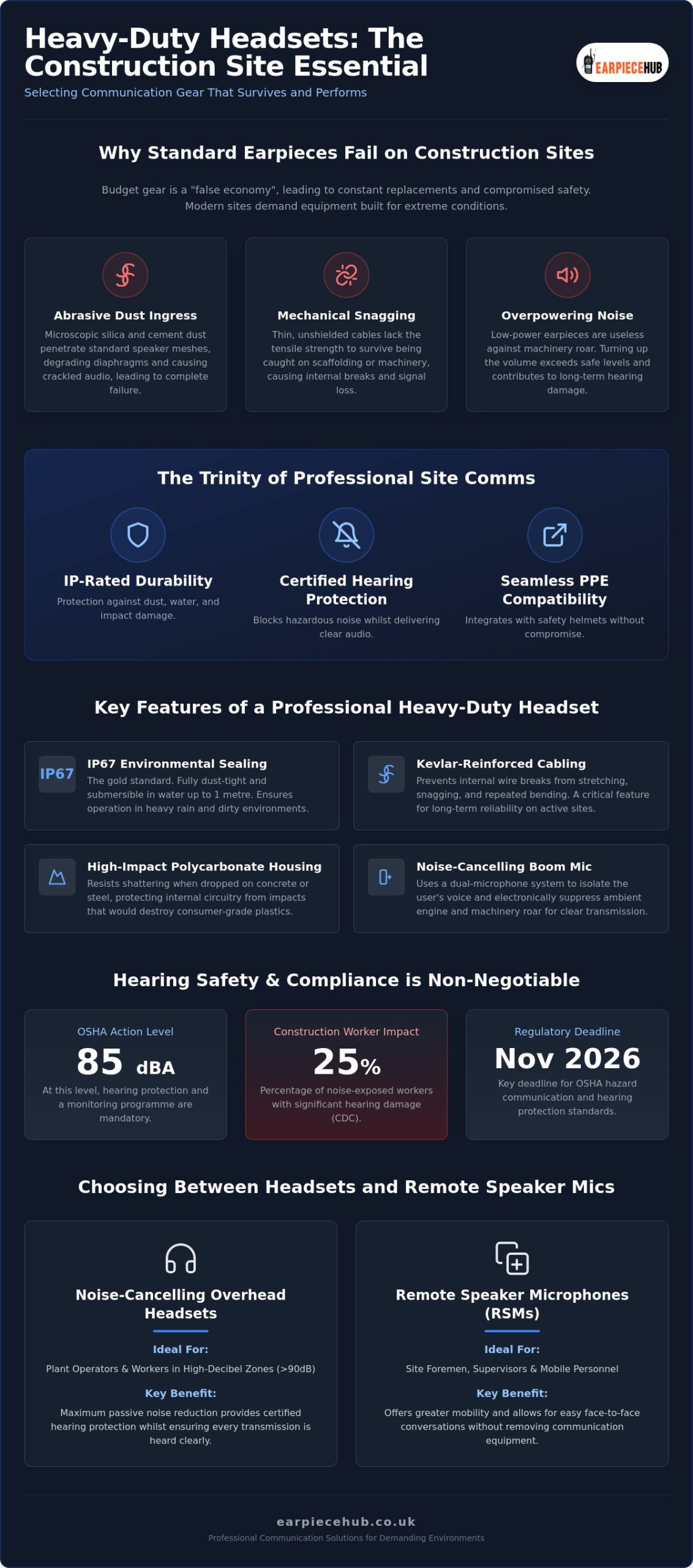
In 2026, a standard earpiece isn’t just a weak link; it’s a safety liability that fails the moment dust hits the circuitry or a jackhammer starts up. Investing in a heavy duty radio headset for construction is no longer optional when you’re managing high-decibel environments and the strict November 2026 OSHA hazard communication deadlines. You need equipment that treats communication as the “Trinity of Site Comms”: IP-rated durability, certified hearing protection, and seamless PPE compatibility.
We understand the frustration of headsets that snap after a week or muffled audio that forces you to remove your ear protection just to hear a command. With OSHA’s action level at 85 dBA, your gear must do more than just relay messages; it must protect your hearing. This guide provides a definitive roadmap to selecting hardware that survives the rigours of the modern site whilst ensuring crystal-clear audio. We’ll explore the technical specifications required for noise-cancelling performance, the importance of impact-rated shells, and how to integrate your comms with safety helmets without compromising protection.
Key Takeaways
- Identify why silica dust and mechanical snagging destroy standard gear and how IP67-rated protection prevents particle ingress.
- Learn how to select a heavy duty radio headset for construction that filters out heavy machinery roar whilst maintaining clear vocal transmission.
- Compare the benefits of noise-cancelling overhead headsets for high-decibel zones against remote speaker microphones for mobile supervisors.
- Master a professional cleaning and storage routine to prevent cable memory breaks and ensure long-term hardware reliability on-site.
- Ensure your communication setup integrates seamlessly with safety helmets to remain compliant with 2026 hearing protection standards.
Why Standard Radio Earpieces Fail on Construction Sites
Standard earpieces designed for quiet retail floors or indoor security teams aren’t built for the abrasive reality of a modern site. Buying budget gear often results in a “false economy” where units are replaced every few weeks. Cement dust and silica particles are microscopic but highly abrasive; they penetrate standard speaker meshes and quickly degrade the internal diaphragm. Once these particles settle, audio becomes crackled and eventually fails entirely.
Cables present another critical failure point. Standard thin wiring lacks the tensile strength to survive snagging on scaffolding, rebar, or heavy machinery. Without reinforced shielding, a single catch can sever the connection or cause internal “memory” breaks that lead to intermittent signal loss. In high-noise environments, low-power earpieces are simply useless. Workers find themselves struggling to hear over the roar of heavy plant machinery, which leads to missed instructions and compromised site safety.
The Reality of Environmental Stress
British construction sites demand gear that survives more than just a light drizzle. Standard equipment often lacks the sealing required to handle horizontal rain or extreme temperature fluctuations. A heavy duty radio headset for construction features ruggedised housing designed to withstand drops onto cured concrete. Without this reinforced casing, a single slip from a workbench or pocket usually ends in a shattered shell and exposed circuitry.
Hearing Protection vs. Communication
There is a significant danger in “turning up” the volume on standard earpieces to overcome background noise. This often exceeds safe decibel levels, contributing to long-term hearing damage. High-quality headsets are classified as Personal Protective Equipment (PPE) because they provide passive noise reduction. Instead of competing with the engine roar, they block out the ambient noise whilst delivering clear audio directly to the ear. This dual-purpose design ensures compliance with 2026 safety standards whilst maintaining a vital communication link amongst the team.
Key Features of a Professional Heavy Duty Headset
Selecting a heavy duty radio headset for construction requires looking beyond the price tag. You need hardware that withstands the grit of a groundworks site. The gold standard for environmental protection is an IP67 rating. This ensures the unit is entirely dust-tight and capable of surviving immersion in water up to one metre deep. It’s the difference between gear that fails after a summer storm and equipment that remains operational for years.
Materials and Construction Quality
Most standard units use cheap ABS plastic. Professional alternatives use high-impact polycarbonate housings. These resist shattering when dropped onto steel or stone. Look for strain relief boots at every connection point. These flexible rubber sleeves prevent the internal copper from snapping at the jack, which is the most common failure point in site comms. Our range of professional-grade radio accessories prioritises these mechanical reinforcements to ensure your investment lasts.
Durability extends to the wiring. Kevlar-reinforced cabling is essential for preventing internal breaks caused by accidental stretching or snagging on scaffolding. On-site efficiency also relies on physical ergonomics. Large, textured Press-to-Talk (PTT) buttons allow operators to transmit clearly without removing thick work gloves, saving time and maintaining safety protocols whilst keeping hands protected.
Audio Performance Standards
High-output speakers are vital when working near plant machinery exceeding 90dB. Clear audio isn’t just about convenience; it’s a safety requirement. CDC statistics on construction worker hearing loss highlight that nearly 25% of noise-exposed workers experience significant auditory damage. Noise cancellation in boom microphones refers to a dual-microphone system that isolates the user’s voice whilst electronically suppressing ambient low-frequency engine roar. This ensures your message gets through without the background noise drowning it out, even in the middle of a busy demolition zone.
Choosing Between Overhead Headsets and Remote Speaker Microphones
Selecting the right heavy duty radio headset for construction depends entirely on your specific role and the ambient noise levels of your work zone. Whilst a plant operator needs maximum isolation, a site foreman requires mobility and the ability to speak with contractors face-to-face. Understanding the mechanical differences between overhead hardware and remote microphones ensures your team remains both safe and productive.
When to Choose an Overhead Headset
For demolition crews or those operating heavy drilling equipment, a noise cancelling overhead headset is the standard choice. These units provide the highest level of passive attenuation. Following CDC guidelines on hearing protection ensures that workers are shielded from harmful decibels without becoming dangerously isolated. Double-muff designs offer maximum protection for the loudest zones, whilst single-muff variants allow for better situational awareness in areas with moving vehicle traffic.
Helmet integration is a vital consideration for site safety. You can choose between behind-the-head (BTH) styles, which use a sprung steel band to sit beneath the rim of a hard hat, or clip-on adapters that attach directly to the helmet’s accessory slots. The BTH style is often preferred for its versatility, as it stays secure even if the helmet is removed during a break. Clip-on versions provide a more integrated feel but require specific adapters compatible with your helmet brand. For those concerned about the physical strain of wearing heavy headgear, you can learn more about neck-strengthening equipment to help improve physical resilience on-site.
The Versatility of Remote Speaker Microphones
Remote Speaker Microphones (RSMs) are the favourite choice for site supervisors and banksmen. An RSM clips to the lapel or shoulder, allowing for quick communication without reaching for a belt-mounted radio. This setup is ideal for those moving frequently across the site who don’t require constant hearing protection. For added privacy or to hear clearly in moderately noisy areas, most RSMs feature a 3.5mm jack for connecting a “listen-only” earpiece.
Compatibility is the final hurdle. Ensure your chosen accessory matches your radio fleet, whether you use Motorola, Hytera, or Kenwood. We offer universal adapters to bridge the gap for mixed-radio fleets, ensuring seamless integration across your entire workforce. Shop our full range of site-ready communication gear to find the perfect fit for your specific role.
Maximising the Lifespan of Your Site Communication Gear
High-performance hardware is a significant investment that requires a disciplined maintenance routine to survive the five-year project lifecycle. A heavy duty radio headset for construction faces constant exposure to abrasive materials that can bypass even the best seals over time. Establishing a daily post-shift inspection prevents minor grit issues from becoming total hardware failures.
Grit removal is your first line of defence. Cement and silica dust act like sandpaper on moving parts. Use a soft-bristled brush or low-pressure compressed air to clear the microphone grilles and PTT housings every evening. Don’t use wet cloths on electrical contact points; instead, use specialised contact cleaners if you notice signal degradation. Proper storage is equally vital. Avoid coiling the wire tightly around the radio body, as this creates “memory” breaks in the internal copper core. Store headsets in loose, natural loops within a ventilated locker.
Battery management shouldn’t be overlooked. If your team uses a Replacement Battery for Motorola DP1400 or Hytera units, ensure they’re cycled correctly. Avoid leaving batteries in chargers for entire weekends, as this leads to capacity loss. For large fleets, using a Six-Way Multi-Unit Charger helps manage these cycles whilst keeping your site office organised; using durable labels from DymoOnline to track battery age and radio assignments further improves site logistics.
Dealing with Dust and Moisture
Horizontal rain is a reality of British site work. After a shift in the wet, wipe down the polycarbonate shells and let the headsets air-dry naturally. Never place them directly on heaters, as this can warp the ear seals. Trapped moisture inside the ear cups leads to internal corrosion and degrades the acoustic drivers, so ensure they’re completely dry before the next morning’s briefing.
Replacement Parts and Maintenance
Even the most rugged gear has consumable components. Replace ear cushions every six months to maintain the certified noise attenuation levels required for HSE compliance. Compressed foam loses its acoustic seal over time, which compromises both audio clarity and worker protection. Keeping spare universal adapters and ear tips on-site prevents unnecessary downtime when a small component eventually wears out. Browse our full range of heavy duty headsets and accessories to keep your communication fleet in peak condition.
Equip Your Team for the Modern Site
Maintaining clear communication on a 2026 construction site isn’t just about convenience; it’s a fundamental pillar of site safety. By prioritising IP67-rated durability and noise cancellation, you ensure your team remains protected whilst staying connected in the most demanding environments. The right gear eliminates the “false economy” of budget replacements. Whether you need maximum isolation or supervisor mobility, technical specification matters.
As a specialist UK supplier since 2015, Earpiece Hub provides the expert support and ruggedised hardware needed for Motorola, Hytera, and Kenwood fleets. Don’t let dust, moisture, or engine roar compromise your operations. We offer Next Day Delivery across the UK for all urgent requirements. Investing in a high-quality heavy duty radio headset for construction is the most effective way to secure your communication infrastructure for the long term.
Shop our range of Heavy Duty Construction Headsets
Stay safe and keep the conversation clear.
Frequently Asked Questions
Can I use a heavy duty headset with a safety helmet?
Yes, you can integrate these headsets with safety helmets using either clip-on adapters or behind-the-head (BTH) bands. Clip-on versions attach directly to the helmet’s side accessory slots for a fixed, integrated fit. Behind-the-head styles feature a sprung steel band that sits beneath the helmet rim, allowing you to remove your hard hat whilst keeping your comms secure and operational.
What is the difference between noise-cancelling and noise-isolating headsets?
Noise-cancelling technology is primarily built into the microphone to filter out background engine roar, ensuring your voice remains clear to other users. Noise-isolating refers to the physical ear muffs that block out ambient sound to protect your hearing. A professional heavy duty radio headset for construction combines both features to provide clear communication whilst meeting safety standards for noise attenuation in 90dB+ zones.
Are these headsets compatible with my existing Motorola or Kenwood radios?
Professional headsets are manufactured with specific connectors to match major radio brands like Motorola, Hytera, and Kenwood. It’s vital to select the correct plug for your specific radio model to ensure the Press-to-Talk (PTT) button functions correctly. If you operate a mixed fleet, universal adapters are available to ensure your headsets can be shared amongst different radio types without issue.
How do I know if a headset is truly ‘heavy duty’ for construction?
A genuine heavy duty unit is identified by its IP rating and construction materials. Look for an IP67 rating, which ensures the headset is entirely dust-tight and waterproof. Industrial units also use high-impact polycarbonate housings instead of standard plastics and feature Kevlar-reinforced cabling. These specifications ensure the hardware survives the abrasive dust and physical impacts common on a modern building site.
What happens if the cable on my headset gets snagged or broken?
If a cable is severed, the headset will typically require a professional repair or a replacement lead assembly. Most high-end headsets use reinforced shielding and strain relief boots to prevent these breaks during accidental snags on scaffolding or machinery. Regular inspections for frayed outer jackets are recommended to catch potential failures before they lead to a total loss of signal during a shift.
Do I need a licence to use these headsets on a construction site?
You don’t need a licence for the headset itself, but the two-way radios they connect to may require one. In the UK, professional high-power radios usually require an Ofcom licence to operate on coordinated frequencies. Licence-free (PMR446) radios are an alternative for smaller sites, but they have lower power and shorter range. Always verify your radio fleet’s legal requirements to ensure site-wide compliance.
