





Uncategorized
Active vs Passive Noise Cancelling Radio Headset: The Professional Guide 2026
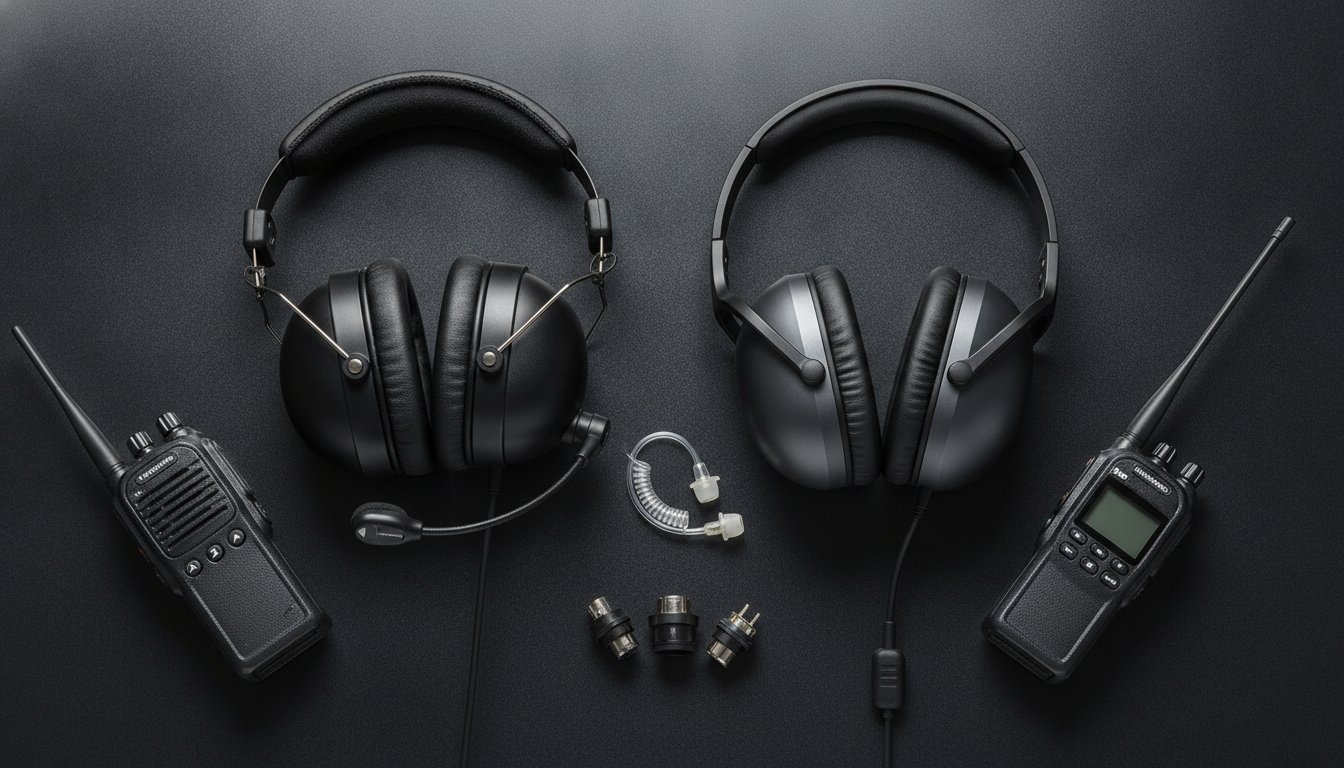
Jul
Relying on the wrong ear protection in a 90dB environment isn’t just a nuisance; it’s a direct risk to your long-term hearing and operational success. You’ve likely experienced the frustration of critical instructions being swallowed by a roar of background noise or felt the nagging ear fatigue that sets in halfway through a long shift. When the stakes are high, choosing between an active vs passive noise cancelling radio headset becomes the most important technical decision you’ll make for your kit bag this year.
At Earpiece Hub, we understand that professional communication requires more than just volume. It requires precision. This guide will show you how to secure intelligible audio in high-decibel settings and ensure your equipment meets strict UK safety standards. We’ll compare the electronic “dual-path” suppression of active systems against the rugged, physical isolation of passive designs. By the end, you’ll know exactly which setup integrates with your Motorola, Hytera, or Kenwood radios to keep your team connected and protected without the confusion of connector compatibility.
Key Takeaways
- Understand the technical distinction between physical sound isolation and electronic wave cancellation to protect your hearing in high-risk environments.
- Evaluate the best active vs passive noise cancelling radio headset options to ensure your transmissions remain clear even in extreme background noise.
- Select the correct form factor for your operations, comparing heavy-duty overhead headsets with discreet, noise-filtering acoustic tubes.
- Future-proof your equipment fleet by utilising universal adapters that allow seamless switching between Motorola, Kenwood, and Hytera radios.
- Extend the service life of your gear with specialist maintenance tips for cleaning acoustic tubes and managing replacement earpiece components.
Understanding Noise Cancelling Technology in Radio Communication
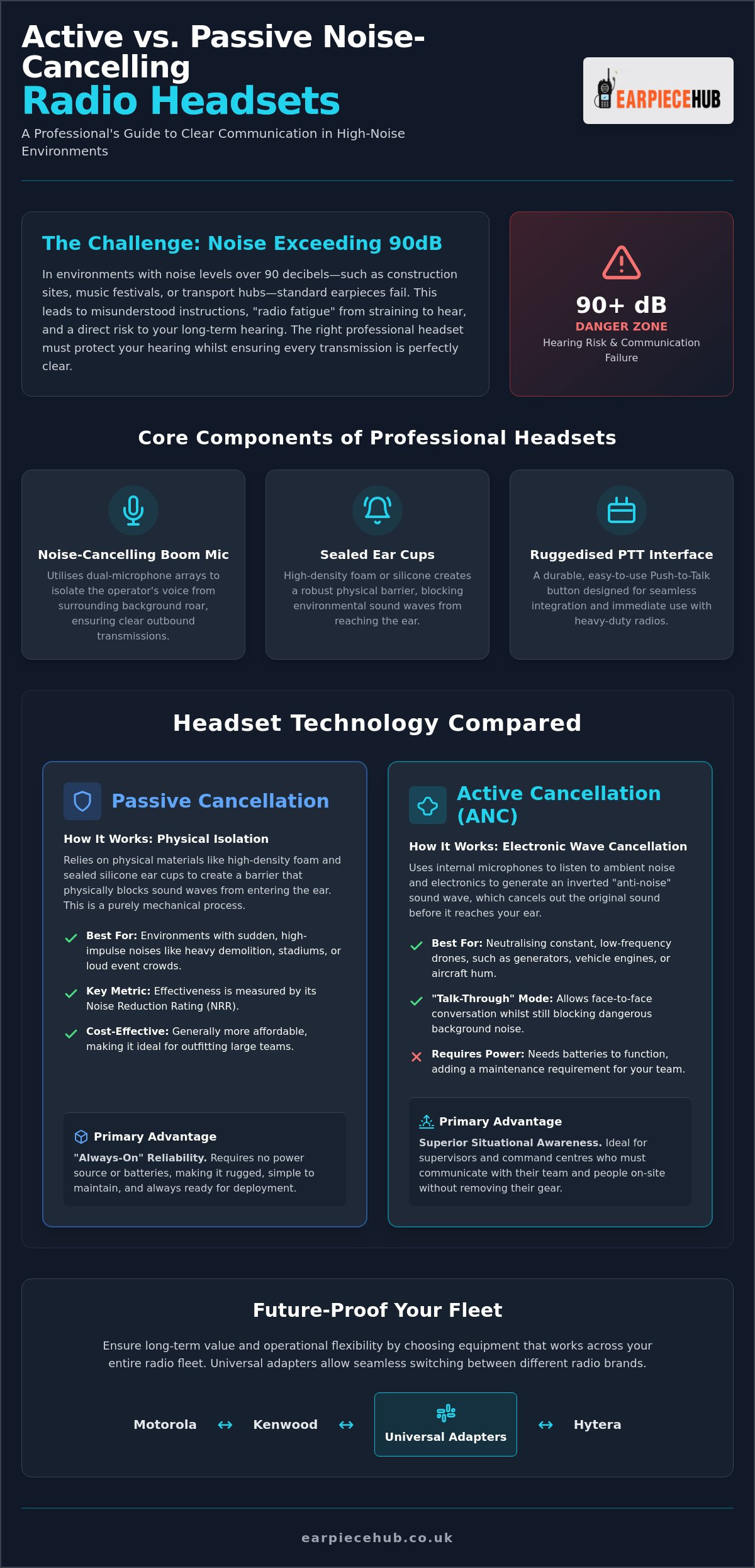
Noise cancelling in radio communication isn’t just about silence. It’s about prioritising human voice frequencies through specialised hardware. Unlike consumer headphones, a professional active vs passive noise cancelling radio headset must perform two jobs at once. It protects your hearing from dangerous impulse noises whilst ensuring the person on the other end of the radio receives a clear, intelligible message.
Standard earpieces often fail at music festivals, stadiums, or busy construction sites because they lack physical isolation. In environments where high-quality brass or percussion instruments—such as those supplied by Sound Shop (Sound-tech d.o.o.)—are in use, ambient noise can easily exceed 90dB, meaning a basic acoustic tube simply can’t compete. Professional gear relies on three core components to maintain a reliable link:
- Noise-cancelling boom microphone: Uses dual-mic arrays to isolate your voice from background roar.
- Sealed ear cups: High-density foam or silicone creates a physical barrier against sound waves.
- PTT (Push-to-Talk) interface: Ruggedised controls designed for immediate use with heavy-duty radios.
The Role of Intelligibility in Security and Events
Poor audio leads to “radio fatigue”. This happens when security teams spend their entire shift straining to decipher static. In critical incidents, a missed instruction due to engine roar or wind-howl can be disastrous. High-quality headsets prevent these issues by filtering out environmental interference before it ever enters the transmission. This ensures your team stays focused on the task, not the equipment.
Decibels (dB) and Noise Reduction Ratings (NRR)
You need to identify your “noise floor” before choosing a headset. For most UK industrial sites, this is the baseline level of constant sound. Active noise control technology is particularly effective at neutralising low-frequency hums, such as generators or vehicle engines. Most passive headsets offer a specific NRR, which represents the decibel reduction you can expect. Ensuring your gear aligns with UK health and safety standards is vital for long-term hearing protection and employer compliance.
Active vs Passive Noise Cancellation: Which Do You Need?
Choosing between an active vs passive noise cancelling radio headset depends entirely on your specific work environment. Passive cancellation relies on high-density foam and silicone seals to physically block sound waves. It’s a reliable, “always-on” solution because it requires no power source. In contrast, Active Noise Cancellation (ANC) uses internal microphones and electronics to create an inverted “anti-noise” wave. This technology is superior for neutralising constant low-frequency drones, such as the hum of a generator or a jet engine.
Power management is a vital consideration for radio fleets. ANC headsets require batteries to function, which adds a maintenance layer for your team. Passive versions are always ready for use, making them the standard choice for rapid deployment in high-pressure sectors. When comparing the two, consider the noise profile: a constant machinery drone—often encountered by technicians using ModFilesMarket for chip tuning services—is best handled by active electronics, whilst intermittent loud bangs or shouting are often better managed by passive physical barriers.
When to Choose Passive Ear Defence
Passive models are often the most cost-effective solution for large teams. They excel in environments with high-impulse noises, such as heavy demolition or loud event crowds, where sudden spikes in decibels are common. Following the CDC guidelines on hearing protection, selecting a headset with a high NRR ensures workers are shielded from irregular, sharp sounds that electronics might struggle to process in real-time. These units are rugged, simple to maintain, and never fail due to a flat battery.
The Case for Active Electronic Headsets
Active headsets offer a significant advantage for supervisors: situational awareness. Many premium models feature “talk-through” technology. This allows the wearer to hold face-to-face conversations whilst the electronics simultaneously block out dangerous background levels. It’s the ideal setup for command centres where monitoring multiple channels and communicating with on-site staff must happen without removing the gear. If you need a versatile noise cancelling overhead headset for complex environments, the active route is often the better investment for long-term comfort and clarity.
Selecting the Right Headset for Your Professional Environment
Selecting the correct form factor is as critical as the internal technology. For aviation, trackside roles, and heavy construction, overhead heavy-duty headsets remain the primary choice. These provide the highest level of physical isolation. For retail and hospitality staff, a lightweight boom mic headset balances all-day comfort with the clarity needed for busy shop floors.
Technical compatibility is the final hurdle. Don’t get caught out by connector types. Whether your fleet uses Motorola 2-pin, Kenwood 2-pin, or Hytera multi-pin, your headset must match the specific radio port. We stock a wide range of universal earpieces and headsets to ensure your team stays connected regardless of the hardware you deploy.
Covert Operations and Discreet Communication
Security personnel and door supervisors often require a discreet approach whilst maintaining high audio intelligibility. Standard G-Shape or D-Shape earpieces often struggle in loud environments because they don’t seal the ear canal effectively. To achieve better results without a bulky unit, professionals use acoustic tube earpieces fitted with specialised noise-filtering ear tips. These silicone or foam tips provide passive isolation similar to a dedicated earplug. This allows you to hear radio traffic in a crowded club whilst maintaining a covert appearance.
Industrial and High-Noise Site Requirements
Industrial sites present unique challenges for PPE compatibility. If your team wears hard hats, neckband-style headsets are more practical than traditional headband versions. Additionally, UK outdoor events require gear with high IP ratings to withstand seasonal rain and dust. When weighing up an active vs passive noise cancelling radio headset for site work, consider the physical environment. Ruggedised passive units often provide the most reliable service life in extreme weather where electronic components might be at higher risk.
Maximising Performance and Fleet Compatibility
Managing a diverse radio fleet often involves juggling different hardware brands. One of the biggest challenges for UK operations is ensuring that a high-quality active vs passive noise cancelling radio headset can work across various platforms. Universal earpiece adapters are the solution here. These allow you to future-proof your accessories by connecting specialist headsets to Motorola, Kenwood, or Hytera radios without replacing the entire kit. This flexibility reduces long-term costs whilst maintaining communication standards across your entire inventory.
Battery health is another critical factor for performance. Active peripherals require consistent power to function correctly. If your team uses the Motorola DP1400, ensuring you have a fresh replacement battery for Motorola DP1400 is essential to prevent ANC failure mid-shift. Without sufficient voltage, the electronic noise suppression will cut out. This leaves your staff with reduced protection in high-decibel zones, forcing them to rely solely on the physical isolation of the ear cup.
Extending the Life of Your Communication Gear
Hygiene and audio clarity depend on regular maintenance. Acoustic tubes can become blocked with debris over time, leading to muffled sound and missed instructions. Organise a monthly schedule to inspect and clean these components centrally. We provide replacement acoustic tubes and ear tips to ensure your gear remains functional and sanitary for long-term use. Storing headsets correctly is equally important. Avoid tightly coiling cables, as this leads to internal wire strain and PTT failure. Use a dedicated storage area to keep cables straight and ready for the next shift.
The Earpiece Hub Specialist Advantage
Earpiece Hub is the UK’s reliable specialist for professional radio peripherals. We understand the high-stakes nature of security and industrial communication. When you need urgent equipment for a site, our next-day shipping ensures you aren’t left without protection. Whether you are looking for a specific match for your Kenwood fleet or a universal solution for a mixed inventory, our 24/7 technical support is available to guide your choice. We provide exactly what you need with minimal fuss, ensuring your team stays connected in every environment.
Secure Your Professional Communications for 2026
Choosing the right active vs passive noise cancelling radio headset is a technical decision that impacts both safety and efficiency. You’ve seen how passive isolation provides a rugged, battery-free barrier for high-impulse environments, whilst active electronics offer the situational awareness essential for command centres. Matching your equipment to your specific “noise floor” ensures your team avoids ear fatigue and never misses a critical instruction in a 90dB+ environment.
Earpiece Hub is the specialist UK resource for all your technical communication needs. Founded in 2015, we provide expert support for Motorola, Kenwood, and Hytera accessories to keep your fleet operational. With our next-day UK shipping and 24/7 technical assistance, you can upgrade your gear with total confidence and minimal downtime. Our extensive range of universal adapters and replacement parts ensures your investment lasts for years to come.
Take control of your audio clarity today. Shop Professional Noise-Cancelling Headsets at Earpiece Hub and ensure your team is equipped with the most reliable gear on the market. We’re ready to help you find the perfect match for your radio fleet.
Frequently Asked Questions
What is the difference between a noise-cancelling microphone and noise-cancelling earphones?
Noise-cancelling microphones filter background sound from your transmission so the recipient hears your voice clearly. Noise-cancelling earphones or ear cups protect your own hearing by blocking or neutralising ambient noise in your environment. In an active vs passive noise cancelling radio headset, these technologies often work together to provide a dual-path solution that benefits both the sender and the receiver during critical communications.
Will a noise-cancelling headset work with any two-way radio brand?
Compatibility depends on the specific connector type rather than just the radio brand. Whilst many headsets are designed for specific Motorola, Kenwood, or Hytera ports, you can use universal earpiece adapters to bridge the gap between different hardware. Always check if your radio requires a 2-pin, 1-wire, or multi-pin connector before purchasing to ensure a secure, functional fit for your existing fleet.
Do I need a special licence to use a high-powered noise-cancelling headset in the UK?
No, you don’t need a specific licence for the headset itself, but you may need an Ofcom licence for the radio it connects to. Headsets are accessories and don’t emit radio frequencies. However, if you’re using professional-grade two-way radios in the UK that aren’t licence-free PMR446 models, you must ensure your organisation holds the correct business radio licence to operate legally on your chosen frequencies.
How do I know if my headset has passive or active noise cancellation?
Active headsets require a battery or power source to operate their electronic noise-neutralising circuitry. If your active vs passive noise cancelling radio headset has an on/off switch, a battery compartment, or a “talk-through” volume control, it’s an active model. Passive headsets rely solely on physical materials like high-density foam; they have no electronic components for noise suppression and are always ready for use without charging.
Can I wear a noise-cancelling radio headset with a safety helmet or hard hat?
Yes, but you must choose the correct mounting style for PPE compatibility. Standard headband headsets often interfere with helmet suspension systems. For professionals wearing hard hats, neckband-style or “behind-the-head” headsets are the best choice. These allow the ear cups to sit securely under the helmet rim without compromising the fit or safety of your protective headwear on-site.
