





Uncategorized
The Ultimate Warehouse Communication Headset Buying Guide (2026)

Jul
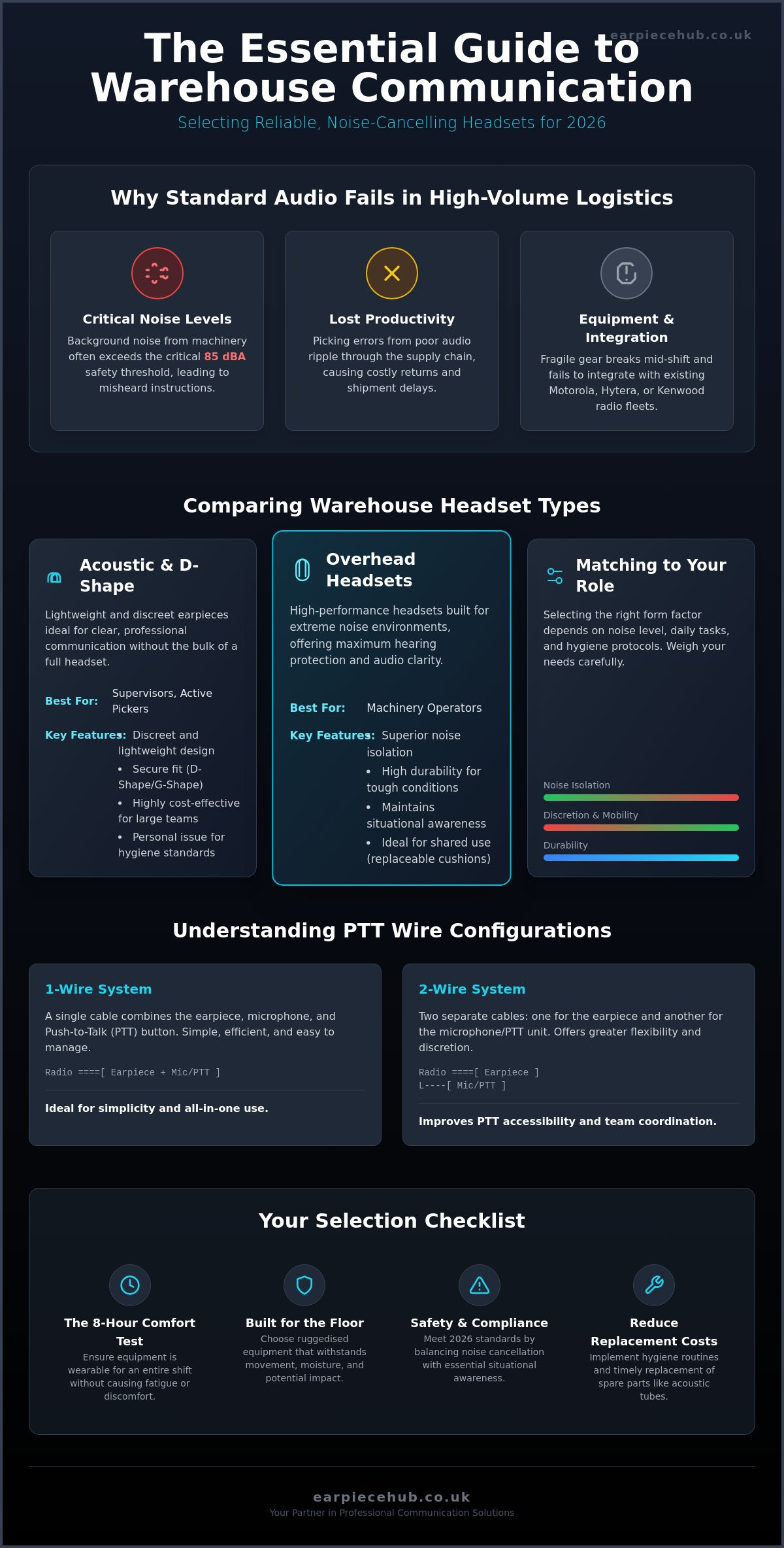
A single misheard instruction in a high-volume distribution centre can cost your operation thousands in lost productivity and safety risks. You already know that standard audio gear often fails when the background noise of forklifts and automated systems hits that critical 85 dBA threshold. It’s incredibly frustrating when fragile equipment breaks mid-shift or refuses to integrate with your existing Motorola, Hytera, or Kenwood radio fleet; leaving your team disconnected and vulnerable.
Finding the right warehouse communication headset doesn’t have to be a gamble or a drain on your budget. This guide will show you how to select reliable, noise-cancelling solutions that prioritise both team safety and long-term durability. We will break down the essential technical specifications you need to consider for 2026, from 1-wire configurations to specialist overhead designs. You’ll discover how to achieve crystal clear audio in the loudest environments whilst ensuring your team stays comfortable from the first hour to the twelfth.
Key Takeaways
- Learn how clear audio reduces picking errors and ensures your distribution centre meets essential safety standards.
- Compare the benefits of different form factors to find the ideal warehouse communication headset for your specific noise levels and operational needs.
- Understand the technical differences between 1-wire, 2-wire, and 3-wire systems to improve PTT accessibility and team coordination.
- Apply the 8-hour comfort test to ensure your chosen equipment remains wearable throughout an entire shift without causing fatigue.
- Reduce replacement costs by implementing a maintenance routine focused on hygiene and the timely use of spare acoustic tubes or ear tips.
Why Effective Warehouse Communication Headsets Are Essential for Logistics
Precision is everything in modern distribution. A warehouse communication headset is not just a peripheral; it is the primary tool for real-time coordination and staff safety. These specialised communication headsets bridge the gap between management and the floor, turning a sprawling facility into a synchronised operation. By providing a direct line of contact, they allow teams to relay critical data without pausing their physical workflow.
Clear audio directly impacts the bottom line. When a picker hears a SKU or shelf location incorrectly due to background noise, the resulting picking error ripples through the entire supply chain. High-quality audio ensures that instructions are understood the first time; reducing the costs associated with returns and mis-shipments. Reliability is key here. If the audio fails, the process stalls.
Constant background drone from conveyor belts and heavy machinery creates significant cognitive load. Professional headsets filter these frequencies; protecting workers from hearing fatigue during long shifts. The integrated Push-to-Talk (PTT) button is another vital feature. It prevents “hot mic” situations where accidental transmissions clutter the radio channel. This keeps the airwaves clear for essential traffic only.
The Impact on Operational Efficiency
Reducing “dead time” is a priority for any logistics manager. Instead of walking across a massive facility to locate a supervisor, staff use their warehouse communication headset to get instant answers. This streamlines vehicle movements, such as forklifts and HGVs, by providing bay updates in real time. When equipment fails or a spillage occurs, the response is immediate; preventing minor hitches from becoming major bottlenecks.
Safety and Compliance Considerations
Safety is non-negotiable on the warehouse floor. As of 2026, OSHA standards require hearing protection programs when noise exposure averages 85 dBA. Specialist headsets must balance noise cancellation with situational awareness. Workers need to hear their radio clearly whilst remaining alert to ambient safety sirens and forklift alarms. Ruggedised equipment that meets these health and safety standards reduces the risk of accidents caused by shouting or misunderstood instructions. Using the right gear ensures your team stays protected and your facility remains compliant.
Comparing Warehouse Headset Types: From Acoustic Tubes to Overhead
Selecting the right warehouse communication headset requires matching the specific form factor to the user’s daily tasks. Logistics environments are diverse. A supervisor coordinating a loading bay has different requirements than a technician operating a high-decibel sorting machine. Choosing the wrong style leads to discomfort, dropped equipment, and wasted investment. Managers must weigh the need for discreet communication against the necessity for maximum noise attenuation.
Durability is a non-negotiable factor. Equipment on the warehouse floor faces constant movement, moisture, and potential impact. Whilst overhead models offer robust protection and long-term resilience, in-ear styles provide the lightweight agility required for active pickers. Hygiene also dictates the choice of form factor. Shared equipment should ideally be overhead with replaceable cushions or covers. In contrast, in-ear pieces like acoustic tubes are strictly personal issue to maintain sanitary standards amongst the workforce.
Acoustic Tube and D-Shape Earpieces
Acoustic Tube Earpieces are the industry standard for supervisors and managers. They are discreet and lightweight; allowing for professional communication without the bulk of a full headset. For more active workers moving stock or operating forklifts, D-Shape and G-Shape earpieces offer a more secure fit. The G-shape, for instance, provides a firm loop that stays in place even during rapid head movements. These styles are the most cost-effective choice for large-scale teams. They provide reliable performance at a fraction of the cost of complex DECT systems that can often exceed £300 per unit. You can browse our full range of compatible earpieces to find the right fit for your radio fleet.
Noise-Cancelling Overhead Headsets
When noise levels spike near conveyor systems or heavy plant machinery, standard in-ear models may not provide sufficient isolation. High-performance overhead headsets are designed for these extreme environments. They must align with the OSHA occupational noise exposure standard to ensure long-term worker safety in areas exceeding 85-90 dBA. Managers can choose between Double-ear (Duo) configurations for maximum isolation or Single-ear (Mono) versions. The Mono style is particularly useful for workers who need to hear radio traffic whilst maintaining awareness of ambient sounds like forklift hooters. Professional features like padded headbands and replaceable ear cushions are essential for equipment to survive the “8-hour test” of a standard warehouse shift.
Technical Configurations: Understanding 1-Wire, 2-Wire, and 3-Wire Systems
Managers often find the technical jargon surrounding radio accessories confusing. In the world of the warehouse communication headset, the term “wire” simply refers to the number of separate cables branching from the radio connector. Understanding this distinction is vital for selecting equipment that won’t hinder your team’s physical movement. While many consumer-focused guides push wireless Bluetooth alternatives, these often lack the ruggedness required for industrial use. Professional wired systems remain the gold standard for reliability because they don’t suffer from pairing drops or battery failure in the middle of a shift.
Durability is a primary concern in logistics. Standard cables easily snag on pallet racking or forklift controls. You should look for equipment with reinforced cabling, often featuring Kevlar lining, to withstand the daily rigours of the floor. This technical choice ensures your fleet stays operational longer; reducing the total cost of ownership. You can find robust, industry-ready solutions at earpiecehub.co.uk to suit any warehouse environment.
1-Wire and 2-Wire Earpiece Setups
The 1-Wire system is the most straightforward configuration. It features a single lead that runs from the radio to the earpiece, with the microphone and Push-to-Talk (PTT) button housed in a single inline unit. It’s the ideal choice for general warehouse staff who need a simple, no-fuss solution. These are quick to issue and easy for staff to manage during busy periods.
A 2-Wire system offers more flexibility. It splits into two separate leads: one for the earpiece and another for the combined mic and PTT button. This allows workers to run the PTT lead down their sleeve or clip the microphone to their lapel. It’s a superior setup for staff who frequently use their hands and need the PTT button in a more accessible location than the chest. Ensuring these devices align with OSHA hearing protection standards is essential; as professional-grade wired kits provide the consistent audio levels required for compliance.
Specialised 3-Wire and Covert Options
For maximum customisation, 3-Wire systems provide separate leads for the earpiece, microphone, and PTT button. This configuration is often favoured by warehouse security or loss prevention teams who require a “covert” setup. By separating the PTT button, a user can hide it in a pocket or palm it for discreet transmissions without reaching for their collar.
Compatibility is the final hurdle. High-quality 3-wire kits must be specifically matched to your radio’s connector type. Whether you’re using Motorola multi-pin connectors, Hytera interfaces, or Kenwood 2-pin setups, the connection must be secure and weatherproof. Investing in the correct technical configuration ensures your warehouse communication headset fleet integrates seamlessly with your existing hardware without the need for unreliable adapters.
Choosing the Right Headset for Your Environment
Pragmatic procurement starts with a noise audit. You don’t need a high-cost noise-cancelling unit for a staff member working in a quiet packing station. It’s an unnecessary expense that can lead to worker isolation. Conversely, a lightweight earpiece will fail completely near a high-speed conveyor or in a busy loading bay. Your choice of warehouse communication headset must mirror the decibel levels of the specific work zone to be effective.
Comfort is the second pillar of selection. We call this the “8-hour test.” If a headset pinches or causes ear fatigue after two hours, it will likely be discarded or worn incorrectly by the end of the shift. Look for ergonomics like adjustable headbands and soft silicone ear tips that allow for all-day wear. Durability matters too. Equipment in logistics faces constant vibration, dust, and moisture. Prioritise components with IP-rated protection and Kevlar-reinforced cables to prevent internal wire breakage from repeated snagging on racking or machinery.
Matching Headsets to Noise Levels
- Low Noise (Offices/Packing): Lightweight D-shape or acoustic tubes are ideal here. They provide enough clarity for coordination without isolating the wearer from their immediate surroundings.
- Medium Noise (General Warehouse): G-shape earpieces or single-ear (mono) overheads work best. These allow workers to hear radio traffic whilst maintaining situational awareness of forklift movements.
- High Noise (Loading Bays/Machinery): Dual-ear (duo) noise-cancelling overhead headsets are essential. These provide the physical barrier and electronic filtering needed to protect hearing and ensure message reception.
Connector Compatibility and Adapters
The most common procurement mistake is ignoring the radio connector. There is no such thing as a truly “universal” headset without the correct pin layout. A Motorola DP1400 uses a specific interface that is entirely incompatible with a Kenwood 2-pin or a Hytera connection. Always identify your radio model before ordering to avoid the frustration of returns and technical downtime. Small details, such as the difference between a multi-pin and a 2-pin plug, determine whether your fleet is operational or idle.
If you are currently transitioning between radio brands, universal earpiece adapters are a cost-effective solution. They allow you to keep using your existing headsets whilst upgrading your handheld radio fleet. This staged approach protects your budget and ensures communication continuity across the floor. Shop our range of radio-specific connectors to ensure your equipment is perfectly matched to your radio fleet.
Optimising Your Communication Fleet: Maintenance and Accessories
Longevity depends on post-purchase care. A warehouse communication headset is a precision tool that requires routine upkeep to remain reliable in a demanding logistics environment. Managers should adopt a “preventative maintenance” mindset rather than a “run-to-fail” approach. This strategy reduces technical downtime and ensures that equipment doesn’t become a bottleneck during peak seasonal periods. Effective fleet management is about more than just buying the right gear; it’s about protecting that investment through proper handling and part replacement.
Staff training is your first line of defence against equipment failure. Most cable breakages occur at the connector pin or the strain relief point due to improper storage. Instruct your team to avoid wrapping cables tightly around the radio body; as this causes internal wire fatigue and eventual failure. Instead, encourage the use of lapel clips to manage cable slack. This simple habit prevents wires from snagging on conveyor belts or pallet racking whilst workers are in motion.
Hygiene and Replacement Parts
Hygiene is a critical factor for workforce health and equipment performance. Shared earpieces are a primary vector for ear infections and skin irritation. Managers should issue personal Replacement Acoustic Tubes and Ear Tips to every staff member to maintain sanitary standards. Over time, acoustic tubes will discolour and harden due to moisture and wax buildup; which significantly degrades audio clarity. Replacing these components every 3 to 6 months is a low-cost way to maintain “like-new” performance across your entire fleet.
Cleaning sensitive microphones requires a precise approach. Use alcohol-free wipes on the earpieces and PTT buttons at the end of every shift. You must avoid spraying liquid cleaning agents directly into the microphone port; as this can ruin the internal transducer. Keeping a “must-have” stock of spares—including lapel clips, ear tips, and spare tubes—ensures your team remains vocal without waiting for new shipments to arrive.
Batteries and Charging Infrastructure
Audio failure is often misdiagnosed as a headset issue when the radio battery is actually the culprit. A Replacement Battery for Motorola DP1400 ensures that handhelds provide consistent voltage throughout a full 12-hour shift. As batteries age, their internal resistance increases; leading to “choppy” audio transmissions or reduced signal range. If your team reports communication drops during the final hours of a shift, it’s a clear sign that your power cells need refreshing.
Charging logistics are just as vital as the headsets themselves. A Six-Way Multi-Unit Charger is an essential asset for large-scale teams. It centralises your communication hub; allowing for rapid inventory checks at the start and end of every workday. These units provide more stable charging cycles than individual wall plugs; which helps extend the overall lifespan of your radio batteries. By treating your communication gear as a managed fleet of assets, you ensure your warehouse operation remains efficient and safe.
Equip Your Distribution Centre for Peak Performance
Selecting the right warehouse communication headset is a strategic decision that balances technical compatibility with your specific environment. By matching noise-cancelling overhead models to high-decibel zones and utilising lightweight earpieces for coordination, you ensure your team remains safe and productive. Remember that durability isn’t just about the initial build; it’s about a consistent maintenance routine for batteries and replacement parts to prevent technical downtime.
Earpiece Hub acts as a central resource for all your communication peripherals. We are UK-based specialists providing next-day shipping and guaranteed compatibility with Motorola, Hytera, and Kenwood radios. With our 24/7 technical support, your radio fleet will stay operational through every shift. Browse our full range of professional warehouse headsets at Earpiece Hub and discover the difference that specialist equipment makes to your bottom line. Equip your team with confidence and keep your logistics operation moving forward without interruption.
Frequently Asked Questions
Do warehouse headsets work with any two-way radio?
No, headsets are not universal and must match the specific pin layout of your handheld radio. Each manufacturer, such as Motorola, Hytera, or Kenwood, uses a unique connection interface. Always verify your radio model before purchasing to ensure a secure and functional fit. Using the wrong connector can lead to audio failure or damage to the radio’s accessory port.
What is the difference between a 1-wire and a 2-wire warehouse earpiece?
The primary difference is the cabling configuration for the microphone and Push-to-Talk (PTT) button. A 1-wire system uses a single lead for all functions; making it the simplest choice for general floor staff. A 2-wire system features separate leads for the earpiece and the combined mic/PTT unit. This allows workers to run the PTT lead down a sleeve for more discreet or accessible operation.
How do I know if a headset is noise-cancelling?
Look for a certified Noise Reduction Rating (NRR) and Environmental Noise Cancellation (ENC) technology in the specifications. A professional warehouse communication headset will often feature dual-ear padded cups to physically block ambient sounds near heavy machinery. These devices help your facility remain compliant with safety standards when noise levels exceed the 85 dBA action level.
Can I use a Bluetooth headset in a warehouse?
You can use Bluetooth 5.4 headsets, but they often lack the industrial ruggedness of wired radio accessories. Wireless models require frequent charging and can suffer from pairing drops in environments with high electronic interference. For demanding 12-hour shifts, a wired warehouse communication headset remains the more reliable choice for consistent team coordination and durability.
How often should I replace the acoustic tubes on our headsets?
We recommend replacing acoustic tubes every 3 to 6 months depending on the intensity of use. Over time, moisture and wax buildup will harden the plastic; which significantly muffles audio clarity. Regular replacement is a low-cost maintenance task that ensures your team hears every instruction clearly without the need to replace the entire earpiece assembly.
What is the best headset for someone operating a forklift?
Single-ear (mono) overhead headsets or G-shape earpieces are the best choices for forklift operators. Drivers must maintain situational awareness to hear safety sirens and vehicle hooting whilst receiving radio traffic. A mono design provides clear audio in one ear whilst leaving the other free to monitor the immediate environment for potential hazards.
Are there headsets compatible with Motorola DP1400 radios?
Yes, specialist accessories are designed specifically for the Motorola DP1400 connector type. This includes acoustic tube earpieces, D-shape loops, and replacement batteries that ensure full-shift performance. Using radio-specific gear ensures a stable connection and prevents the intermittent audio issues often associated with generic or poorly fitted universal adapters.
How can I keep shared headsets hygienic for multiple staff members?
Hygiene is best managed by issuing personal ear tips and acoustic tubes to each individual staff member. For shared overhead headsets, use replaceable ear cushions and clean the equipment with alcohol-free wipes at the end of every shift. You should avoid spraying cleaning liquids directly into the microphone ports; as this will cause permanent damage to the sensitive internal components.
