





Uncategorized
Retail Store Two-Way Radio Headset Guide: Choosing the Best Audio for Your Team in 2026
Jul
The most expensive radio on the market is practically useless if your staff refuse to wear the earpiece because it’s uncomfortable. In the high-pressure retail environment of 2026, a high-quality retail store two way radio headset is the difference between a coordinated team and a chaotic shop floor. You already know that clear communication is the backbone of great customer service. However, finding equipment that doesn’t cause ear fatigue during an eight-hour shift remains a constant struggle for many managers.
This guide will help you identify the perfect audio solutions to improve staff coordination and ensure discreet, professional communication. We’ll explain how to match the correct connectors to your Motorola and Kenwood models whilst ensuring your gear survives the daily wear and tear of a busy shop. From understanding the benefits of acoustic tubes to selecting durable G-shape or D-shape earpieces, you’ll discover how to cost-effectively replace broken peripherals without sacrificing audio clarity or team comfort.
Key Takeaways
- Eliminate disruptive “radio blare” on the shop floor to maintain a professional atmosphere whilst keeping your team instantly connected.
- Identify the unique benefits of G-shape, D-shape, and acoustic tube styles to choose the most comfortable retail store two way radio headset for long shifts.
- Navigate the “connector minefield” by learning the technical differences between Motorola M1 and M12 plugs to ensure total fleet compatibility.
- Tailor your audio equipment to specific staff roles to improve equipment durability and prevent ear fatigue during busy periods.
- Discover why choosing a specialist peripheral provider ensures better technical support and more cost-effective replacement of broken equipment.
Why Retail Store Two-Way Radio Headsets are Essential for Modern Shops
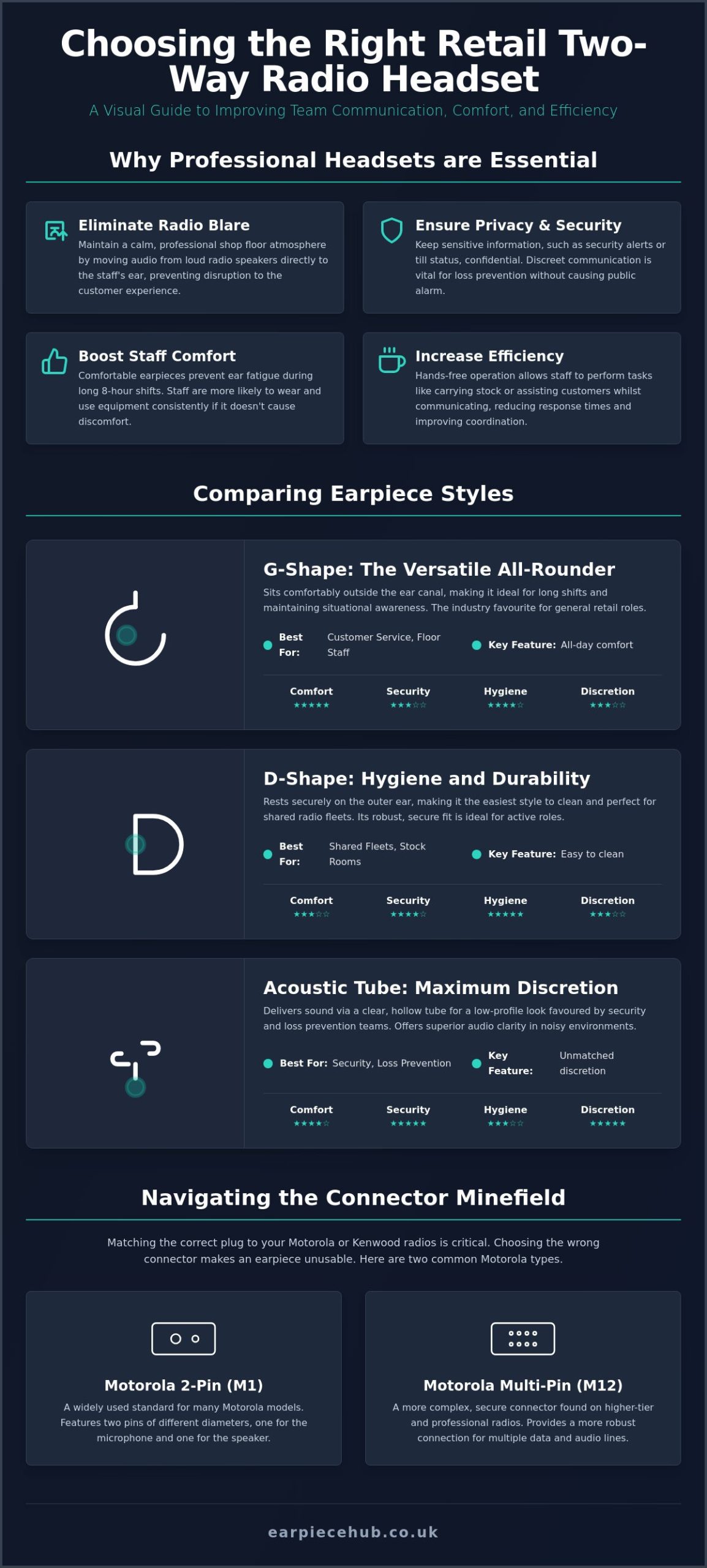
In a high-stakes retail environment, the radio is your engine, but the earpiece is the user experience. A retail store two way radio headset serves as the critical interface for hands-free, discreet team coordination. Relying on the built-in speaker of a handheld unit is no longer viable in 2026. Constant “radio blare” and static bursts disrupt the customer shopping experience and can even alert potential shoplifters to staff presence. By moving audio directly to a staff member’s ear, you maintain a calm, professional atmosphere whilst keeping everyone connected.
Discreet communication is vital for loss prevention and rapid response. Whether it’s a suspicious individual or a spillage in aisle four, earpieces allow for instant alerts without causing public alarm. Whilst two-way radio technology has been a staple of business operations for decades, the modern retail-optimised headset is a specific breed of equipment. A retail-optimised headset is a professional audio peripheral designed to balance crystal-clear voice reception with a discreet, non-intimidating profile that complements the store’s aesthetic.
The Impact on Customer Perception
Visible, bulky radios can feel aggressive or overly “security-focused” in high-end retail environments. This can make customers feel watched rather than welcomed. Using sleek earpieces allows staff to communicate whilst remaining fully engaged with shoppers. There’s a significant psychological benefit to a “silent” shop floor; when customers don’t hear the background chatter of logistics and stock checks, the staff appear naturally coordinated and more approachable. It creates an environment where service feels effortless rather than managed.
Operational Efficiency and Staff Safety
Efficiency gains are immediate when teams stop walking across the store to find a manager. Earpieces reduce the need for staff to leave their posts to check stock in the warehouse or verify a price. The Push-to-Talk (PTT) button is the most important feature here, providing a tactile, instant way to broadcast messages during emergencies or busy periods. This level of connectivity improves team morale significantly. It removes the frustration of misheard messages in noisy environments and ensures no one feels isolated during a long shift. Clear audio means fewer mistakes and a faster pace of work across the entire floor.
- Hands-free operation: Allows staff to carry stock or assist customers whilst talking.
- Privacy: Keeps sensitive information, such as till lifts or security alerts, away from public ears.
- Durability: Specialist retail headsets are built to survive the constant movement of a 12-hour shift.
Comparing Earpiece Styles: G-Shape, D-Shape, and Acoustic Tube
Choosing a retail store two way radio headset isn’t just about technical specifications. It’s about how your team interacts with the equipment. There are three primary styles used amongst UK retail teams, each offering a different balance of comfort, hygiene, and discretion. Selecting the wrong style often leads to staff removing their earpieces midway through a shift, which breaks the chain of communication and compromises service levels.
G-Shape: The Versatile All-Rounder
The G-shape is the industry standard for general retail staff. It features a soft plastic loop that wraps around the ear, holding the speaker firmly in place. This design is the favourite for “soft” retail roles, such as customer service desks or floor assistants. It’s built for comfort during long shifts. The G-shape sits outside the ear canal, making it ideal for staff who need to maintain situational awareness whilst listening to radio traffic. Whilst it’s comfortable, it offers slightly less security than an acoustic tube during high-intensity physical activity. If you prioritise ease of use for your floor team, you can view our G-shape range to find the right fit for your radios.
D-Shape: Hygiene and Shared Fleets
In environments where radios are shared amongst different shifts, hygiene is a major concern. The D-shape earpiece is the easiest style to clean because it rests on the outer ear rather than inside it. This makes it the best choice for shared fleets where staff may be sensitive about using equipment previously worn by others. It also provides a very secure fit. This prevents the earpiece from falling off during active stock-room work or whilst moving heavy items. Staff who wear glasses often find the D-shape more comfortable than wrap-around styles because it doesn’t interfere with the arms of their frames.
Acoustic Tube: Maximum Discretion
Luxury retail and store security personnel often prefer the “covert” look of an acoustic tube. This style uses a clear, coiled tube to deliver sound directly into the ear canal. It provides superior audio isolation, which is perfect for noisy sales periods or busy bank holidays. This ensures instant communication remains private and audible even in loud environments. Discretion is the main advantage here; the clear tube is nearly invisible from a distance. One maintenance tip: acoustic tubes require regular cleaning of the ear tip to prevent wax buildup and maintain audio quality. We recommend keeping a supply of replacement ear tips to ensure long-term performance.
The trade-off between comfort and discretion is the most important factor to consider. A G-shape is generally more comfortable for an eight-hour shift but is highly visible to customers. An acoustic tube is discreet and professional but can feel intrusive after several hours if not fitted correctly. Managers must weigh these factors based on the specific store environment and the physical demands of each role.
Technical Compatibility: Finding the Right Connector for Your Fleet
The “connector minefield” is the most common pitfall for retail procurement managers. Even if you find the perfect retail store two way radio headset, it’s useless if the plug doesn’t match your radio’s accessory port. Manufacturers often use different pin configurations even within the same brand. Motorola fleets, for instance, typically use either the M1 (2-pin) connector found on many entry-level models or the M12 (multi-pin) connector used for professional DP series radios. Using the wrong one can damage the radio’s port or result in no audio at all.
Kenwood radios usually rely on the K1 connector. This 2-pin setup is a standard for many licence-free and professional units, making it one of the most common peripherals in the UK. Hytera users face a different challenge, as the H-series connectors vary significantly between the PD and BP series. Identifying these technical differences before purchasing is essential to avoid unnecessary returns and equipment downtime. Always check your radio’s model number against the connector specification to ensure a secure, static-free connection.
Understanding 1-Wire vs. 2-Wire Systems
A key technical choice involves the wiring configuration. A 1-Wire system is the simplest setup, where the microphone and Push-to-Talk (PTT) button are housed on a single cable. This is the standard choice for most retail roles because it’s easy to wear and manage during a busy shift. In contrast, a 2-Wire system uses separate cables for the earpiece and the mic/PTT unit. This allows for “cuff-miking,” where the microphone is threaded down a sleeve for maximum discretion. Whilst 2-Wire systems offer higher covert capability, they are often more complex to fit, so balance your need for discretion against the simplicity required for general floor staff.
Universal Adapters and Cross-Brand Compatibility
Transitioning between radio brands doesn’t always require a complete overhaul of your audio accessories. An earpiece adapter for any radios can save significant costs by allowing your current headsets to work with new handheld models. Earpiece Hub universal earpieces and headsets are designed to bridge the gap between different fleets, ensuring your investment remains protected even if you upgrade your hardware. To identify your needs, perform a quick pin-out check by visually comparing your radio’s port to our technical diagrams. Look for the number of pins and the specific spacing between them; this simple step prevents the frustration of ordering incompatible gear.
- Motorola M1: Standard 2-pin for GP and CP series.
- Motorola M12: Multi-pin for digital DP series.
- Kenwood K1: The 2-pin industry standard.
- Hytera H-Series: Specific to PD and BP digital models.
Choosing Headsets Based on Retail Roles and Environments
A one-size-fits-all approach to audio equipment often leads to wasted budget and frustrated staff. The physical demands of a warehouse worker are vastly different from those of a luxury boutique assistant. To get the most out of your retail store two way radio headset, you must match the earpiece style to the specific movement and noise levels of each role. A till operator needs comfort for stationary work, whilst a stockroom assistant requires a secure fit that won’t dislodge during heavy lifting.
For shop floor assistants and till operators, the G-shape earpiece remains the preferred choice. It’s approachable and non-intimidating for customers whilst providing enough clarity for standard service enquiries. In the warehouse or stockroom, durability and a secure fit are the priorities. D-shape earpieces are excellent here because they hook firmly over the ear, ensuring the unit stays in place whilst staff move boxes or climb ladders. Store security and loss prevention teams, however, demand the high discretion of an acoustic tube to maintain a covert presence and isolate audio in loud areas.
High-Noise Environments: Black Friday and Sale Periods
Busy shopping days like Black Friday present unique audio challenges. Background music, crowd chatter, and tannoy announcements can easily drown out standard radio transmissions. In these scenarios, noise-cancelling features in the microphone are vital to ensure your voice is heard over the din. Acoustic tubes provide a significant advantage here by delivering sound directly into the ear canal, which naturally blocks out external noise. This isolation also prevents audio “leakage,” ensuring that sensitive security communications aren’t overheard by nearby customers, preserving both privacy and the store’s professional atmosphere.
Durability and Longevity for Daily Use
Retail environments are surprisingly harsh on technical equipment. Constant movement, snagging on clothing, and daily cleaning take a toll on cables and connectors. Investing in Kevlar-reinforced cabling is a smart move for long-term retail longevity, as it prevents the internal wires from stretching or snapping. Look for headsets with robust strain relief features at the plug and earpiece ends to withstand the rigours of a twelve-hour shift. To maintain your fleet without replacing entire units, you can shop our replacement ear tips and acoustic tubes to keep your audio crisp and hygienic.
- Shop Floor: G-shape for approachable, all-day comfort.
- Warehouse: D-shape for a secure fit during physical activity.
- Security: Acoustic tubes for covert, isolated communication.
- Maintenance: Use replaceable parts to extend the life of your gear.
Why Earpiece Hub is the UK’s Reliable Specialist for Retail Audio
Reliability in retail communication isn’t just about the radio; it’s about the entire audio chain. Earpiece Hub serves as the central resource for professional peripherals, specialising exclusively in the equipment that connects your team. Unlike general radio resellers who focus on selling handheld units, we dedicate our expertise to the interface your staff wear every single day. This focus allows us to provide a level of technical depth that generalists simply cannot match. When you purchase a retail store two way radio headset from a specialist, you’re investing in gear that has been vetted for the specific rigours of the shop floor.
Urgency is a reality in the retail sector. A broken earpiece means a disconnected staff member, which can lead to service delays or security gaps. We address this with a commitment to UK-wide next-day shipping on all essential components. Our expert technical support team is also available to perform fleet audits or help you identify specific connector types. This ensures you receive the correct equipment the first time, eliminating the downtime associated with ordering incorrect parts. We act as a dependable partner that understands the high-stakes nature of your communication needs.
Our Range: From Motorola to Universal Solutions
We maintain a comprehensive stock of audio accessories tailored to the most popular radio brands in the UK. Our inventory includes high-quality Acoustic Tube Earpieces for Motorola Radios, designed for maximum discretion and clarity. We also provide robust G-shape and D-shape options for Hytera and Kenwood fleets, ensuring compatibility across mixed radio environments. Beyond headsets, we support your logistics with high-capacity replacement batteries for models like the Motorola DP1400, helping your team stay powered through extended shifts without interruptions. Whether you need a single replacement or a full fleet upgrade, our brisk and logically organised categories make it easy to find exactly what you need.
The Earpiece Hub Guarantee
Our personality as a Reliable Specialist is backed by tangible service standards. We provide 24/7 support for technical enquiries, ensuring that retail managers always have access to expert advice when managing their communication fleets. Every audio accessory undergoes rigorous testing to ensure it meets professional-grade reliability standards before it reaches your store. We understand that retail needs can change, so we offer a simple, no-fuss return process. This gives you total peace of mind that every retail store two way radio headset you order will be 100% compatible with your existing equipment. Shop now to ensure your team remains coordinated and professional across every shift.
Optimise Your Shop Floor Coordination Today
Selecting the right retail store two way radio headset is a strategic investment in both your staff’s morale and your store’s professional reputation. By matching specific earpiece styles to individual roles and verifying technical compatibility across your entire fleet, you eliminate the common frustrations that lead to communication breakdowns. Whether your team requires the covert discretion of an acoustic tube for security or the all-day comfort of a G-shape loop for customer service, the correct gear ensures everyone remains connected without distraction.
Earpiece Hub has served as a specialist UK stockist since 2015, providing the technical expertise required to navigate the complexities of radio peripherals. We offer next-day shipping nationwide and 24/7 technical support for fleet managers to ensure your shop floor operations never face unnecessary downtime. High-quality audio is the backbone of a coordinated team, so don’t settle for generic equipment that fails when you need it most.
Shop our full range of Retail Two-Way Radio Headsets at Earpiece Hub and equip your team with the professional audio they deserve today.
Frequently Asked Questions
What is the best earpiece for retail staff who wear glasses?
The D-shape earpiece is the most comfortable option for staff who wear glasses. It rests on the outer ear rather than wrapping behind it, which prevents the earpiece from pressing against the arms of the frames. This reduces pressure points during long shifts and ensures the earpiece remains secure even when glasses are removed or adjusted.
Can I use a Motorola earpiece with a Kenwood radio?
You cannot use a standard Motorola earpiece with a Kenwood radio without a specific earpiece adapter. Each manufacturer uses proprietary pin-outs and connector spacing. We recommend using a dedicated adapter to ensure a secure connection and to prevent electrical damage to your radio’s accessory port whilst maintaining audio quality.
What is the difference between a 1-pin and 2-pin radio connector?
A 1-pin connector uses a single jack plug, whilst a 2-pin connector uses two separate prongs with specific spacing. Professional retail store two way radio headset models often favour 2-pin designs for a more secure physical connection. This prevents the plug from rotating or pulling out easily during active movement on the shop floor.
How do I clean my acoustic tube earpiece to keep it hygienic?
Clean your acoustic tube by disconnecting the clear plastic section from the main transducer and washing it in warm, soapy water. Use a can of compressed air to blow out any remaining moisture before reconnecting it to the headset. Never submerge the electrical microphone or PTT unit in liquid, as this will cause immediate internal damage.
Why is my radio earpiece making a whistling sound?
Whistling sounds, also known as feedback, usually occur if the microphone is too close to the speaker or if there is a crack in the acoustic tube. Check for air leaks in the clear tubing and ensure the ear tip is seated firmly in your ear canal. A loose connection at the radio port can also cause static that sounds like high-pitched whistling.
Are wireless Bluetooth headsets better than wired ones for retail?
Wired headsets are generally superior for retail because they don’t require separate charging and eliminate pairing failures. Whilst Bluetooth offers more freedom, a wired retail store two way radio headset provides the total reliability needed for consistent team coordination throughout a full shift. You don’t have to worry about a headset battery dying mid-way through a busy sale period.
What does ‘Kevlar-reinforced’ mean for radio headsets?
Kevlar-reinforced cabling contains synthetic fibres braided around the copper wiring to provide extreme tensile strength. This prevents the cables from stretching or snapping if they get snagged on clothing, door handles, or shop fittings. It is an essential durability feature for equipment used in active warehouse and stockroom environments.
How often should I replace the ear tips on my team’s headsets?
Replace ear tips every three to six months to maintain hygiene and audio clarity. Over time, silicone tips can harden or accumulate wax, which muffles sound and can lead to ear irritation for the wearer. Keeping a stock of replacement ear tips ensures your team’s equipment remains professional, clean, and comfortable for daily use.
