





Uncategorized
The Ultimate Buying Guide to Push-to-Talk Earpiece Microphones for Professional Radios

Jun
What if the only thing standing between a successful operation and a total communication breakdown is a single copper pin? You know the frustration of audio failing mid-shift or the nagging distraction of a budget headset that chafes after just four hours. In high-pressure environments, your push-to-talk earpiece microphone is your most critical link. It’s not just about hearing; it’s about maintaining reliable, clear, and discreet communication when every second counts.
We agree that technical jargon often makes choosing gear more complicated than it needs to be. This guide will help you master the technical specifications and operational requirements needed to organise the perfect PTT earpiece setup for your radio fleet in 2026. We will demystify the differences between 1-wire, 2-wire, and 3-wire setups, explain connector compatibility for major brands, and identify the most durable styles for your specific professional role. From acoustic tubes to D-shape designs, you’ll find the exact solution to ensure crystal clear audio and total reliability for your team.
Key Takeaways
- Master the differences between 1-wire, 2-wire, and 3-wire architectures to select the setup that best suits your team’s movement and covert needs.
- Identify the best earpiece style for your environment, balancing the need for situational awareness with the professional look of D-shape or G-shape designs.
- Prevent radio damage and “constant PTT” errors by learning how to match specific connector pins to your Motorola, Kenwood, or Hytera fleet.
- Extend the lifespan of your push-to-talk earpiece microphone by choosing Kevlar-reinforced cables and following professional maintenance protocols to prevent wax buildup.
- Gain the technical expertise required to procure high-performance audio solutions that remain comfortable and reliable throughout demanding twelve-hour shifts.
Understanding PTT Earpiece Microphones: Wiring and Architecture
A push-to-talk earpiece microphone is the primary interface between a professional and their radio. It isn’t just a cable; it’s a precision-engineered tool designed to facilitate instant communication in high-stakes environments. At its core, this equipment relies on push-to-talk (PTT) technology to toggle the radio between receiving and transmitting modes. Whilst consumer headsets focus on aesthetics or music fidelity, professional PTT systems prioritise the transducer. This component converts electrical signals into clear, intelligible audio, ensuring that instructions are heard correctly the first time, even amongst the roar of a crowd or heavy machinery.
Durability sets these devices apart from standard mobile accessories. A professional PTT button must be resilient. Quality manufacturers test these switches to withstand hundreds of thousands of clicks. This ensures the mechanical components don’t fatigue during a standard twelve-hour shift. If a button fails, the communication chain breaks. That’s why professional gear uses reinforced housings and heavy-duty springs to maintain a tactile, reliable response every time you press to speak.
1-Wire, 2-Wire, and 3-Wire Configurations Explained
Selecting the right wiring architecture is essential for user comfort and operational efficiency. We categorise these systems based on how the cables are organised:
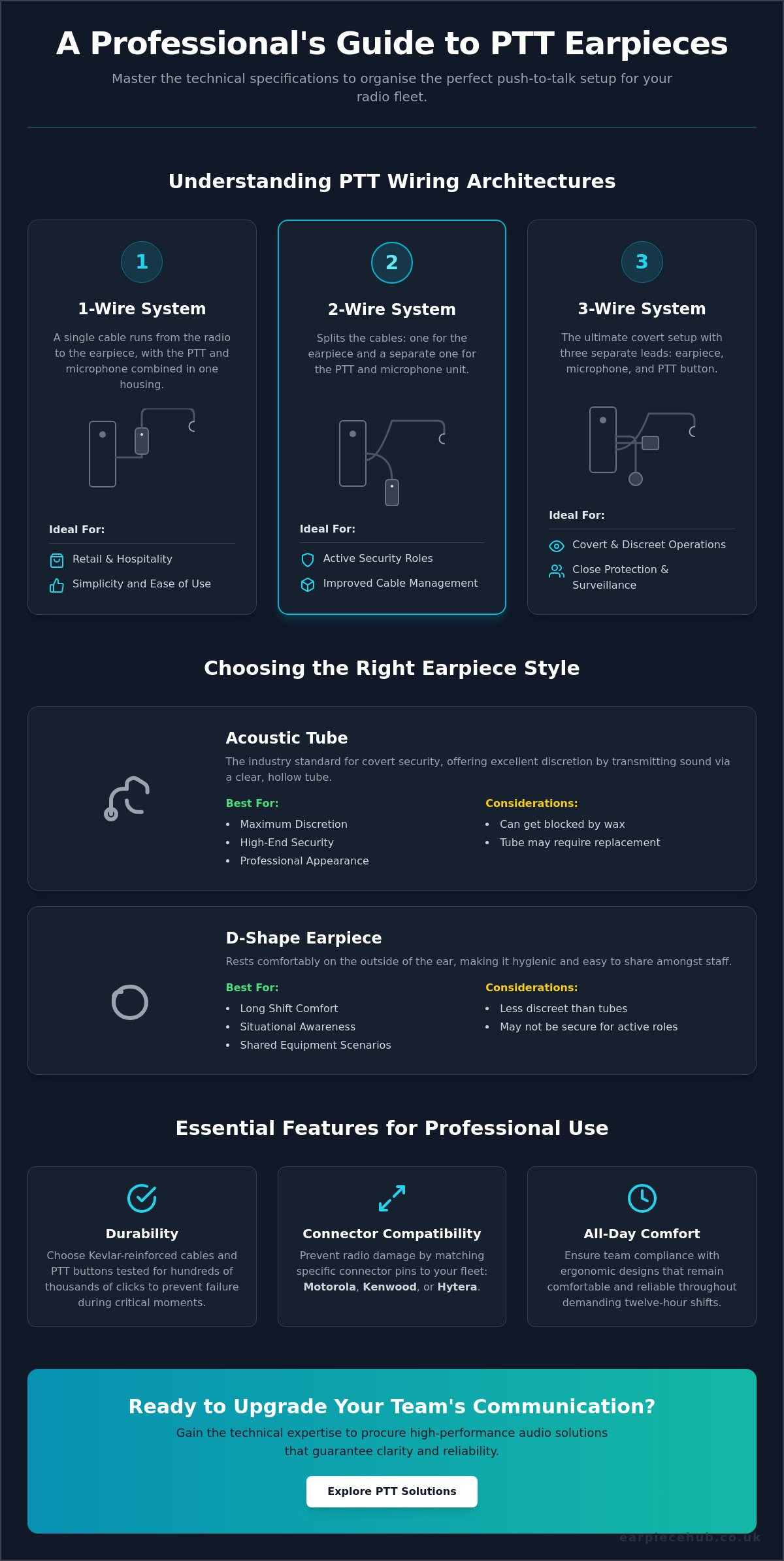
- 1-Wire: The most straightforward setup. A single cable runs from the radio to the earpiece, with the PTT and microphone housed in a small pod mid-way up the wire. It’s ideal for retail and hospitality where simplicity is favoured.
- 2-Wire: This configuration splits the cables. One lead goes to the earpiece, while a second lead houses the PTT and microphone. This allows you to run the PTT button down a sleeve or clip it to a lapel, providing better cable management for active security roles.
- 3-Wire: The ultimate covert setup. It features three separate leads: one for the earpiece, one for the microphone, and a third for a palm-hidden PTT button. This allows for completely discreet communication, as the user can transmit by subtly pressing a button hidden in their hand.
The Mechanics of the In-Line Microphone
The push-to-talk earpiece microphone typically utilises an omnidirectional capsule. These microphones are designed to pick up voice clearly regardless of the angle, which is vital when the unit is clipped to a uniform lapel or cuff. To ensure performance in outdoor event environments, professional mics often incorporate internal wind-shielding. This mechanical barrier reduces the “buffeting” sound caused by gusts of wind. The engineering challenge lies in balancing high microphone sensitivity, which captures quiet whispers in covert scenarios, with effective background noise suppression to keep the channel clear in noisy centres.
Choosing the Right Earpiece Style for Your Environment
The operational environment is the primary factor when selecting a push-to-talk earpiece microphone. A retail floor requires a different technical approach than a crowded nightclub or a busy construction site. High-noise zones demand audio isolation so the user can hear transmissions clearly over ambient noise. Conversely, low-noise environments like hotel lobbies require high situational awareness. If an earpiece blocks out the sounds of the surrounding area too effectively, staff may miss customer enquiries or local safety cues. Identifying these operational zones is the first step in procurement; for those managing large facilities, you can learn more about how energy-efficient heating systems maintain a stable environment for on-site teams. A warehouse team might need noise-cancelling overhead headsets, whilst a concierge needs a lightweight, non-intrusive solution.
In more specialised industrial settings like the oil and gas industry, where safety and communication must go hand-in-hand, you can visit PetroHab LLC to find out more about their modular Hot Work Safety Enclosures designed for hazardous areas.
Comfort is the silent driver of team compliance. If equipment causes irritation after four hours, staff will inevitably remove it, leading to communication gaps. Whilst technical standards for radio equipment are often guided by international frameworks like the FCC Personal Radio Services guides, the physical fit is what matters on the ground. Professional teams need gear that remains comfortable for the duration of a twelve-hour shift. Matching the aesthetic to the uniform also matters. A discreet earpiece maintains the professional look required for high-end security or corporate concierge roles. Compliance improves when the gear fits the person, not just the radio.
Acoustic Tube Earpieces for Covert Security
Clear acoustic tubes are the industry standard for door supervisors amongst UK venues. They provide a discreet profile that doesn’t clash with formal attire. The surgical-grade silicone ear tip is designed for long-term wear and can be easily replaced for hygiene purposes. Beyond aesthetics, the air-filled tube serves a functional purpose. It acts as a natural buffer, protecting the eardrum from sudden high-volume radio bursts or digital feedback that can occur in crowded frequency bands.
D-Shape and G-Shape Earpieces for Retail and Hospitality
D-Shape earpieces are an over-the-ear favourite for shared radio fleets. Because the speaker sits outside the ear canal, they are arguably the most hygienic option for teams where equipment is passed between shifts. G-Shape earpieces offer a more secure fitment. The G-hook wraps tightly around the ear, making them ideal for active roles involving running or physical movement. These overt styles are often preferred in UK retail centres as they signal to the public that staff are part of a coordinated team. Finding the right balance between comfort and clarity is easier when you browse our specialist range of professional earpieces.
Compatibility Guide: Matching Connectors to Radio Brands
Compatibility is the most frequent point of failure in radio procurement. There is no universal standard for the connection between a radio and its accessories. If you choose the wrong push-to-talk earpiece microphone, you risk more than just a poor fit. Using an incompatible connector can physically damage the radio’s accessory port or cause “constant PTT” errors, where the radio remains stuck in transmit mode and jams the entire channel. Whilst the Department of Homeland Security communication equipment standards provide a framework for responder gear, the UK market remains fragmented with proprietary designs from Motorola, Kenwood, and Hytera.
Precision matters when matching pins to ports. Even a fraction of a millimetre in pin spacing or length can result in static or intermittent audio. For professional fleets, the goal is a secure, static-free connection that won’t pull loose during physical activity. If your team uses a mixed fleet of radios, you might require an earpiece adapter for any radios to bridge the gap between different connector standards without replacing your entire stock of headsets.
Motorola and Hytera Connector Standards
Motorola uses a variety of connectors depending on the radio’s tier. The Motorola 2-pin (M1) is common on entry-level models, but professional digital series like the DP1400 and DP4400 use more complex multi-pin side connectors. These often require a “screw-in” fitment. This mechanical lock is essential for heavy-duty security use, as it prevents the cable from being wrenched out during a scuffle. Hytera follows a similar logic with their H1 and H2 connectors. Always verify if your Hytera radio is a PD series or the newer digital models, as the pin configurations are not interchangeable.
Kenwood K1 and Universal 2-Pin Connectors
The Kenwood K1 2-pin connector is the most ubiquitous standard in the UK. It’s the default choice for the majority of licence-free radios and budget-friendly fleet expansions. The K1 standard is defined by a specific 12mm spacing between the two pins. Because so many manufacturers adopt this layout, it’s often referred to as the “universal” 2-pin. However, you must still check the pin thickness. A loose fitment leads to “crackle” on the line, which can be just as disruptive as a total audio failure during a critical shift. Ensuring a snug fitment is the only way to maintain crystal clear communication across your site.
Durability and Maintenance: Maximising Your Equipment Lifespan
Professional radio gear takes a beating. Most failures in a push-to-talk earpiece microphone occur at the physical stress points. Cable strain from catching on door handles, furniture, or during physical confrontations is a common culprit. For those working in demanding trades where equipment toughness is vital, you might also check out New Local Tools for professional cordless gear. Wax buildup in the transducer or ear tip is the second leading cause of audio degradation. To combat this, professional-grade equipment often features Kevlar-reinforced cabling. This internal braiding prevents the copper strands from snapping when the wire is stretched or snagged. If your environment involves physical intervention or high-paced movement, Kevlar is a non-negotiable requirement for your fleet.
You don’t always need a completely new unit when things go quiet. Establishing a weekly cleaning routine can double the lifespan of your gear. If the audio becomes muffled or crackly, check the ear tip and connector pins first. Often, a simple replacement of the silicone tip or the acoustic tube restores the unit to factory-standard clarity without the cost of a full headset. However, if the push-to-talk button becomes intermittent or the outer cable sheath is exposed, it’s time for a full replacement to ensure operational safety and reliability.
Similarly, proactive protection is the best way to maintain the value of other essential assets; for those who need to keep their vehicles in showroom condition, In The Garage offers premium indoor and outdoor shielding solutions.
Maintaining Acoustic Tubes and Ear Tips
Condensation is a major issue in the UK climate. When warm air from the ear canal meets the cooler plastic tube, moisture traps the sound. Using a small air pump or blower is the most effective way to clear these blockages without damaging the transducer. Hygiene is equally vital. In shared radio environments, sanitising ear tips after every shift is essential to prevent ear infections amongst the team. We recommend replacing tubes every three to six months, especially when they begin to yellow or harden. Hardened plastic loses its flexibility and becomes uncomfortable, which negatively impacts staff compliance.
Cable Management and Strain Relief
Proper coiling prevents internal copper fractures that lead to “dead spots” in the audio. Never wrap the cable tightly around the radio body for storage. Instead, use a loose “figure-of-eight” or “over-under” technique. Always utilise rotational clothing clips to secure the wire to your uniform. These clips allow the cable to move with your body, which reduces tension on the radio jack and prevents the connector from being pulled at a damaging angle. Strain relief is the reinforced junction where the cable meets the PTT housing, designed to absorb the energy of sudden tugs and protect the internal solder points. To keep your audio clear, shop replacement acoustic tubes and ear tips from our specialist range.
Why Earpiece Hub is the UK Specialist for PTT Solutions
Earpiece Hub serves as the central resource for security and communication professionals across the UK. We aren’t just a shop; we are a specialist partner that understands the high-stakes nature of your work. Our inventory features an extensive stock of specialist earpieces designed specifically for Motorola, Hytera, and Kenwood radios. Every push-to-talk earpiece microphone we supply is selected for its ability to deliver high-performance audio under pressure. We maintain rigorous quality control standards to ensure that every unit meets the technical requirements of modern digital and analogue systems.
Navigating the fragmented market of radio connectors is often the biggest hurdle for procurement officers. Our UK-based support team provides the expert technical knowledge needed to identify the exact connector for your specific fleet. We eliminate the risk of ordering incompatible gear that could damage your radio chassis. Efficiency is our priority. We offer rapid delivery options and next-day shipping to ensure your team is never left without a critical communication link. Trust a reliable specialist to keep your operations running smoothly.
Our Range of Professional Accessories
Our catalogue addresses the full spectrum of professional needs. We provide the industry-standard acoustic tube earpiece for Motorola radios for covert security, alongside the G-shape earpiece for Kenwood radios for more active roles. For high-noise event environments, our noise-cancelling overhead headsets provide the isolation required for clear instructions. We also stock essential power solutions, such as the replacement battery for Motorola DP1400, ensuring your handsets don’t fail mid-shift. If you manage a mixed fleet, our universal earpieces and the earpiece adapter for any radios provide the flexibility to use a single earpiece style across multiple radio brands.
Ready to Upgrade Your Comms?
Organising a bulk order for a large security or hospitality team requires a dependable supplier. We provide a streamlined path to purchase that prioritises your time and budget. Every item in our shop carries the Earpiece Hub guarantee of compatibility and performance. We focus on getting you the specific product you need with minimal fuss. Your communication reliability is our primary character trait. Browse our full range of PTT earpiece microphones today and experience the difference that specialist expertise makes to your team’s safety and efficiency.
Optimise Your Team Communications for 2026
Reliable communication depends on the perfect alignment of wiring architecture, connector precision, and environmental suitability. You now understand how to differentiate between 1-wire and 3-wire systems whilst recognising why matching the exact pin configuration for your fleet is vital. Precision is paramount. Maintaining your push-to-talk earpiece microphone through regular cleaning ensures your team remains connected throughout every high-pressure shift in 2026.
Earpiece Hub has operated as a specialist UK supplier since 2015. We provide the deep technical expertise required to navigate the complexities of radio peripherals. We offer 24/7 technical support to help you identify the correct gear for your specific radio model. Next day shipping is available on all in-stock items. Upgrade your gear today with minimal fuss. Ensure your team has the reliable tools they need to stay safe and effective.
Shop Professional PTT Earpiece Microphones at Earpiece Hub
Frequently Asked Questions
What is the difference between a 1-wire and 2-wire PTT earpiece?
A 1-wire earpiece uses a single cable that connects the radio to the earpiece, with the microphone and PTT button housed in one small pod. It’s the simplest setup for retail or hospitality. A 2-wire system splits the cables, allowing you to run the earpiece to your ear whilst clipping the microphone and PTT button to your lapel or cuff for better cable management.
Will a Kenwood earpiece work with my Motorola radio?
No, Kenwood earpieces are generally incompatible with Motorola radios because they use different proprietary connector standards. Kenwood typically uses the K1 twin-pin layout, whereas Motorola uses M1 pins or multi-pin side connectors. You must match the connector to your specific radio brand or use a specialist earpiece adapter to ensure the pins align correctly and prevent audio failure.
How do I clean my acoustic tube earpiece safely?
To clean an acoustic tube, first detach it from the transducer to avoid damaging the electronics with moisture. Use a dedicated air blower or pump to clear condensation and debris from inside the clear tube. You should sanitise the silicone ear tip with an alcohol-free wipe or replace it with a fresh tip every three months to maintain hygiene and audio clarity.
Why is my radio constantly transmitting when I plug in the earpiece?
This “constant PTT” error usually happens because the earpiece connector isn’t a perfect match for your radio’s accessory port. If the pins are slightly misaligned, they can short-circuit the transmit path and jam the channel. Always verify that your push-to-talk earpiece microphone uses the exact pin configuration required for your radio model to avoid this technical fault.
Can I use a PTT earpiece with a smartphone app like Zello?
You can use a PTT earpiece with apps like Zello only if the accessory is specifically wired for mobile devices. Standard two-way radio earpieces use different electrical protocols that won’t trigger the PTT function on a smartphone. Professional mobile-ready earpieces usually feature a 3.5mm jack or USB-C connection designed to interface with digital communication apps. To ensure your smartphone hardware remains as reliable as your audio gear, you can discover iRepairMan London for expert on-site screen and back glass repairs.
What is the most comfortable earpiece for a 12-hour security shift?
G-shape and D-shape earpieces are the best choices for long shifts because they sit on the outer ear rather than inside the canal. This prevents the “ear fatigue” and pressure often felt with acoustic tubes after several hours. The G-shape is particularly favoured for active security roles as it wraps securely around the ear, ensuring the earpiece stays in place during physical movement.
Are acoustic tubes better than D-shape earpieces for noise cancellation?
Acoustic tubes offer superior audio isolation because the silicone tip seals the ear canal, delivering sound directly to the eardrum. This makes them better for hearing transmissions in noisy clubs or stadiums. However, D-shape earpieces are better for situational awareness. They allow you to hear ambient sounds and customer enquiries whilst still receiving radio messages through the outer-ear speaker.
Do I need a special licence to use PTT earpiece microphones in the UK?
The push-to-talk earpiece microphone itself doesn’t require a licence, but the radio frequencies you use might. In the UK, a licence for shared VHF or UHF frequencies costs £75 per year when purchased online. If you use PMR446 licence-free radios, you don’t need to pay this fee, but your equipment will have lower power limits and a shorter range.
