





Uncategorized
Best Listen-Only Earpieces for Radio: The Ultimate 2026 Buying Guide

Jun
What if the only thing standing between a successful operation and a total communication breakdown is a single millimetre of plastic? In high-stakes environments, a generic listen-only earpiece for radio isn’t just a minor inconvenience; it’s a liability that can lead to missed commands and compromised safety. Choosing the right kit is a matter of technical precision, where the correct fit for your Remote Speaker Microphone (RSM) jack and your specific physical environment determines your success. With the global two-way radio accessories market projected to reach $14.07 billion by 2033, the sheer volume of choices often masks the reality that not all gear is built for professional endurance.
You likely already know the frustration of audio cutting out during a critical transmission or the nagging ache of ear fatigue halfway through a twelve-hour shift. We understand that your equipment must be as reliable as your team. This guide will show you how to identify the perfect professional-grade earpiece that delivers crystal-clear reception whilst remaining comfortable from start to finish. We will break down the essential differences between 2.5mm and 3.5mm jacks, explore the latest 2026 trends in AI-based noise suppression, and help you select a durable accessory that survives the rigours of daily professional use.
Key Takeaways
- Technical precision is essential; learn to identify whether your Remote Speaker Microphone requires a 3.5mm or 2.5mm connector.
- Choose the right style for your specific role, from covert acoustic tubes for security to hygienic D-shape models for shared fleet use.
- Optimise your setup with a professional listen-only earpiece for radio to achieve discreet communication without sacrificing all-day comfort.
- Protect your hearing and equipment by following specialist maintenance and hygiene protocols designed for intense daily shifts.
- Solve compatibility issues amongst different radio brands by using specialist adapters and universal audio solutions.
What is a Listen-Only Earpiece and Why Do Professionals Need One?
A listen-only earpiece for radio is a specialised audio-reception peripheral designed for professional environments where clarity and discretion are paramount. Unlike standard communication kits, these units are purpose-built strictly for hearing transmissions. They lack the bulky integrated microphones or push-to-talk (PTT) buttons found on traditional 1-wire or 2-wire setups. Professionals across security, door supervision, event management, and emergency services rely on this gear to maintain a constant stream of information whilst keeping their hands free for tactical operations; to complement your operational security, you can check out HubHound for professional screening and background verification.
The functionality of this equipment hinges on its connection to a Remote Speaker Microphone (RSM). By plugging the earpiece into the secondary audio jack of a shoulder mic, the signal is diverted from the external speaker directly to the user’s ear. This setup is the gold standard for teams using a two-way radio in complex or loud environments. It allows the user to benefit from the rugged, accessible controls of a shoulder-mounted mic whilst enjoying the private, clear audio of a dedicated earpiece.
The Secondary Audio Benefit
Privacy is often the most critical reason professionals choose a listen-only earpiece for radio. In public-facing roles, such as retail security or close protection, broadcasting sensitive radio traffic through an RSM speaker is a significant security risk. A dedicated earpiece ensures that only the intended recipient hears the transmission, keeping tactical details amongst the team. Audio clarity also improves significantly; in high-decibel environments like music festivals or sporting stadiums, direct-to-ear audio cuts through the ambient noise. This allows for better focus and situational awareness, as users don’t have to struggle to hear commands over a roaring crowd.
Listen-Only vs. Integrated Earpieces
Choosing a modular listen-only unit over an integrated 1-wire or 2-wire kit is usually a matter of durability and long-term cost-effectiveness. Professional radio setups are designed to be modular to withstand the rigours of daily use. If an ear tip becomes unhygienic or a cable snaps during a shift, you only need to replace the earpiece itself rather than the entire wiring loom or the expensive RSM. This makes them a favourite choice for large fleets where equipment maintenance is a constant requirement. The ability to swap between different styles, such as an acoustic tube for covert work or a D-shape for shared use, provides a level of flexibility that integrated kits cannot match.
At Earpiece Hub, we understand that your equipment is a tool for success. Whether you need a G-Shape Earpiece for Kenwood Radios or a specialised D-shape for Hytera systems, our range is built for reliability. These accessories are designed to survive the high-stakes nature of security and radio communication with minimal fuss and maximum performance.
Technical Specifications: Jacks, Cables, and Connectors
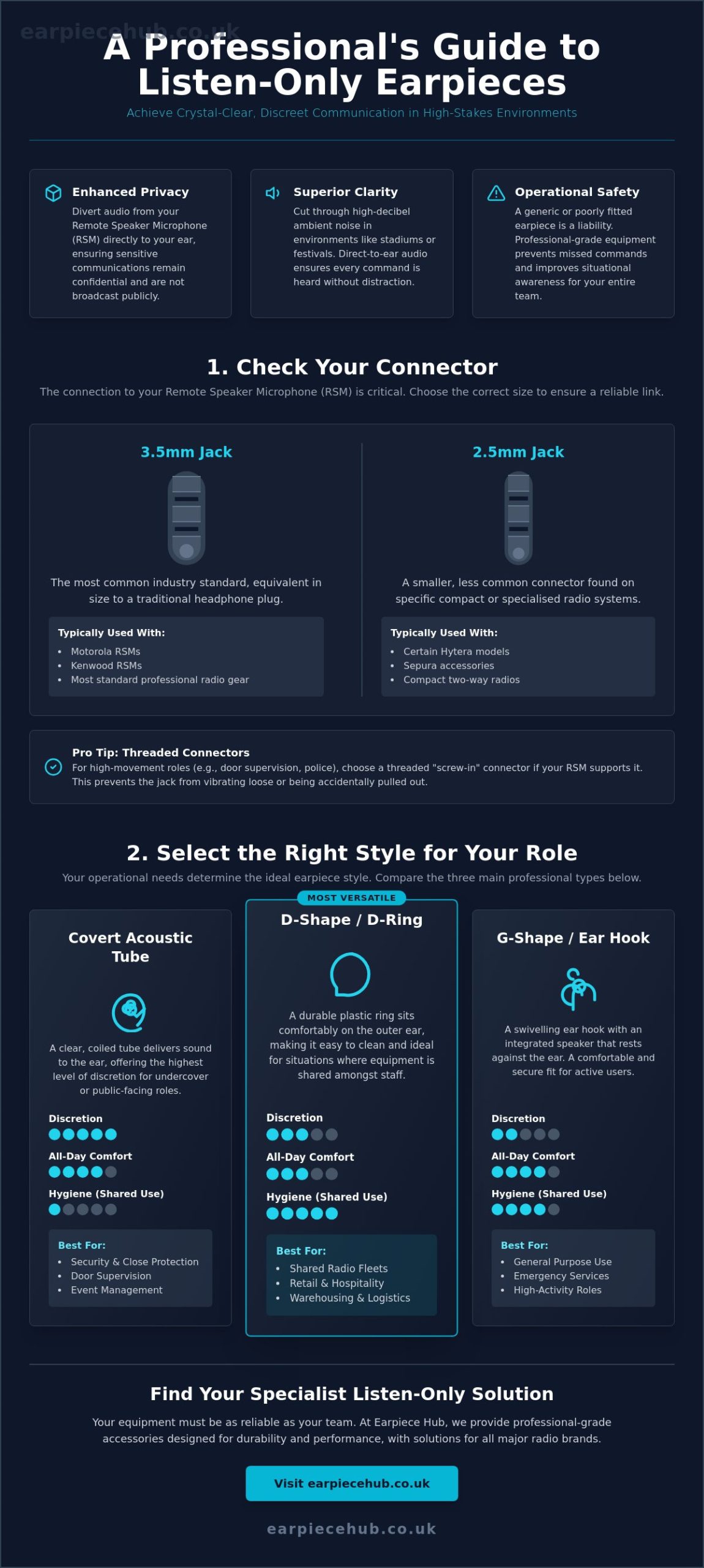
The physical interface of your listen-only earpiece for radio is the most common point of failure in a professional setup. Precision matters because a fraction of a millimetre determines whether you have a reliable link or a dead line. Most professional Remote Speaker Microphones (RSMs) utilise one of two industry standards: the 3.5mm jack or the 2.5mm jack. The 3.5mm version is the dominant standard for Motorola and Kenwood RSMs, whilst the smaller 2.5mm jack is frequently found on compact radios or specific Hytera and Sepura accessories.
Beyond the diameter, the security of the connection is paramount. For high-movement roles like door supervision or tactical police work, a threaded or “screw-in” connector is essential. This ensures the jack remains seated even if the cable is snagged. If your RSM features a threaded port, using a non-threaded jack is a risk; it will likely vibrate loose or pop out during a pursuit. For those managing diverse fleets, an earpiece adapter for any radios can bridge the gap between different connector standards without requiring a full kit overhaul.
Identifying Your Connector Size
Identifying the correct port size is simpler than it looks. A standard 3.5mm jack is the same size as a traditional wired headphone plug. If that plug feels loose or won’t enter the port at all, you likely require a 2.5mm version. Avoid the pitfall of using consumer-grade mobile phone earpieces in professional RSMs. These often feature an extra “ring” on the jack for microphone input which can short-circuit the audio on a professional radio. We recommend choosing gold-plated connectors, which offer superior corrosion resistance against the damp UK climate, ensuring a clean signal year-round.
Cable Durability and Reinforcement
The cable is the lifeline of your listen-only earpiece for radio. Professional-grade units use Kevlar-reinforced wiring to prevent internal stretching and snapping. When selecting your kit, consider your radio’s mounting position. Coiled cables are the best choice for belt-mounted radios as they expand and contract with your movement. Straight cables offer a lower profile and are preferred by those who mount their radio or RSM on a tactical vest. Regardless of the style, ensure the unit has robust strain relief at the point where the wire meets the jack. This reinforcement prevents the copper from fraying after thousands of bends. Reliable equipment is a cornerstone of hearing protection and communication, as it prevents the need to crank the volume to dangerous levels to compensate for a poor connection.
Style Comparison: Acoustic Tube vs. D-Shape vs. G-Shape
The chassis of your listen-only earpiece for radio dictates both your professional profile and your physical endurance during a shift. Whilst technical specs like jack size ensure connectivity, the physical design determines whether the gear stays in place during a foot pursuit or remains comfortable after ten hours on a door. Selecting the wrong style often leads to nagging ear fatigue or, worse, compromised situational awareness. Professional users must choose a chassis that balances the need for discretion with the realities of their physical environment.
Acoustic Tubes: The Professional Choice
Acoustic tubes are the industry benchmark for covert operations and high-stakes security. These units use a clear, hollow tube to deliver sound via air vibration, which creates a discreet profile that is nearly invisible from a distance. Because the tube sits directly against the skin, material quality is vital for long-term wear. Professional-grade versions use surgical-grade plastic to prevent skin irritation and yellowing over time. The acoustic tube is the standard for UK law enforcement and close protection officers who require a blend of high-fidelity audio and low-profile aesthetics. For those using standard-issue kit, an Acoustic Tube Earpiece for Motorola Radios provides the necessary reliability for daily patrol work.
D-Shape and G-Shape: Comfort and Hygiene
For roles where discretion is less critical than hygiene and speed, the D-shape and G-shape designs are often superior. The D-shape earpiece is a non-invasive “over-ear” classic. It is a favourite amongst event staff and festival security teams where earpieces might be shared across shifts, as the speaker sits outside the ear canal rather than inside it. This design eliminates the pressure associated with in-ear buds, significantly reducing the risk of ear fatigue during double shifts.
The G-shape earpiece offers a more secure, “wrap-around” fit that is ideal for roles involving high physical exertion. It features an adjustable pivot that allows the speaker to be positioned perfectly for different ear shapes, ensuring it stays in place during a chase or a struggle. When choosing these overt styles for loud environments, it is important to consider OSHA regulations on earpiece safety to ensure that volume levels are managed correctly to prevent hearing damage. Whether you require a D-Shape Earpiece for Hytera Radios or a G-Shape Earpiece for Kenwood Radios, matching the chassis to your specific operational movement is the key to maintaining a professional listen-only earpiece for radio setup that won’t fail when you need it most.
Comfort, Hygiene, and Maintenance for Daily Use
Professional endurance depends on equipment that remains comfortable for the duration of a shift. Ear fatigue isn’t just a minor annoyance; it’s a distraction that can pull your focus away from critical situational awareness. Most standard-issue gear fails because it uses rigid plastics that don’t conform to the unique shape of the human ear. A high-quality listen-only earpiece for radio should be constructed from lightweight, surgical-grade silicone. This material remains soft against the skin and reduces the pressure that leads to that familiar, dull ache after eight hours on duty.
Hygiene is a primary concern for professional fleets where equipment may occasionally be shared amongst team members. Sharing an in-ear device without a strict cleaning protocol is a significant health risk. We recommend a “one user, one earpiece” policy for acoustic tubes, whilst D-shape and G-shape models should be sanitised with alcohol-free wipes between users. Maintaining your gear doesn’t just protect your health; it extends the life of the accessory. Dirt and wax build-up are the most common causes of muffled audio, often leading users to believe their radio is faulty when the earpiece simply needs a thorough clean.
Maintaining Your Acoustic Tube
Moisture is the silent enemy of the acoustic tube. In the damp UK climate, condensation can build up inside the clear pipe, creating a physical barrier that blocks sound waves. You’ll notice this as a sudden drop in volume or “crackling” audio. To resolve this, follow these steps:
- Disconnect the tube from the transducer.
- Use a dedicated air blower to force moisture out of the pipe.
- Check for discolouration or “yellowing” of the plastic, which indicates the material is becoming brittle.
- Inspect the tube for sharp kinks or bends that permanently restrict airflow.
Air blowers are essential tools for any specialist communication kit. They allow you to clear obstructions without introducing new moisture from your breath. If the tube remains discoloured or the plastic feels stiff, it’s time for a replacement.
Customising the Fit
The standard “mushroom” tip provided with most kits is a one-size-fits-all solution that rarely fits anyone perfectly. For superior comfort, consider semi-custom earmolds available in small, medium, and large sizes for both the left and right ear. These open-frame molds allow ambient sound to enter the ear whilst holding the acoustic tube securely in place. A proper seal improves audio clarity whilst reducing volume requirements, which protects your long-term hearing health. If you’ve noticed a decline in your audio quality, it might be time to refresh your kit with Replacement Acoustic Tubes and Ear Tips to restore peak performance.
Find Your Specialist Listen-Only Solution at Earpiece Hub
Earpiece Hub has served as the UK’s primary resource for professional radio peripherals since 2015. We understand that in the high-stakes sectors of security and emergency response, there is no room for equipment failure. Our curated range of universal 3.5mm and 2.5mm listen-only earpiece for radio solutions is built to withstand the rigours of daily professional use. Whether you are operating in a covert capacity or managing a large-scale public event, we provide the technical expertise to ensure your communications remain crystal clear. We position ourselves as a central, essential resource for the security community rather than just a retail shop.
Reliability is our core character trait. We don’t just sell equipment; we act as a dependable partner for your communication needs. Our inventory includes specialist adapters designed to solve compatibility issues amongst different fleets, allowing for seamless cross-brand radio use. To support the urgent requirements of our clientele, we offer next-day shipping and provide 24/7 support to ensure your team is never left without essential gear. This commitment to speed and availability ensures that professionals can identify a need and have the solution in hand within 24 hours.
Professional Compatibility Guaranteed
Our earpieces are designed with precision for industry-leading systems, including Motorola, Hytera, and Kenwood. Finding the correct jack size can be a technical minefield, which is why our specialists are available to provide direct guidance on your purchase. We offer a “Reliable Specialist” promise, ensuring you receive the exact technical specifications required for your specific Remote Speaker Microphone. For security firms and event organisers, we provide bulk purchasing options to equip entire teams with uniform, high-performance audio kit. This ensures every operative benefits from the same standard of reliability and comfort throughout their shift, regardless of the radio brand they carry.
Ready to Upgrade Your Comms?
Maintaining peak performance requires more than just a good earpiece; it requires a commitment to equipment health. Alongside our professional listen-only earpiece for radio range, we stock a comprehensive selection of replacement ear tips and acoustic tubes. Refreshing these components regularly is the most effective way to prevent audio degradation and maintain hygiene standards across your fleet. Browse our curated selection of covert acoustic tubes, D-shape, and G-shape models to find the perfect fit for your operational needs. Our logically organised categories, from “1 Wire” to specialist listen-only units, make it easy to find exactly what you need with minimal fuss.
While earpieces are critical for radio operations, professionals looking to expand their knowledge of the wider audio software ecosystem can find out more about the leading tools for film scoring and production in 2026.
Shop the full range of Listen-Only Earpieces at Earpiece Hub
Equip Your Team for Mission-Critical Clarity
Reliable radio communication is built on technical precision rather than guesswork. As this guide has shown, the difference between a successful operation and a total breakdown often lies in selecting the correct connector size and a chassis style that matches your physical movement. Whether you require the discreet profile of an acoustic tube or the hygienic benefits of an over-ear D-shape; your gear must be as durable as your team. Regular maintenance and the use of specialised ear tips will ensure your audio remains crystal clear whilst protecting your long-term hearing health.
Choosing the right listen-only earpiece for radio doesn’t have to be complicated when you partner with a specialist. Earpiece Hub has been a trusted UK resource since 2015, providing the expertise and high-performance peripherals required for high-stakes environments. We offer 24/7 expert support and next-day shipping to keep your operations running without delay. Equip your team with gear that won’t fail when it matters most.
Shop Professional Listen-Only Earpieces at Earpiece Hub
Frequently Asked Questions
Can I use a listen-only earpiece with any two-way radio?
No, compatibility depends entirely on the audio output port of your radio or Remote Speaker Microphone (RSM). Whilst many professional radios feature a standard jack, some require a specific earpiece adapter for any radios to bridge the gap between different connector standards. You must match the millimetre size and the wiring configuration of your specific device to ensure the audio signal is received correctly without shorting the circuit.
What is the difference between a 2.5mm and a 3.5mm earpiece jack?
The difference lies in the physical diameter of the connector plug. A 3.5mm jack is the industry standard for most Motorola and Kenwood shoulder microphones, whilst the 2.5mm jack is a smaller variant often found on compact Hytera or Sepura accessories. Using the wrong size results in a physical mismatch; the plug either won’t fit or will be too loose to maintain a reliable connection during movement.
How do I clean my acoustic tube earpiece properly?
Proper cleaning involves disconnecting the clear tube from the transducer and using an air blower to remove internal moisture. You can wash the tube and ear tip in warm, soapy water, but you must ensure they’re completely dry before reattaching them. Never use high-pressure air or boiling water, as this can warp the surgical-grade plastic and permanently muffle the audio quality of your transmissions.
Why is the audio in my earpiece muffled or quiet?
Muffled audio is usually caused by moisture build-up, earwax blockages, or a kinked tube. Condensation is a frequent issue in the UK climate, where temperature changes cause water droplets to form inside the hollow pipe. If the tube appears clear, check the connection at the jack; a partially unseated plug or a frayed internal wire can also significantly reduce the volume and clarity of your reception.
Do I need a specific earpiece for a Motorola DP1400 radio?
Yes, the Motorola DP1400 typically uses a 2-pin connector, but most professionals connect a listen-only earpiece for radio to an RSM rather than the radio itself. If you’re plugging directly into the radio, you need a compatible 2-pin kit. If using a shoulder mic, verify if the mic’s accessory port is 3.5mm or 2.5mm to ensure you buy the correct peripheral for your setup.
Are listen-only earpieces compatible with standard mobile phones?
No, professional listen-only earpieces are rarely compatible with standard mobile phones due to different wiring standards. Mobile jacks use a TRRS configuration to support microphones and volume controls, which can short-circuit the audio on a mono professional radio earpiece. Using a radio accessory with a smartphone often results in audio only playing in one ear or failing to register at all with the device.
How often should I replace the ear tips on my radio earpiece?
We recommend replacing ear tips every three to four months for hygiene and comfort. Over time, silicone tips lose their elasticity and can become a breeding ground for bacteria, especially during long shifts. If you notice the material becoming stiff, discoloured, or failing to create a secure seal in your ear canal, it’s time to swap them for fresh replacements to maintain peak audio performance.
Which earpiece style is best for high-noise environments?
The acoustic tube style is generally the best choice for high-noise environments like concerts or stadiums. By delivering sound directly into the ear canal via an airtight seal, a listen-only earpiece for radio naturally blocks out ambient noise. This allows you to hear transmissions clearly without having to increase the volume to dangerous levels. For extreme noise, pairing this with a noise cancelling overhead headset provides maximum protection.
