





Uncategorized
The Professional Guide to Motorola Radio Replacement Batteries: Optimising Your Fleet for 2026

Jun
Your lead security officer is monitoring a high-stakes event when their radio suddenly cuts out. They are isolated during a critical moment. It’s a scenario that happens too often when teams rely on ageing power cells that can’t survive a standard eight-hour shift. You understand that in professional environments, a dead battery isn’t just an inconvenience; it’s a breach in your safety protocol. Finding a reliable Motorola radio replacement battery shouldn’t feel like a gamble between high-cost units and risky generics that might damage your equipment.
We agree that reliable communication is the foundation of any discreet operation. This guide will help you master the technical specifications and selection criteria needed to ensure your team remains connected whilst on duty. We’ll explore the 2026 IATA regulations regarding lithium-ion transport, compare Li-ion versus NiMH chemistries, and explain how IMPRES 2 technology delivers up to 60% more charge cycles to help you optimise your fleet for maximum runtime and long-term reliability.
Key Takeaways
- Identify early warning signs of failure, such as rapid heat buildup and voltage sag, to prevent communication blackouts during critical shifts.
- Select the ideal Motorola radio replacement battery by decoding mAh ratings and choosing the correct chemistry for your specific operational environment.
- Understand the technical differences between genuine Motorola cells and premium alternatives to ensure your equipment remains safe and functional.
- Match high-performance power solutions to your specific fleet, whether you are using the DP1400 series or advanced DP4000 series radios.
- Extend the lifespan of your battery fleet by implementing professional maintenance protocols, including proper initialisation and temperature management.
Recognising the Signs: When to Seek a Motorola Radio Replacement Battery
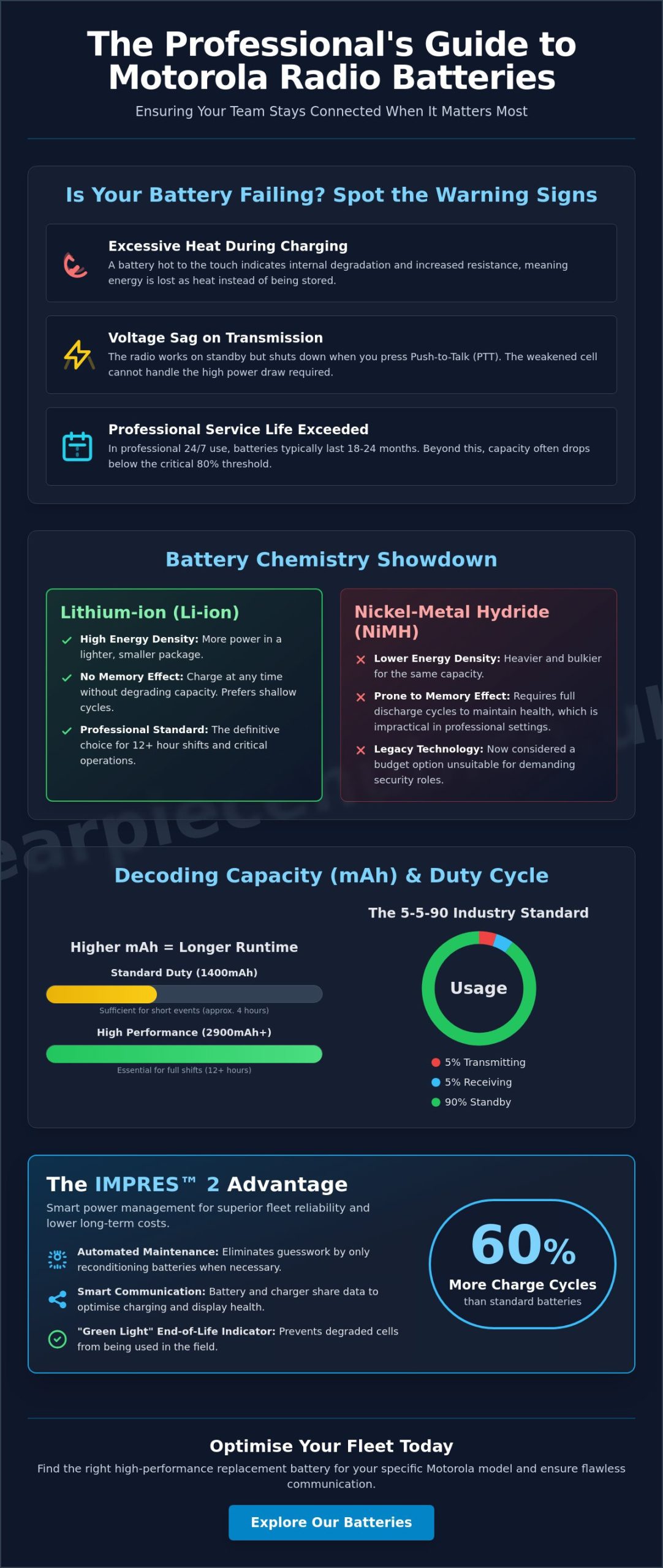
A reliable Motorola radio replacement battery is the heartbeat of your communication system. In a high-pressure security environment, you can’t afford to wait for a total failure before acting. Professional teams must identify the subtle symptoms of degradation to maintain operational safety. One of the earliest signs of a failing cell is excessive heat during the charging cycle. As the internal chemistry degrades, resistance increases; this generates thermal energy rather than storing power. If your battery feels hot to the touch after just thirty minutes in the charger, the internal structure is likely compromised.
Voltage sag is a more deceptive killer of performance. Your radio might function perfectly in standby mode, but the moment you press the PTT (Push-to-Talk) button, the unit shuts down. This happens because the weakened battery cannot maintain the high current draw required for transmission. For professionals using Lithium-ion battery technology, this drop-off often becomes more pronounced as the cell nears the end of its functional life. In a 24/7 security operation where radios are constantly swapped between shifts, professional batteries typically last between 18 and 24 months. Beyond this point, the capacity usually drops below 80% of its original rating.
Few users realise that battery health directly impacts audio clarity, especially when using covert acoustic tube earpieces.
Decoding Specifications: mAh, Chemistry, and IMPRES Technology
Selecting a Motorola radio replacement battery requires more than just checking for a physical fit. You must understand the technical data printed on the casing to ensure the unit matches your operational demands. These specifications dictate your radio’s runtime, its weight, and how many years the cell will remain in service before requiring a trip to the recycling centre. Professional communication depends on matching these variables to your specific shift patterns.
Modern Motorola units primarily use Lithium-ion (Li-ion) chemistry. This has almost entirely replaced Nickel-Metal Hydride (NiMH) in professional settings. Li-ion is lighter, offers higher energy density, and lacks the “memory effect” that plagued older batteries. You no longer need to fully discharge your battery before recharging it; in fact, modern cells prefer shallow discharge cycles. Whilst NiMH remains a budget-friendly option for light civilian use, it cannot compete with the power-to-weight ratio required for 12-hour security details.
Understanding Battery Capacity (mAh)
Capacity is measured in milliampere-hours (mAh). Think of this as the size of the fuel tank. A standard 1400mAh battery might suffice for a light four-hour event, but high-use security teams should look towards 2900mAh or 3400mAh units. The choice depends on the 5-5-90 duty cycle. This industry standard assumes you spend 5% of your time transmitting, 5% receiving, and 90% on standby. If your role involves heavy transmission, a higher mAh rating is non-negotiable to prevent mid-shift failure.
There is a physical trade-off to consider. High-capacity cells are often thicker and heavier. If your team prioritises discreet, covert operations, you might opt for a slimmer, mid-range capacity battery to keep the radio profile low under a suit jacket. However, for those using a Six-Way Multi-Unit Charger to manage a large fleet, standardising on a single high-capacity model often simplifies logistics and ensures everyone has maximum runtime.
The IMPRES Advantage for Fleet Management
Motorola’s IMPRES technology represents the pinnacle of “smart” power. Each IMPRES battery contains a microchip that communicates directly with the charger. This system automates maintenance by only reconditioning the battery when necessary. It eliminates the guesswork of manual battery conditioning. According to industry data, IMPRES 2 batteries can be charged up to 60% more times than standard Lithium-ion cells, representing a significant return on investment for large organisations.
The most practical benefit for a fleet manager is the “Green Light” end-of-life indicator. When an IMPRES battery can no longer hold a sufficient charge for a full shift, the charger alerts you. This prevents the “dead battery” lottery where staff unknowingly grab a degraded cell from the rack. Whilst the initial cost for IMPRES-enabled hardware is higher, the extended lifespan and reduced replacement frequency make it the most cost-effective choice for professional 2026 fleets.
Genuine Motorola vs High-Quality Replacement Batteries
The price gap between original equipment and aftermarket alternatives is often the first thing a fleet manager notices. You might wonder if the premium for a genuine Motorola radio replacement battery is truly justified. In high-stakes security environments, the answer lies within the internal architecture of the cell. While budget knock-offs found on consumer marketplaces often cut corners, professional-grade replacements focus on the safety circuitry that protects both your staff and your expensive radio hardware.
Premium batteries include internal safety fuses and thermistors. These components are essential for preventing thermal runaway; a dangerous condition where a battery overheats and potentially catches fire. A thermistor acts as a heat sensor, communicating with the radio and charger to throttle or stop the power flow if temperatures spike. Cheap generic batteries frequently omit these parts to reduce costs. This leaves your equipment vulnerable to catastrophic failure during a fast-charge cycle. Professional replacement cells from specialist suppliers mirror the OEM standards, ensuring your team isn’t carrying a safety risk on their hip.
Safety Standards and Certifications
For UK businesses, CE and UKCA markings are non-negotiable legal requirements. These certifications prove that the battery has passed rigorous testing for electromagnetic compatibility and electrical safety. Using non-certified batteries in hazardous or high-temperature environments isn’t just a technical risk; it’s a liability issue for your organisation. We vet every manufacturer in our inventory to ensure their products meet these strict criteria. This provides the peace of mind that a third-party Replacement Battery for Motorola DP1400 will perform exactly as the original manufacturer intended.
Environmental protection is another key differentiator. Professional Motorola radios are often rated to IP67 or IP68 standards. For example, the high-end PMNN4486A battery is IP68 rated, meaning it can withstand submersion in two metres of water for up to four hours. A low-quality replacement with poor housing seals will compromise your radio’s water resistance. If your team works outdoors in the British weather, ensuring your replacement batteries maintain these IP ratings is vital for long-term fleet survival.
Warranty and Long-term Reliability
The hidden cost of cheap batteries often appears six months after purchase. Budget cells tend to have higher self-discharge rates and lower-quality lithium chemistry, leading to frequent downtime and premature replacement. Whilst genuine Motorola cells offer the most robust warranty, high-quality replacements from specialist suppliers provide the sweet spot for large fleets, offering the safety and durability of original equipment at a more manageable price point. By investing in vetted replacements, you avoid the radio chassis damage often caused by leaking or swelling budget cells, ensuring your communication infrastructure remains operational throughout 2026.
Selecting the Right Battery for Your Motorola Model
Navigating the vast catalogue of radio accessories requires technical precision. You must ensure your chosen Motorola radio replacement battery is electrically and physically compatible with your specific handset. A mismatched battery won’t just fail to power the device; it can damage the internal contact pins or void your equipment’s IP rating. Whether you’re managing a small security team or a nationwide logistics fleet, precision in selection is paramount for maintaining 24/7 connectivity.
Physical fit is only the first step. You must also consider the specific features of your radio model. Higher-tier digital handsets with integrated GPS and Bluetooth modules have significantly higher power demands than basic analogue units. Selecting a battery with insufficient capacity for these features leads to mid-shift failures and frustrated staff. Always match the battery’s output and internal circuitry to the radio’s intended use case.
The Motorola DP1400 Replacement Guide
The DP1400 and its predecessor, the CP040, remain the backbone of UK security operations. When sourcing a Replacement Battery for Motorola DP1400, you’ll likely encounter the PMNN4252 (NiMH) and the PMNN4415 (Li-ion). The PMNN4415 is the preferred choice for modern fleets due to its lighter weight and superior energy density. You can upgrade your DP1400 from NiMH to Li-ion without replacing your existing charging infrastructure, provided your chargers are compatible with both chemistries. This simple swap significantly reduces the weight on a guard’s belt whilst extending their effective shift time.
High-Tier Digital Radios: DP4400e and Beyond
Units in the DP4000 series, including the DP4400, DP4600, and DP4800, often feature power-hungry tools like GPS tracking, Bluetooth, and Man-Down sensors. These radios require high-capacity IMPRES batteries to maintain performance throughout long shifts. You should look for model numbers like the PMNN4488, PMNN4489, or the PMNN4491. The PMNN4486A is particularly noteworthy for its 3400 mAh capacity and IP68 rating. It ensures your radio remains submersible in two metres of water for up to four hours. Always verify that your battery choice maintains this seal, as a lower-rated battery will compromise the entire radio’s protection in wet environments.
SL Series and Charger Integration
The slimline SL series, such as the SL1600 and SL4000, uses dedicated batteries designed for a low profile. These units prioritised portability for hospitality and retail environments. Before purchasing, check your existing charging rack. Most professional fleets use a Six-Way Multi-Unit Charger. Ensure your new high-capacity batteries fit the specific pockets of your charger, as some ultra-high capacity third-party cells are too thick for standard multi-unit slots. Standardising your battery models across the fleet simplifies your charging logistics and ensures every staff member can grab a fresh unit and go without delay.
Fleet Maintenance: Maximising Performance and Lifespan
Managing a radio fleet is about more than just the initial purchase. It’s about preservation. Even a premium Motorola radio replacement battery will underperform if your team’s charging habits are poor. Professional organisations must establish a strict initialisation protocol for all new Lithium-ion cells. When you receive a fresh batch of batteries, ensure they receive a full, uninterrupted charge before their first deployment. This protocol ensures the internal chemistry is correctly balanced, providing a stable foundation for the hundreds of charge cycles to follow.
Environmental factors are the most common silent killers of battery health. Charging a battery in a freezing security van or a sweltering server room causes irreversible chemical damage. Lithium-ion cells are incredibly sensitive to temperature extremes. Charging in high heat accelerates the degradation of internal components, while charging in near-freezing conditions can cause “lithium plating.” This permanently reduces the cell’s capacity and can lead to safety risks. Always aim for a climate-controlled charging centre to protect your equipment investment.
The 2026 Charging Protocol
Discipline in the charging room prevents mid-shift failures. Follow these three steps to ensure your fleet remains operational throughout 2026:
- Step 1: Always switch the radio off before placing it in the charger. A radio left “on” continues to draw power, which can confuse the charger’s circuitry and prevent it from entering the essential “trickle” or maintenance mode.
- Step 2: Avoid “topping up” batteries that are still above 50% charge. While modern Li-ion is resilient, frequent shallow cycles on a nearly full battery can eventually reduce the overall cycle life of the cell. Wait until the unit is below the halfway mark before returning it to the rack.
- Step 3: Conduct a monthly “deep cycle” for non-IMPRES batteries. While Li-ion doesn’t suffer from the classic “memory effect” seen in older NiMH units, a full discharge and recharge once a month helps recalibrate the internal fuel gauge. This ensures the battery meter on the radio remains accurate, preventing “sudden death” scenarios during a shift.
Storage and Disposal Best Practices
If you’re storing equipment during an off-season or for standby events, never leave batteries at 0% or 100% charge. The “sweet spot” for long-term health is between 40% and 50%. Storing a fully depleted Motorola radio replacement battery for several months can lead to a “deep discharge” state. In this state, the internal protection circuit may trip, rendering the battery unable to accept a charge from a standard unit. Regularly check your standby stock every three months to ensure they haven’t dropped below a critical voltage level.
UK businesses must also prioritise environmental responsibility. When a battery eventually fails or no longer holds a charge for a full eight-hour shift, it must be disposed of correctly. Don’t throw them in general waste. Use a certified UK battery recycling scheme to ensure hazardous materials like Cobalt and Lithium are recovered and repurposed. Ready to refresh your fleet with reliable power? Shop our Motorola replacement batteries now for next-day shipping and specialist support.
Future-Proof Your Professional Fleet Power
Mastering your radio power supply is the foundation of operational security. By recognising the early signs of voltage sag and leveraging the data-driven benefits of IMPRES technology, you ensure your team never faces a mid-shift blackout. Selecting a high-quality Motorola radio replacement battery provides the necessary IP-rated protection and internal safety circuitry required for mission-critical tasks in 2026. Avoid the risks of uncertified cells and focus on vetted solutions that maintain your radio’s integrity.
Earpiece Hub is a dedicated UK specialist with over 10 years of experience in the communications industry. We provide 24/7 support for all technical compatibility queries and offer Next Day Shipping for urgent replacements. Don’t let ageing hardware compromise your team’s safety or efficiency. Take control of your fleet’s performance and ensure every transmission is crystal clear.
Browse our full range of Motorola Radio Replacement Batteries
Frequently Asked Questions
How long should a Motorola radio battery typically last on a full charge?
A standard battery typically lasts between 9 and 12 hours based on the industry-standard 5-5-90 duty cycle. This assumes 5% transmission time, 5% reception, and 90% standby. High-capacity units, such as those with a 3400 mAh rating, can extend this runtime to over 20 hours. Your actual performance depends on transmission frequency and whether you’re using power-hungry features like GPS or Bluetooth.
Can I use a Lithium-ion battery in a radio that originally came with NiMH?
You can usually use a Lithium-ion Motorola radio replacement battery in a radio that originally shipped with NiMH, such as the DP1400. However, you must verify that your existing charger is a tri-chemistry model capable of sensing Li-ion cells. Using an older NiMH-only charger with a Li-ion battery is a safety risk and will likely damage the internal chemistry of the new cell.
What is the difference between a high-capacity and a standard Motorola battery?
The primary difference lies in the milliampere-hour (mAh) rating, which determines the energy storage and shift runtime. Standard batteries are typically slimmer and lighter, making them ideal for short shifts or discreet, covert operations. High-capacity batteries provide significantly longer operational life but often add physical bulk and weight to the radio chassis, which may affect earpiece cable positioning.
Why is my Motorola battery charger flashing red when I insert the radio?
A flashing red light usually indicates a battery fault or a communication error between the charger and the battery microchip. This is often caused by dirty gold-plated contacts, a completely depleted cell, or an internal short circuit. Try cleaning the contacts with a dry, lint-free cloth. If the flashing continues, the battery has likely reached its end-of-life and requires immediate replacement.
Is it safe to use third-party replacement batteries in Motorola radios?
It is safe provided the batteries are sourced from a specialist retailer that vets for safety certifications like CE and UKCA. Professional replacement cells must include internal thermistors and safety fuses to prevent thermal runaway. Cheap, unbranded packs from generic marketplaces often lack these critical components, posing a risk to your radio hardware and your staff’s safety.
How many times can a Motorola battery be recharged before it needs replacing?
A standard Lithium-ion battery typically supports between 300 and 500 charge cycles before its capacity drops significantly. If you use Motorola IMPRES technology, this lifespan increases. According to industry data, IMPRES batteries can be charged an additional 150 times compared to standard cells. This represents a 43% increase in total charge cycles, making them more cost-effective for 24/7 security operations.
Do I need to buy a new charger if I upgrade to a higher mAh battery?
You don’t usually need a new charger, as most modern Motorola units are designed to handle various capacities. However, a higher-capacity battery will naturally take longer to reach a full charge. If your team operates on back-to-back shifts, ensure your charging window is long enough to accommodate the higher mAh rating, or consider a multi-unit charger to manage the fleet more efficiently.
How can I tell if my Motorola battery is a genuine original or a fake?
Genuine batteries feature high-quality holographic labels and specific serial numbers that match Motorola’s database. If you’re using IMPRES-compatible equipment, an authentic battery will communicate its manufacture date and cycle count to the charger. Fake batteries often lack these data-storage chips, have poorly printed labels, or feature contact points that don’t align perfectly with the radio chassis.
