





Uncategorized
Heavy Duty Radio Headset for Construction: 2026 Buyer’s Guide
Jun
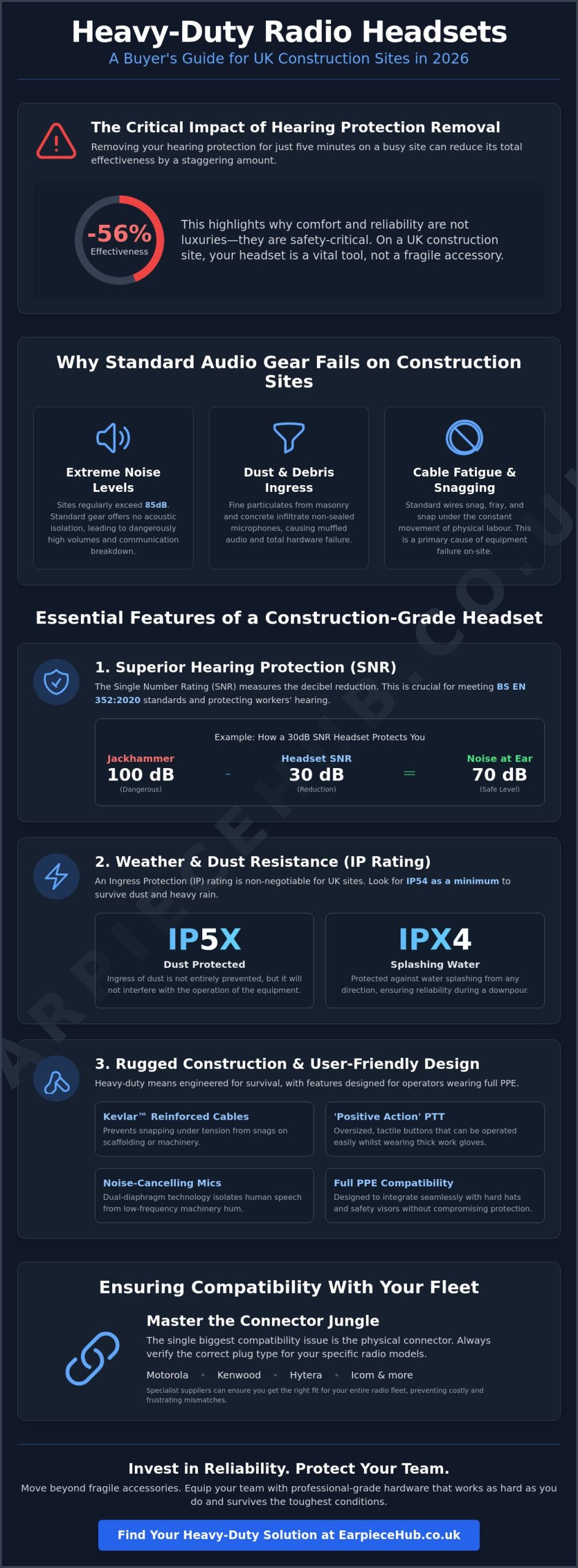
Did you know that removing your hearing protection for just five minutes on a busy site can reduce its total effectiveness by 56%? It’s a staggering figure that highlights why comfort and reliability aren’t just luxuries. On a UK build, your heavy duty radio headset for construction is a safety-critical tool. You shouldn’t have to struggle with audio failure due to high ambient noise or cables that snap under the first sign of stress.
We understand the frustration of gear that fails to integrate with your safety helmet or PPE. This 2026 buyer’s guide will show you how to identify the most durable, noise-cancelling solutions that meet BS EN 352:2020 standards. You will learn how to secure equipment that survives drops, dust, and heavy rain while keeping your team’s communication crystal clear.
We will examine the technical specifications required for reliable 24/7 site operations and how to ensure your choices protect workers when noise levels hit the 85 dB(A) upper exposure action value. It’s time to move beyond fragile accessories and invest in professional-grade hardware that works as hard as you do.
Key Takeaways
- Learn why standard audio gear fails in environments exceeding 85dB and how to select high SNR-rated protection for your team.
- Understand IP ratings to ensure your equipment survives the fine dust and heavy rain typical of UK construction sites.
- Discover how to choose the right heavy duty radio headset for construction to maintain full compatibility with hard hats and safety visors.
- Master the connector jungle by identifying the correct physical plugs for Motorola, Kenwood, and Hytera radio fleets.
- Gain insights into specialist noise-cancelling overhead headsets and remote speaker microphones designed for 24/7 site reliability.
Why Standard Audio Equipment Fails on Construction Sites
Standard consumer earpieces aren’t built for the rigours of a modern UK building site. Whilst they might perform well in retail, they fall apart when faced with the extreme conditions of heavy industry. Most construction environments regularly exceed 85dB, a level where standard audio equipment becomes effectively useless. Without proper acoustic isolation, workers find themselves cranking the volume to dangerous levels just to hear instructions. This leads to long-term hearing damage and immediate communication breakdown.
Dust is another silent killer of standard gear. Fine particulates from masonry, wood, and concrete infiltrate non-sealed microphone housings within days. This debris coats the internal diaphragms, causing muffled audio or total hardware failure. Professional Two-way radio technology relies on clear signal transmission. If the microphone is choked by grit, the most expensive radio in the world won’t help you. Industrial-grade attenuation differs from consumer noise cancellation because it physically blocks high-decibel impact noise rather than just filtering out background hums.
Physical durability remains a major hurdle for standard equipment. Standard wires aren’t designed for the constant movement of physical labour. They snag on scaffolding, get caught in high-vis zippers, and eventually fray or snap. This cable fatigue is the primary reason for equipment failure on-site. Choosing a heavy duty radio headset for construction ensures you have a tool engineered for survival rather than a fragile accessory.
The True Cost of Communication Failure
Missing a single instruction from a crane operator or plant driver can have catastrophic safety consequences. Beyond the physical risks, there’s a massive productivity drain. Every time a worker has to ask someone to ‘say again’ because of wind noise or background clatter, project timelines slip. Replacing flimsy, cheap earpieces every few months creates a hidden financial leak that far outweighs the initial cost of professional-grade equipment. Reliable gear prevents these avoidable expenses.
Defining ‘Heavy Duty’ for 2026
A heavy duty headset is a reinforced audio solution engineered with high IP and SNR ratings to withstand extreme environmental stress whilst providing superior noise attenuation. The industry has shifted towards ruggedised materials like Kevlar-reinforced cabling to prevent snapping under tension. A true heavy duty radio headset for construction must deliver both industrial-grade physical toughness and the audio clarity required to cut through the roar of heavy machinery. It’s about equipment that survives drops, dust, and rain without failing when you need it most.
Essential Features of a Construction-Grade Radio Headset
Selecting a heavy duty radio headset for construction requires looking past marketing buzzwords and into technical specifications. Two primary metrics define hearing safety: Single Number Rating (SNR) and Noise Reduction Rating (NRR). These values represent the decibel reduction provided by the earcups. For instance, if a jackhammer operates at 100dB and your headset has an SNR of 30dB, the noise level reaching your ears is reduced to a safer 70dB. Adhering to OSHA noise regulations or the UK’s Control of Noise at Work Regulations 2005 is essential for site compliance.
Weather resistance is equally critical. In the UK, an IP54 rating is the bare minimum. This ensures the headset is protected against dust ingress and splashing water from any direction. Without this seal, the internal circuitry will succumb to the first autumn downpour or dusty demolition phase. It’s the difference between a tool that lasts a season and one that fails in a week. Reliable equipment must be able to handle the unpredictable nature of outdoor work without compromising audio quality.
For those using radios in high-traffic zones, a ‘Positive Action’ Push-to-Talk (PTT) button is non-negotiable. These buttons are oversized and provide tactile feedback, allowing operators to communicate without removing thick work gloves. When it comes to microphones, boom mics with wind-socks are usually superior for general site work. However, throat mics are specialised for environments where wearing a mask or respirator is mandatory, as they pick up vibrations directly from the larynx.
Audio Clarity and Noise Attenuation
Modern noise-cancelling microphones use dual-diaphragm technology to filter out low-frequency machinery hum while isolating the higher frequencies of human speech. This ensures your message gets through even next to a running generator. You should also consider the difference between passive protection, which relies on physical barriers, and active protection. Active systems use electronics to compress loud sounds whilst amplifying quiet ones, which is vital for maintaining situational awareness on a busy site.
Build Quality and Ergonomics
Durability in 2026 is defined by Kevlar-reinforced cables. These wires are virtually impossible to snap through manual tension alone. Look for significant strain relief at the connector point, as this is where most earpieces fail. For 12-hour shifts, breathable ear cushions and adjustable headbands aren’t just about comfort; they ensure the user doesn’t remove the protection due to heat build-up. If you need a reliable heavy duty radio headset for construction, explore our noise-cancelling overhead headset range for professional-grade performance.
Choosing the Right Form Factor for Your Site Role
Selecting a heavy duty radio headset for construction isn’t a one-size-fits-all process. Your specific role on-site dictates the physical design of the equipment. Overhead headsets offer the highest level of passive noise attenuation. These are the gold standard for the loudest zones. However, their traditional headband can often interfere with standard safety helmets or face shields.
Behind-the-head styles solve this compatibility issue. These use a ruggedised neckband to secure the earcups, allowing a hard hat to sit correctly on the head without compromising the acoustic seal. For those who don’t require full ear coverage, single-sided headsets provide a vital middle ground. They allow you to monitor radio traffic whilst keeping one ear open to the immediate environment. If you work in a lower-noise zone but still need rugged gear, a Remote Speaker Microphone (RSM) is a reliable alternative. It clips to your lapel, keeping the radio safely on your belt whilst providing easy access to audio.
Headsets for Heavy Plant and Crane Operators
Operators inside cabins face constant low-frequency rumble from engines and hydraulics. Dual-ear protection is vital here to prevent the cognitive fatigue that leads to accidents. Whilst hands-free VOX (Voice Activated Transmit) seems like a benefit, it has significant pitfalls in a plant environment. High ambient noise often triggers the microphone accidentally, ‘hanging’ the channel and preventing others from speaking. We recommend using a large, tactile PTT button that is easy to find without looking, ensuring you keep your eyes on the load at all times.
Ground Crew and Supervisor Solutions
Supervisors and ground crews need to move rapidly between the site office, vehicle cabins, and active work faces. This requires equipment that supports high mobility. ‘Listen-through’ or ambient listening technology is a game-changer for these roles. It uses external microphones to pass safe environmental sounds through the headset, so you can hear approaching plant machinery or verbal warnings without removing your earcups.
- Lightweight, reinforced frames reduce neck strain during active 12-hour shifts.
- Quick-release connectors allow you to swap between a full headset and a simple earpiece in seconds.
- High-visibility earcup options ensure ground crews remain seen by plant operators in low-light conditions.
Choosing the correct heavy duty radio headset for construction ensures that your team stays connected without sacrificing situational awareness. It’s about matching the tool to the specific hazards of the job. Reliable communication isn’t just about the radio; it’s about the interface that stays comfortable from clock-on to clock-off.
Ensuring Compatibility with Your Existing Radio Fleet
Navigating the “Connector Jungle” is the primary challenge when sourcing a heavy duty radio headset for construction. Even within a single manufacturer like Motorola, you’ll encounter the 2-pin, the GP340 multi-pin, and the DP1400 bolt-on styles. Physical compatibility is only the first step. Kenwood and Hytera often share a similar 2-pin layout, but the internal wiring configurations frequently differ. This means a Kenwood-wired headset won’t work on a Hytera radio despite the plug looking identical. This “plug-and-play” fallacy is a major cause of equipment returns in the UK construction sector.
Earpiece adapters provide a cost-effective way to maintain a mixed fleet without replacing every headset. They allow you to standardise your equipment whilst keeping legacy radios in service. As sites move toward digital standards, you must ensure your headset supports the specific audio processing of your digital fleet. Digital radios process audio differently than analogue ones. Using an older analogue-only headset can result in muffled or robotic sound. This is particularly noticeable on busy sites where every syllable matters for safety. Digital radios also have more complex power requirements for microphones. If your headset isn’t designed for digital signals, you might find the Push-to-Talk (PTT) becomes unresponsive or the audio cuts out intermittently.
Identifying Your Radio Connector
A quick visual check of your radio’s side port is essential. Motorola DP1400 models use a large, secure bolt-on connector, whilst smaller licence-free units typically use a 2-pin push-in style. ‘Universal’ earpieces are a great investment, but they still require specific lead adapters to function. A common mistake is ordering for legacy Motorola fleets without verifying if the port is a side-mount or a top-mount. This single detail determines whether your new gear is a functional tool or a useless paperweight.
The Importance of Impedance and Mic Sensitivity
A headset that physically ‘fits’ might still deliver quiet or distorted audio if the impedance doesn’t match. You must match the headset specifications to the radio’s output power to ensure clarity in high-noise zones. Modern digital radios often require specific software settings to be tweaked before they’ll work perfectly with external gear. Many units need the ‘external mic gain’ boosted through the programming software to cut through site noise effectively. Always check your radio’s manual or consult a specialist to ensure the audio levels are optimised for your specific environment.
If you’re unsure which plug you need for your heavy duty radio headset for construction, explore our range of earpiece adapters for any radios to ensure a perfect match for your fleet.
Why Earpiece Hub is the UK’s Specialist for Heavy Duty Audio
Earpiece Hub acts as the central, essential resource for professionals who cannot afford communication failure. When you’re searching for a heavy duty radio headset for construction, you need more than a generic product listing. You need technical certainty. Our team understands the high-stakes nature of site safety and radio communication. We’ve curated a selection of hardware that meets the specific demands of the UK’s toughest environments, ensuring every piece of gear is functional and authoritative.
Reliability is our core character trait. A broken cable or a dead battery doesn’t just mean a quiet radio; it means a stalled project and compromised safety. We focus on equipment that survives the grit, water, and vibration of a live build. We treat every order with the urgency it deserves, offering Next Day Shipping across the UK to ensure your team stays connected without delay. It’s the reason industry veterans trust us as their dependable partner.
Our Specialist Range for Construction
Our inventory is purpose-built for industrial use. The Noise Cancelling Overhead Headset is our flagship solution for high-decibel zones, providing the maximum attenuation required for plant operators and ground crews. For those who prefer a more modular setup, our Remote Speaker Microphones (RSMs) deliver rugged, all-weather performance without the bulk of a full headset. These tools are designed to be used with gloves and in heavy rain, maintaining clarity when it matters most.
Maintenance is just as important as the initial purchase. We stock essential replacement parts, including the Replacement Battery for Motorola DP1400 and various acoustic tubes, to keep your existing fleet operational. This focus on the full lifecycle of your gear ensures you get the best value from your investment. Whether you need a G-Shape earpiece for Kenwood radios or a D-Shape for Hytera, we provide the specific technical categorisation to match your hardware perfectly.
Support Beyond the Sale
We understand that identifying the correct connector for a mixed fleet can be difficult. Our 24/7 Support is available to handle technical queries and compatibility checks, ensuring you never order the wrong lead or adapter. For large-scale infrastructure projects, our bulk order specialists provide tailored solutions to kit out entire teams quickly and efficiently. We value your time and focus on getting you the specific product you need without unnecessary fluff.
Choosing the right heavy duty radio headset for construction shouldn’t be a gamble. With Earpiece Hub, you’re partnering with a specialist that prioritises your site safety and communication uptime. Browse our heavy duty construction headsets now to find the professional-grade equipment your project requires.
Build a More Reliable Site Communication Strategy
Selecting a heavy duty radio headset for construction is about more than just hearing audio; it’s about ensuring safety and durability in the UK’s most demanding environments. By prioritising high SNR ratings and IP54 weather resistance, you protect your team’s hearing whilst eliminating the constant cost of replacing flimsy gear. You’ve seen how matching headset form factors to specific site roles ensures that crane operators and ground crews remain both safe and connected.
Compatibility doesn’t have to be a headache. Whether you run a legacy Motorola fleet or modern digital Hytera and Kenwood radios, the right technical interface is essential for clear transmission. At Earpiece Hub, we provide the expert UK technical support needed to navigate the connector jungle with confidence. Our next-day shipping ensures your project stays on schedule without communication delays. Don’t let poor audio compromise site safety or productivity.
Shop the full range of heavy duty construction headsets at Earpiece Hub
Invest in equipment that works as hard as your crew does and experience the difference of professional-grade audio today.
Frequently Asked Questions
What is the best radio headset for a very loud construction site?
A Noise Cancelling Overhead Headset is the most effective choice for environments with extreme ambient noise. These units provide high SNR ratings to attenuate machinery roar whilst using dual-diaphragm microphones to isolate speech. This ensures your heavy duty radio headset for construction delivers clear audio even when you’re working next to heavy plant machinery or generators.
Will these headsets work with my existing Motorola DP1400 radios?
Yes, we provide specific headsets and adapters designed specifically for the Motorola DP1400. This radio uses a unique bolt-on side connector that requires a precise fit to maintain a reliable connection. You should always ensure you select the DP1400-compatible lead to prevent audio dropouts or physical damage to the radio’s accessory port during active site work.
Can I wear a heavy duty headset with a safety helmet or hard hat?
You can wear these headsets with standard PPE by selecting a behind-the-head or neckband style. These designs feature a ruggedised band that sits at the nape of the neck, allowing your safety helmet to fit correctly on your head. This maintains the acoustic seal around your ears whilst ensuring you remain fully compliant with UK site safety regulations.
What is the difference between noise-cancelling and noise-attenuating headsets?
Noise-cancelling typically refers to the microphone technology that filters out background clatter so others can hear you clearly. Noise-attenuating refers to the physical earcups or electronic compression that reduces the volume of outside noise reaching your ears. A high-quality heavy duty radio headset for construction should offer both features to protect your hearing and ensure clear outgoing transmissions.
How do I know which connector I need for my Kenwood or Hytera radio?
Identifying the correct connector requires checking the pin configuration on your radio’s accessory port. Kenwood and Hytera often use a 2-pin style, but the spacing and internal wiring are not always interchangeable. We categorise our range by brand and model, such as D-Shape earpieces for Hytera or G-Shape for Kenwood, to help you find the exact match for your fleet.
Are these headsets waterproof or just splash-proof for UK weather?
Most construction-grade headsets are rated to IP54 or IP55, making them splash-proof and dust-resistant rather than fully waterproof. This level of protection is sufficient for typical UK weather conditions, including heavy rain and wind-blown grit. The sealed housings protect the internal circuitry, though you should avoid submerging the equipment or leaving it in standing puddles.
Can I use hands-free (VOX) with heavy duty headsets on a building site?
Whilst many headsets support hands-free VOX, it is often unreliable on busy building sites. High ambient noise from generators or power tools can accidentally trigger the microphone, blocking the radio channel for other users. We recommend using a large, tactile Push-to-Talk (PTT) button which provides positive feedback and prevents accidental transmissions in noisy environments.
Do you offer replacement ear tips and acoustic tubes for your headsets?
We stock a full range of replacement acoustic tubes and ear tips to keep your equipment hygienic and functional. These parts are essential for maintaining audio clarity and user comfort over long-term use. Regularly replacing these components is a cost-effective way to extend the lifespan of your headsets without needing to replace the entire electronic unit.
