





Uncategorized
The Ultimate Guide to Choosing a Comfortable All-Day Radio Earpiece

Jun
Why does your radio earpiece feel like a lead weight after only four hours of a twelve-hour shift? For many security and event professionals, the search for a comfortable all-day radio earpiece often ends in frustration, itching, and nagging pain in the outer ear. You’ve likely dealt with moisture build-up in acoustic tubes or the constant nuisance of wires pulling whenever you turn your head. It’s an unnecessary distraction when your focus needs to remain on the task at hand.
Professional communication shouldn’t come at the cost of physical comfort. You deserve equipment that ‘disappears’ during wear, providing crystal clear audio whilst remaining completely unobtrusive. This guide shows you how to eliminate ear fatigue by selecting the right ear-tip materials and wire-weight distribution. We will examine the technical specifications that separate flimsy gear from durable, professional-grade equipment designed to survive the rigours of daily use.
Key Takeaways
- Identify the root causes of ear fatigue and learn how to avoid painful pressure points during 12-hour shifts.
- Compare the pros and cons of Acoustic Tube, D-Shape, and G-Shape designs to find your ideal comfortable all-day radio earpiece.
- Evaluate how different wire configurations and weight distribution can prevent equipment from pulling or shifting during movement.
- Master the hygiene and maintenance schedule for ear tips to ensure long-term skin health and equipment durability.
- Discover the advantages of open ear inserts and soft plastic moulds for improved airflow and moisture control.
The Science of Ear Fatigue: Why Most Radio Earpieces Hurt
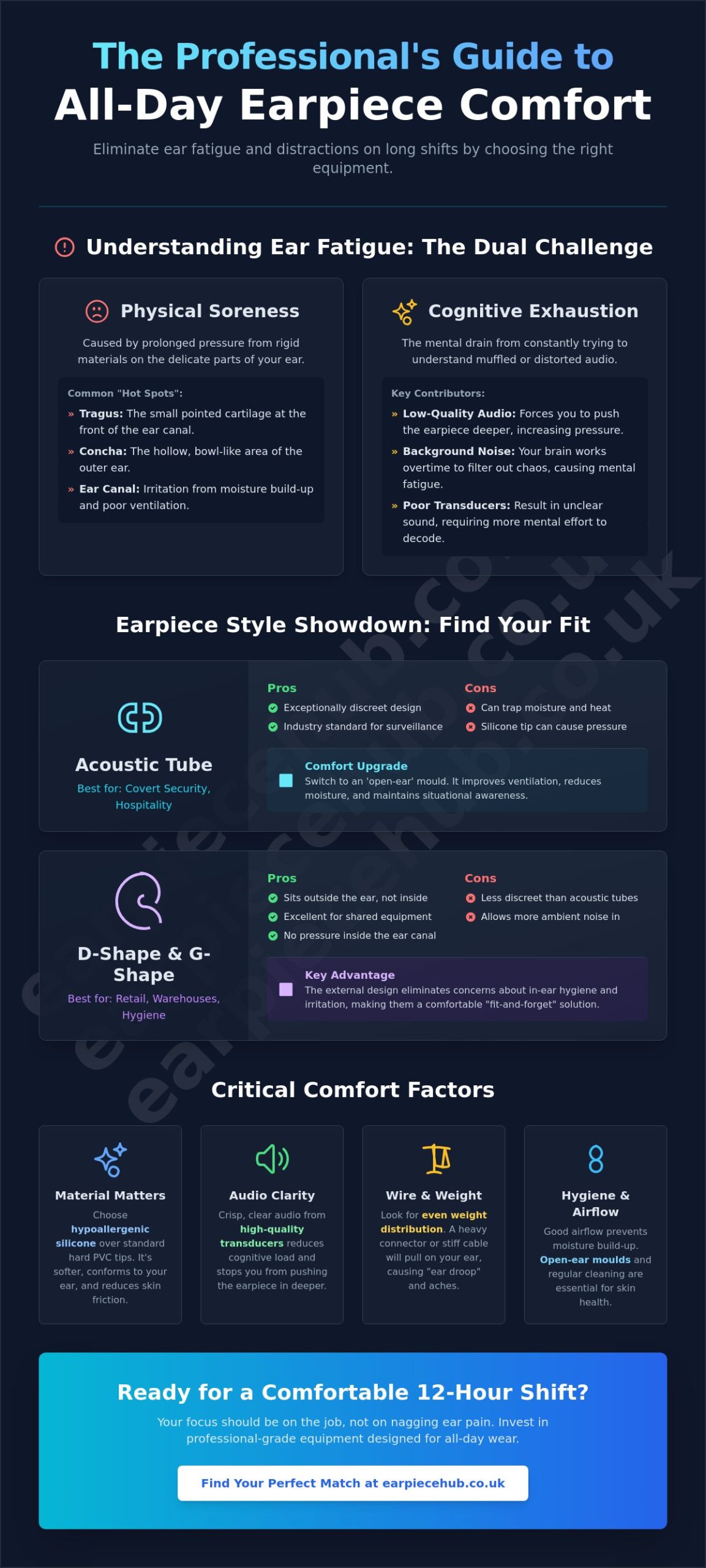
Ear fatigue represents a dual challenge for security professionals and event staff. It combines physical soreness with cognitive exhaustion. Physical fatigue occurs when the rigid materials of a standard earpiece press against the delicate cartilage of the pinna. Over a 12-hour shift, these “hot spots” become unbearable. Cognitive fatigue is more subtle. It happens when your brain constantly struggles to decode distorted audio. This mental effort leaves you drained by the end of your shift. Finding a comfortable all-day radio earpiece requires understanding how these factors interact.
Moisture build-up is another significant factor during long shifts. Acoustic tubes can trap heat and perspiration within the ear canal. This creates a humid environment that leads to itching or skin irritation. Switching to open ear inserts or high-quality silicone tips allows for better airflow. This keeps the ear canal dry and comfortable whilst you remain focused on your surroundings.
Pressure Points and Skin Irritation
Most entry-level equipment uses standard PVC tips. These are often too hard for prolonged contact. Hypoallergenic silicone is the professional alternative. It conforms to the ear’s shape and reduces friction. Two specific areas of the ear, the tragus and the concha, are particularly sensitive. The tragus is the small pointed part of the outer ear, whilst the concha is the hollow bowl-like area. Both are prone to irritation if the earpiece is too large or rigid.
When an earpiece doesn’t fit perfectly, the weight of the connector can lead to “ear droop.” This constant pulling irritates the skin and causes the outer ear to ache. Professionals need equipment that respects these anatomical boundaries. High-quality kits distribute weight evenly, preventing the earpiece from dragging on the ear during movement.
Audio Clarity and Cognitive Load
Audio quality directly impacts physical comfort. If the sound is muffled, your natural reaction is to press the earpiece deeper into your ear canal. This increases pressure and worsens pain. High-quality transducers ensure that voices are sharp and distinct. When you match the earpiece transducer to your radio’s specific output, you eliminate the need for excessive volume.
Understanding the mechanics of different types of earpieces helps in selecting the right tool for the job. In high-noise environments, like concert venues or busy retail centres, clear communication is vital. Noise-cancelling features are not just for audio fidelity; they reduce the mental effort required to stay alert. By filtering out background chaos, these features lower your cognitive load. You stay sharper for longer, making a comfortable all-day radio earpiece an essential part of your professional kit.
Comparing Earpiece Styles: Acoustic Tube, D-Shape, and G-Shape
Selecting a comfortable all-day radio earpiece involves more than just checking connector compatibility with your handset. You must match the physical design to your specific work environment and ear anatomy. While one style might offer superior covertness, another might provide the ventilation needed for a high-intensity shift. Most professionals find that their choice of earpiece style is the single most important factor in preventing shift-long discomfort.
If you are unsure which style suits your team, you can explore the full range of professional accessories at Earpiece Hub to compare technical specifications. Below, we break down the four primary styles used in the industry today.
Acoustic Tubes: Covertness vs. Canal Comfort
Acoustic tubes are the industry standard for covert security and high-end hospitality. They use a clear plastic tube to carry sound from a transducer to a ‘mushroom’ tip inside the ear. This design is incredibly discreet, but the silicone tip creates a seal that can cause pressure changes and moisture build-up over several hours. This is often the primary cause of itching and irritation during long shifts.
To improve comfort whilst wearing a tube, many professionals switch to an ‘open-ear’ mould. These soft plastic inserts allow ambient sound to enter the ear canal, maintaining your situational awareness. They also provide much-needed ventilation, making them a vital upgrade for anyone seeking a comfortable all-day radio earpiece in a surveillance role.
D-Shape and G-Shape: The External Specialists
For those who find in-ear tips intrusive, external styles like the D-shape and G-shape offer a practical alternative. These designs are particularly useful in shared equipment environments where hygiene is a priority, as they do not enter the ear canal.
- D-Shape: This is a firm favourite for retail and warehouse staff. The earpiece loops over the outside of the ear, allowing it to sit securely without applying internal pressure. It is easy to clean and quick to put on or take off.
- G-Shape: Offering a more secure fit than the D-shape, this style is ideal for active roles like door supervisors. The ‘G’ design wraps around the ear, ensuring the speaker stays aligned with the ear canal even during physical activity.
- C-Shape (Swivel): This is the best ‘one-size-fits-all’ option. The swivel mechanism allows the earpiece to adjust to varied ear sizes and shapes, preventing the wire from twisting or pulling against the skin.
G-shape earpieces also offer a distinct ergonomic advantage for users who wear glasses. Because the hook is thinner and more flexible than a D-shape, it sits more comfortably alongside the arms of your spectacles. Modern G-shapes often include a swivel mechanism that allows the speaker to rotate, ensuring a perfect fit regardless of which ear you prefer to use.
Wire Configurations and Their Impact on All-Day Wear
While the style of the ear-tip is vital, cable architecture directly dictates the “Pull Factor.” This term refers to the tension created when you move your head or torso. If a wire is too short or lacks sufficient flexibility, it constantly drags the earpiece out of position. This friction causes the “hot spots” mentioned earlier. Selecting a comfortable all-day radio earpiece requires a configuration that distributes weight across your clothing rather than your cartilage.
Cable routing is a specialist consideration. A poorly managed wire snagging on a door handle or equipment vest can instantly dislodge your earpiece. High-quality kits use reinforced cabling that resists tangling whilst remaining supple enough to follow your natural movements. This stability is the difference between a secure fit and constant readjustment.
1-Wire vs 2-Wire: Choosing Your Setup
1-wire systems are the most common choice for retail and light event work. A single cable runs from the radio to the earpiece, with the PTT (Push-to-Talk) button located in-line. These are simple to deploy and ideal for shorter shifts. However, the weight of the entire cable hangs from the ear. To mitigate this, you must use clothing clips to anchor the wire to your collar. This simple step transfers the load to your uniform, preventing the earpiece from sagging.
A 2-wire system is the professional standard for long-duration shifts. By separating the earpiece wire from the PTT and microphone line, you achieve far better weight distribution. You can route the PTT down your sleeve to your cuff or clip it to the centre of your chest. This configuration ensures that no single point of contact bears the weight of the equipment. For high-stakes surveillance, 3-wire systems provide the ultimate covert setup, allowing each component to be hidden amongst your clothing for maximum stability and discretion.
The Role of the PTT (Push-to-Talk) Button
The PTT button is your primary interface. Its placement and tactile response affect your cognitive load. If you have to hunt for a fiddly button, you’re distracted from your surroundings. In-line PTT buttons are discreet but can rotate on the wire. Separate “barrel” PTT buttons are often preferred by security professionals because they are easier to locate by touch, even whilst wearing gloves.
Ergonomics are essential to prevent repetitive strain during frequent communications. Ensure your PTT clip is robust enough to stay anchored to your suit or tactical vest. A clip that frequently slips causes the wire to slacken, which increases the pull on your ear. A comfortable all-day radio earpiece stays in place because the secondary components, like the PTT, remain firmly fixed to your person.
Customisation and Hygiene: The Secret to Long-Term Comfort
Many professionals overlook the direct link between hygiene and physical pain. A dirty earpiece is an uncomfortable earpiece. Over time, skin oils, sweat, and earwax degrade the materials of your equipment, causing them to lose their flexibility. When the components become stiff, they turn into abrasive surfaces that irritate the skin. Maintaining a comfortable all-day radio earpiece requires a commitment to regular maintenance and the timely replacement of consumable parts. Treating your gear with the same care as a piece of precision medical equipment will significantly extend its lifespan and your own comfort levels.
The Upgrade: Soft Silicone Ear Moulds
The standard ‘mushroom’ tip included with most kits is a generic, one-size-fits-all solution. It often fails to provide a secure fit for varied ear shapes, leading to the pressure points discussed in earlier sections. Soft silicone ear moulds, frequently referred to as ‘open ear inserts’, are the professional’s choice for 12-hour shifts. These moulds sit comfortably in the concha of the ear rather than sealing the canal. This design allows for superior airflow, which prevents the moisture build-up and itching that plagues standard acoustic tubes.
Size selection is critical for success. Most manufacturers offer these moulds in Small, Medium, and Large. To find your perfect match, measure the height of the concha bowl of your ear. A well-fitted mould stays in place during physical activity without applying internal pressure. Using ‘Left’ and ‘Right’ specific moulds ensures the ergonomic curves match your ear’s natural anatomy perfectly, allowing ambient sound to enter the ear whilst you receive radio traffic. This maintains your situational awareness in busy environments.
Hygiene Protocols for Professional Users
Skin health is paramount when wearing equipment for extended periods. Contact dermatitis is a common issue amongst radio users who neglect their daily cleaning routine. You should use non-alcoholic wipes every day to remove oils from the ear-tip and the wire. Avoid alcohol-based cleaners; they can cause silicone and PVC materials to dry out and crack, which creates even more skin irritation. If you notice your acoustic tube has started to ‘harden’ or has taken on a yellowed appearance, it’s time for a replacement.
Acoustic tubes have a finite lifespan. Exposure to body heat and UV light eventually makes the plastic brittle. Hardened tubes transmit less sound and put significantly more physical strain on the ear. You should replace your ear tips and acoustic tubes every 3 to 6 months to ensure both audio clarity and skin safety. Never share earpieces within a team. Personal-issue equipment is the only way to prevent the spread of ear infections. If your team uses shared radios, ensure you have your own personal kit of replacement acoustic tubes and ear tips to swap onto the device at the start of every shift.
Finding Your Perfect Match at Earpiece Hub
Choosing a comfortable all-day radio earpiece shouldn’t be a gamble. At Earpiece Hub, we position ourselves as the central resource for professionals who cannot afford equipment failure. Our selection process is rigorous. We only stock accessories that meet strict professional durability standards. Every product in our inventory is tested to ensure it survives the demands of 12-hour shifts in high-pressure environments like security, events, and retail centres.
Reliability is our core character trait. We understand that equipment needs often arise on short notice. This is why we offer next-day shipping and 24/7 support. It ensures your team remains connected without unnecessary downtime. Whether you’re managing a small retail team or a large-scale security operation, we provide the technical equipment you need with minimal fuss. Our goal is to be your dependable partner in communication.
Tailored Solutions for Motorola, Hytera, and Kenwood
We provide specialist accessories designed for the industry’s leading brands. Our Acoustic Tube Earpiece for Motorola Radios is a top choice for those using the Motorola DP1400. For teams using Hytera or Kenwood multi-pin radios, we offer dedicated D-Shape and G-Shape options that ensure a secure, ergonomic fit. These aren’t generic imitations; they’re functional tools built for specific hardware.
- Acoustic Tube Earpiece for Motorola Radios: Ideal for covert surveillance.
- D-Shape Earpiece for Hytera Radios: Perfect for shared hygiene environments.
- G-Shape Earpiece for Kenwood Radios: The standard for active door supervisors.
- Universal earpieces and headsets: Flexible solutions for mixed-brand radio fleets.
If your fleet includes various radio models, our earpiece adapters for any radios allow for total flexibility. You can maintain your favourite comfortable all-day radio earpiece even if your radio hardware changes. This universal compatibility protects your investment and ensures consistent comfort across your entire team, regardless of the handset they carry.
The Earpiece Hub Advantage
We’re a UK-based specialist. We understand the physical toll of a long shift and the “all-day” struggle caused by poor equipment. Beyond earpieces, we stock a comprehensive range of essentials, including the Replacement Battery for Motorola DP1400 and six-way multi-unit chargers. This specialist focus ensures you get the right technical specifications the first time. Professional communication is about more than just sound; it’s about reliable, durable equipment that works as hard as you do.
While earpiece comfort is vital for field work, those who manage security operations from a control room should also prioritise their physical well-being; to create a more supportive workspace, you can explore I-Easy dual motors Electric Standing Desk for advanced ergonomic benefits.
Don’t settle for equipment that causes pain or fails when you need it most. Shop our range of comfortable all-day radio earpieces today and experience the difference that specialist equipment makes to your daily performance.
Optimise Your Communication Comfort
Eliminating ear pain during long shifts is a matter of technical precision. You now understand how pressure points in the concha and the cognitive strain of poor audio contribute to fatigue. By selecting the correct style, whether it’s an Acoustic Tube for covertness or a G-shape for active roles, you can maintain professional focus for the full 12 hours. Regular maintenance and soft silicone upgrades are essential for long-term skin health and equipment durability.
Earpiece Hub is your dedicated partner for high-performance accessories. We specialise in Motorola, Hytera, and Kenwood equipment, ensuring your gear meets the highest durability standards. We understand the stakes. With our UK-based support and next-day shipping, you can secure the right equipment exactly when you need it. It’s time to stop the itching and soreness that distracts you from your duty. Upgrade to a comfortable all-day radio earpiece at Earpiece Hub today. Stay sharp, stay connected, and stay comfortable whilst on the front line.
Frequently Asked Questions
What is the most comfortable radio earpiece for 12-hour shifts?
The most comfortable all-day radio earpiece for extended shifts is typically a G-shape or an acoustic tube fitted with a soft silicone open-ear mould. These designs avoid sealing the ear canal, which prevents the moisture build-up and pressure changes that cause pain. For active roles, the G-shape offers the most secure fit whilst remaining external to the ear canal.
Why does my ear hurt after wearing a radio earpiece for a few hours?
Pain usually occurs due to “hot spots” where rigid plastic components press against the sensitive cartilage of the pinna or tragus. Over time, this constant pressure restricts blood flow and causes physical soreness. Additionally, standard PVC tips can trap perspiration in the ear canal, leading to itching and skin irritation that worsens as the shift progresses.
Can I use a custom ear mould with my standard acoustic tube earpiece?
Yes, you can easily upgrade a standard acoustic tube by replacing the mushroom tip with a semi-custom ear mould. These moulds are designed to fit the natural anatomy of the concha bowl. They provide a much more stable and comfortable experience for long-term wear whilst allowing ambient noise to reach the ear, improving your situational awareness.
How often should I replace my earpiece ear tips for hygiene and comfort?
You should replace your ear tips and acoustic tubes every 3 to 6 months to maintain skin health and audio clarity. Over time, these components absorb skin oils and sweat, causing the material to harden and become abrasive. Fresh silicone tips ensure a soft, flexible fit that prevents the build-up of bacteria and protects the ear from irritation.
Is a G-shape or D-shape earpiece better for people who wear glasses?
A G-shape earpiece is generally the superior choice for professionals who wear spectacles. The hook design is thinner and more supple than the rigid frame of a D-shape earpiece. This allows the G-shape to sit flush against the ear alongside the arms of your glasses without creating painful pressure points behind the ear.
What is the difference between a 1-wire and 2-wire radio earpiece?
A 1-wire earpiece uses a single cable for both the speaker and the PTT button, which is often preferred for simplicity. A 2-wire system separates the earpiece from the PTT and microphone line. This configuration allows for better weight distribution and lets you route the PTT to your cuff or chest, reducing the weight hanging from your ear.
How do I stop my radio earpiece from falling out when I move?
Stopping an earpiece from falling out requires managing the “pull factor” by using clothing clips to anchor the wires to your uniform. This transfers the weight of the cable from your ear to your clothing. Ensuring you have the correct size of ear mould, such as a medium or large insert, also provides the anatomical grip needed for a comfortable all-day radio earpiece.
Are there earpieces that allow me to hear my surroundings whilst using the radio?
External earpieces like G-shape or D-shape styles sit outside the ear canal, leaving your ambient hearing completely unobstructed. If you prefer the discreet look of an acoustic tube, you can use an “open-ear” silicone mould. This allows sound waves to pass into the ear canal naturally whilst you receive clear radio transmissions at the same time.
