





Uncategorized
Covert Acoustic Tube Earpiece Buying Guide: Choosing Professional Gear for 2026

Jun
Imagine your lead security officer goes silent during a critical intervention because a sub-standard connector failed at the worst possible moment. It’s a high-stakes nightmare that highlights why your choice of a covert acoustic tube earpiece is a vital operational decision rather than a simple purchase. You understand that in the fast-paced world of security and hospitality, reliable gear is the backbone of a safe environment. Shifting through a 12-hour rotation shouldn’t mean enduring constant ear discomfort or worrying about whether your earpiece will actually transmit when it matters most.
We’ve designed this guide to help you master the technical nuances of professional communication gear for 2026. You’ll learn how to select the perfect setup to ensure crystal-clear, discreet communication for your entire team. We’ll examine the specific benefits of 1, 2, and 3-wire architectures, discuss the latest durability trends like Kevlar-reinforced cabling, and provide a clear path to verifying compatibility with your Motorola or Hytera radio fleet.
Key Takeaways
- Learn why the clear tube design remains the gold standard for discreet security operations and how air vibration technology ensures clear audio.
- Discover how to match your specific operational role to the right wiring configuration, from low-profile 1-wire setups to fully concealed 3-wire systems.
- Avoid costly compatibility errors by mastering the technical differences between Motorola 2-pin and multi-pin connectors for your covert acoustic tube earpiece.
- Maximise the longevity and hygiene of your equipment with professional maintenance tips and scheduled replacement cycles for tubes and ear tips.
- Ensure your security or hospitality team remains connected with verified gear that balances technical reliability with all-day wearing comfort.
What is a Covert Acoustic Tube Earpiece?
A covert acoustic tube earpiece is a specialised audio peripheral engineered for professional two-way radio users. It isn’t a standard earphone; it’s a precision tool designed for high-stakes environments. These devices use a clear, hollow plastic tube to deliver audio from a transducer directly into the ear canal via air vibration. This specific design choice ensures high-fidelity sound whilst maintaining a low profile. Security professionals, door supervisors, and event managers rely on this equipment to stay connected with their teams without drawing attention to their communication hardware.
The “covert” advantage is found in the nearly transparent nature of the acoustic tube. When properly fitted, the tube follows the natural contour of the neck and ear, making it virtually invisible to the casual observer from a distance. This level of discretion is the established industry standard for close protection officers and retail loss prevention teams who must blend into crowds whilst remaining operationally ready. The mechanism works by converting electrical signals into sound waves through a transducer, which then travel through the air-filled tube. This prevents the “sound leakage” common in standard headsets, ensuring your communications remain private.
The Anatomy of a Professional Earpiece
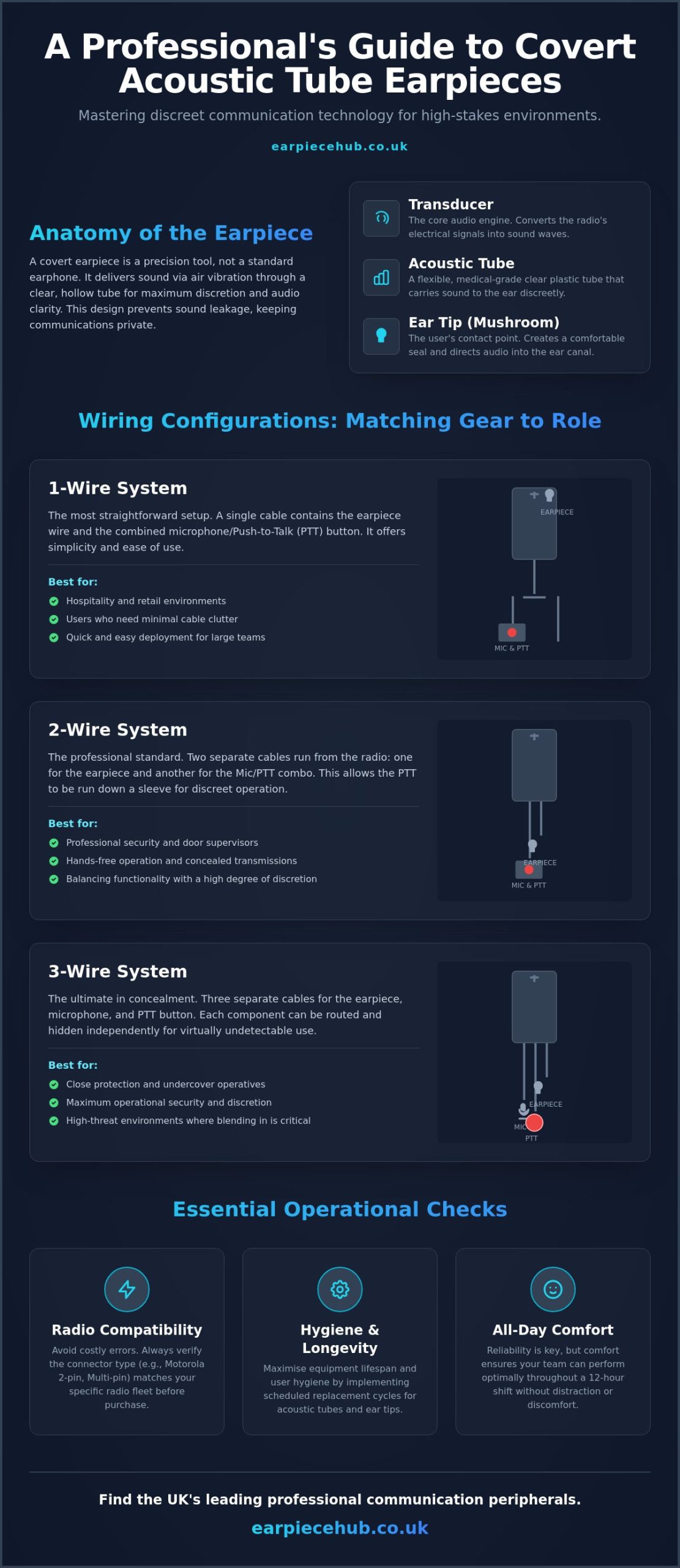
Understanding the hardware helps you choose the right gear for your fleet. A professional setup consists of three core components:
- Transducer: The heart of the audio system. It sits at the base of the tube and converts electrical signals from the radio into physical sound waves.
- Acoustic Tube: Constructed from medical-grade, clear plastic, this tube acts as a conduit for sound. Its flexible nature allows for a comfortable fit that doesn’t restrict head movement during a 12-hour shift.
- Ear Tip (Mushroom): This is the contact point with your ear. While the standard “mushroom” tip is common, many professionals upgrade to semi-custom earmoulds for better stability in high-movement roles.
Why Professionals Favour Acoustic Tubes
The preference for this technology amongst industry veterans is driven by functionality. First, the covert acoustic tube earpiece provides a passive seal in the ear, which helps reduce ambient noise. This allows the wearer to hear radio traffic clearly even in loud nightclubs or busy event centres. It’s a significant advantage over G-shape or D-shape alternatives in high-decibel environments.
Hygiene is another critical factor for professional teams. In large fleets where radios might be shared, the acoustic tube and ear tip are the only parts that touch the user’s skin. These components are inexpensive and easy to replace. Managers can issue a fresh tube to each staff member, ensuring a sanitary environment without replacing the expensive electronic transducer or wiring. This modularity makes it the most cost-effective and hygienic choice for modern security operations.
Wiring Configurations: 1-Wire, 2-Wire, and 3-Wire Compared
In the professional radio industry, “wire count” refers to the number of separate cables running from your radio connector to your interface points. Selecting the right configuration is a balance between ease of use and the level of concealment required for your specific role; understanding these differences ensures you don’t buy gear that hinders your team’s physical movements during a shift. While a single wire might suffice for a retail floor, a high-threat security detail demands a more complex architecture to maintain total discretion.
1-Wire and 2-Wire Systems
A 1-wire system is the most straightforward covert acoustic tube earpiece setup. It uses a single cable that splits near the top into the earpiece and a combined microphone and PTT (Push-to-Talk) button. This configuration is best for hospitality environments where the radio is worn on the belt and the microphone is clipped to the chest or lapel for easy access. It’s simple to put on and minimises cable clutter for staff who aren’t concerned with total concealment.
The 2-wire setup is where professional security begins. It features two separate cables: one for the earpiece and another for the combined microphone and PTT button. This allows the PTT to be run down a sleeve for discreet operation, enabling the user to transmit by simply pressing a button in their palm. Door supervisors favour the 2-wire configuration because it allows them to communicate with the team whilst maintaining a professional, hands-free stance that doesn’t alert the public to their radio traffic.
3-Wire Professional Setups
For those in close protection or undercover roles, the 3-wire system is the gold standard. It provides the maximum level of discretion by separating the earpiece, the microphone, and the PTT button into three distinct lines. This is often called the “Bodyguard” setup because it allows for total concealment. The architecture includes:
- Dedicated Earpiece: A single line for crystal-clear incoming audio.
- Lapel Microphone: A separate line for a microphone that can be hidden under a tie or collar.
- Palm PTT: A discreet line run down the sleeve for immediate, invisible activation.
This setup is ideal for high-stakes security environments where even a small gesture towards a lapel mic could compromise an operative’s position. When your role demands that you blend perfectly into a crowd whilst staying in constant contact, the 3-wire architecture is the only viable choice. If you’re looking to equip a professional team, you can explore our specialist wiring options to ensure your gear matches your operational requirements. Each system is built to withstand daily use in the most demanding UK environments.
Selecting the Correct Connector for Your Radio Fleet
Choosing the right connector is the single most critical technical decision when purchasing a covert acoustic tube earpiece. It isn’t just about the plug fitting into the socket; it’s about ensuring a secure electrical interface that maintains signal integrity under physical stress. Getting this wrong leads to more than just silence. It often results in intermittent audio that cuts out during a confrontation or, in some cases, bent pins that permanently damage your radio’s accessory port. Professional radio brands use proprietary pin configurations to ensure their gear remains locked in place, and identifying these specific standards is vital for operational readiness.
Motorola DP1400 and Professional Series
The Motorola DP1400 is a workhorse for UK security and event teams. This model uses the M1 2-pin connector, a design favoured for its simplicity and robust connection. When you’re equipping a team using these handsets, you should also consider the synergy between your audio peripherals and your power supply. Sourcing a fresh Replacement Battery for Motorola DP1400 ensures your radio has the consistent voltage required to drive the earpiece transducer at full volume throughout a long shift. For users on higher-tier digital platforms like the DP4000 or MTP series, you’ll need multi-pin connectors. These provide a more complex data interface and are often required for advanced noise-cancelling features. Always verify if your radio is operating on a digital or analogue signal, as this can occasionally affect the impedance requirements of your earpiece hardware.
Hytera and Kenwood Compatibility
Kenwood and Hytera handsets are prevalent across both licence-free and professional sectors. The Kenwood 2-pin (K1) standard is perhaps the most widely used connector in the industry. It’s the default for most Kenwood professional handsets and many universal radio models. However, don’t assume all 2-pin plugs are identical. Hytera uses distinct connectors across their range. For instance, a PD505 requires a different pin configuration than a PD705. Verification is the only way to avoid buying the wrong gear. We recommend checking the exact model number on the white sticker located behind your radio’s battery before you order. While universal earpiece adapters exist to help manage mixed fleets, they can add physical bulk and occasionally introduce a slight signal hiss. For roles where clear communication is non-negotiable, a brand-specific covert acoustic tube earpiece with a native connector is always the most reliable choice.
Maximising Comfort and Longevity in Professional Environments
Professional security work often involves 12-hour shifts where your equipment must perform without fail. A covert acoustic tube earpiece is a physical extension of your uniform, and its comfort level directly impacts your operational focus. If an earpiece causes pain or requires constant adjustment, it becomes a distraction during critical moments. Beyond comfort, longevity depends on how you manage the physical stresses placed on the cabling and the internal hygiene of the tube itself. High-quality gear often features Kevlar-reinforced wiring to prevent internal snapping, but even the toughest cables can fail if they aren’t routed correctly under clothing to avoid snags during physical interventions.
Cable stress is a common cause of equipment failure in the field. To extend the life of your gear, always route the wires under your shirt and secure them with the provided clips. This prevents the weight of the radio from pulling on the transducer connection and stops the wire from catching on external objects. We recommend a replacement cycle of 3 to 6 months for the acoustic tube and ear tip. Over time, the plastic will lose its flexibility and may become brittle or discoloured due to UV exposure and skin oils. Regular replacement ensures the “hygiene part” of your setup remains sanitary and the audio remains sharp.
Hygiene and Cleaning
Condensation is the primary enemy of audio clarity in an acoustic system. As you breathe and move, body heat creates moisture inside the clear tube which eventually forms droplets that block sound waves. You can clear this whilst on shift by detaching the tube from the transducer and blowing a quick burst of air through it. For daily upkeep, clean the mushroom tip with alcohol-free wipes. Avoid alcohol-based cleaners as they can degrade the medical-grade plastic over time. If you notice muffled audio or a persistent crackle that isn’t related to radio interference, it is often a sign that the transducer is failing or the tube is blocked with earwax.
Ear Tip Variations
The standard “mushroom” tip is the most common choice for multi-user fleets because it’s inexpensive and fits most ear shapes quickly. However, for long-term comfort, professionals often upgrade their covert acoustic tube earpiece with specific inserts. An open-ear insert is a popular alternative; it sits inside the concha of the ear without blocking the canal, allowing you to hear ambient sounds and face-to-face conversations whilst simultaneously monitoring radio traffic. For the ultimate secure fit, custom earmoulds are available in left or right-ear versions. These provide maximum stability during high-movement tasks and are the preferred choice for close protection officers. To maintain your team’s performance, you can shop our range of replacement acoustic tubes and ear tips for next-day delivery across the UK.
Why Earpiece Hub is the UK’s Specialist for Communication Peripherals
Choosing a covert acoustic tube earpiece is only the first step in building a resilient communication network. Earpiece Hub serves as a central resource for security professionals across the UK, providing the technical expertise and logistics support required to keep teams operational. We understand that in high-stakes environments, there’s no room for equipment failure or delayed shipments. Our inventory is curated specifically for the rigours of UK security work, ensuring every component meets the demands of 12-hour rotations and high-movement roles. We don’t just sell products; we provide the technical infrastructure that keeps your team connected.
Beyond the Earpiece: Full Fleet Support
Maintaining a professional radio fleet involves more than just earpieces. We provide comprehensive support for your entire inventory to ensure total operational readiness. This includes sourcing a Replacement Battery for Motorola DP1400 to ensure your handsets don’t die mid-shift, and providing a Six-Way Multi-Unit Charger to keep your equipment organised and ready in the briefing room. If you manage a mixed fleet of Motorola, Hytera, and Kenwood radios, our specialists can advise on the correct Earpiece adapter for any radios to ensure cross-brand compatibility without sacrificing audio quality. This holistic approach to fleet management minimises downtime and simplifies your procurement process by providing a single, reliable point of contact for all accessories.
The Earpiece Hub Guarantee
Reliability is our core character trait. We prioritise professional-grade hardware over consumer-level alternatives because we know the cost of failure in the field is too high. Our commitment to your operation includes 24/7 support for technical enquiries and compatibility checks, ensuring you never buy the wrong connector for your specific radio model. We’ve built our reputation on being a dependable partner that understands the urgency of security operations. With next-day delivery available across the UK, we act as an essential resource for urgent operational requirements. Whether you’re equipping a new team or replacing worn components, we provide the gear you need with minimal fuss and maximum technical precision.
Shop our range of professional covert acoustic tube earpieces today to secure your team’s communication for 2026 and beyond.
Secure Your Team’s Communication for 2026
Mastering the technical details of your radio gear ensures your team remains connected when it matters most. You now understand how to match specific wiring configurations to operational roles and why verifying your connector type is the only way to avoid costly downtime. A high-quality covert acoustic tube earpiece is a foundational tool for any professional security or hospitality fleet. By prioritising hygiene and regular maintenance cycles, you guarantee that your equipment performs reliably throughout every shift.
Earpiece Hub has supported industry professionals as a reliable specialist since 2015. We provide expert UK-based support to help you navigate technical specifications and ensure total fleet compatibility. Our commitment to professional-grade hardware means you don’t have to settle for consumer-level alternatives that fail under pressure. With Next Day Shipping available, you can equip your team with the latest peripherals without missing a beat. Take the next step in professionalising your radio communications today.
Browse Professional Covert Earpieces at Earpiece Hub
Frequently Asked Questions
How do I know if an earpiece is compatible with my Motorola radio?
You must identify the specific pin configuration of your handset, as Motorola uses several proprietary designs. Most entry-level professional models like the DP1400 use the M1 2-pin connector, whilst higher-tier digital radios require multi-pin interfaces. To be certain, check the exact model number on the white sticker located behind your radio’s battery and match it against our compatibility lists before purchasing.
What is the difference between a 1-wire and a 2-wire covert earpiece?
The primary difference lies in the cable architecture and how you wear the device. A 1-wire system combines the microphone and Push-to-Talk (PTT) button on a single cable, making it ideal for hospitality roles where the radio is on the belt. A 2-wire covert acoustic tube earpiece separates the earpiece and the mic/PTT into two lines, allowing you to run the PTT down your sleeve for discreet palm activation.
Can I clean my acoustic tube or should I replace it?
While you can clear moisture and debris on shift, we recommend replacing the acoustic tube every 3 to 6 months for hygiene and performance. You can blow air through the tube to remove condensation, but the plastic eventually becomes brittle or discoloured from skin oils and UV exposure. Replacing the tube is a low-cost way to ensure your audio remains crisp and your setup stays sanitary.
Why is the audio in my acoustic tube earpiece muffled?
Muffled audio is almost always caused by a physical blockage within the covert acoustic tube earpiece or the transducer. Condensation often builds up inside the tube, creating water droplets that stop sound waves from travelling effectively. Alternatively, earwax may have migrated into the mushroom tip or the transducer nib. Detach the tube and blow it through to see if clarity returns; if not, it’s time for a replacement.
Do I need a different earpiece for a digital radio versus an analogue one?
Most professional handsets use the same accessory port for both digital and analogue signals, so a standard earpiece will typically function on both. However, some advanced digital radios require specific impedance matching to support noise-cancelling features or data transmission. Always verify that your chosen peripheral is rated for your specific digital series to ensure you don’t experience a persistent background hiss or low volume levels.
What are the benefits of using an open-ear insert instead of a mushroom tip?
An open-ear insert provides superior situational awareness by leaving the ear canal unobstructed. Unlike the standard mushroom tip that plugs the ear, the open-ear design allows you to hear ambient sounds and face-to-face conversations clearly whilst simultaneously monitoring your radio traffic. This is the preferred choice for close protection officers who must remain alert to their physical surroundings during a long shift.
How often should I replace the ear tip on my covert earpiece?
We recommend replacing your ear tip every 3 to 6 months to maintain hygiene and comfort. Constant contact with the ear canal leads to a buildup of bacteria and skin oils, which can cause ear infections if the tip isn’t cleaned or swapped regularly. If the silicone starts to feel hard, loses its shape, or becomes permanently discoloured, you should replace it immediately to avoid discomfort.
Is it possible to use one earpiece with different radio brands using an adapter?
It’s possible to use adapters for cross-brand compatibility, though native connectors offer the most secure interface. If your fleet includes a mix of Motorola and Kenwood handsets, an adapter can save you from buying two separate sets of gear. Just be aware that adapters add physical bulk to the radio and can sometimes be a weak point for moisture ingress or signal interference in high-interference environments.
