





Uncategorized
The Comprehensive Guide to Choosing a Security Radio Earpiece in 2026
Jun
You might believe the brand name on your radio is the most critical factor for clear communication, but the real secret to a reliable security radio earpiece lies in its wire configuration and physical shape. It is a common frustration to have equipment fail during a critical incident or snag on a door handle mid-shift. Most professionals have struggled with uncomfortable ear tips or muffled audio that makes a 12-hour shift feel even longer. We recognise that gear which breaks easily or lacks a discreet profile is simply not fit for purpose in a high-stakes environment.
This guide will help you master the technical specifications of security earpieces to ensure crystal-clear communication and long-term reliability for your team. You will learn how to choose between 1-wire, 2-wire, and 3-wire systems whilst ensuring total compatibility with your Motorola or Kenwood units. We also preview the impact of the March 2026 FCC “Covered List” updates and how to select ergonomic designs that maintain a professional appearance in any conditions.
Key Takeaways
- Identify the most effective earpiece architecture—Acoustic Tube, D-Shape, or G-Shape—based on your specific noise levels and comfort requirements.
- Master the technical specifications of 1-wire, 2-wire, and 3-wire configurations to select a security radio earpiece that matches your team’s tactical needs.
- Avoid costly audio failures by learning to match specific connector types to Motorola, Hytera, and Kenwood radio models.
- Gain expert insights into maintaining audio clarity and extending equipment lifespan with professional-grade replacement parts.
- Understand why specialist communication gear outperforms standard consumer earphones in high-stakes security environments.
Choosing the Right Security Radio Earpiece for Professional Use
A security radio earpiece is the final, most vulnerable link in your communication chain. If this component fails, even the most expensive radio handset becomes a useless weight on your belt. Professionals understand that standard consumer earphones simply don’t cut it in high-stakes environments. While general headphone and earpiece technology focuses on audio fidelity for leisure, security-grade equipment prioritises reliability, durability, and operational discretion above all else.
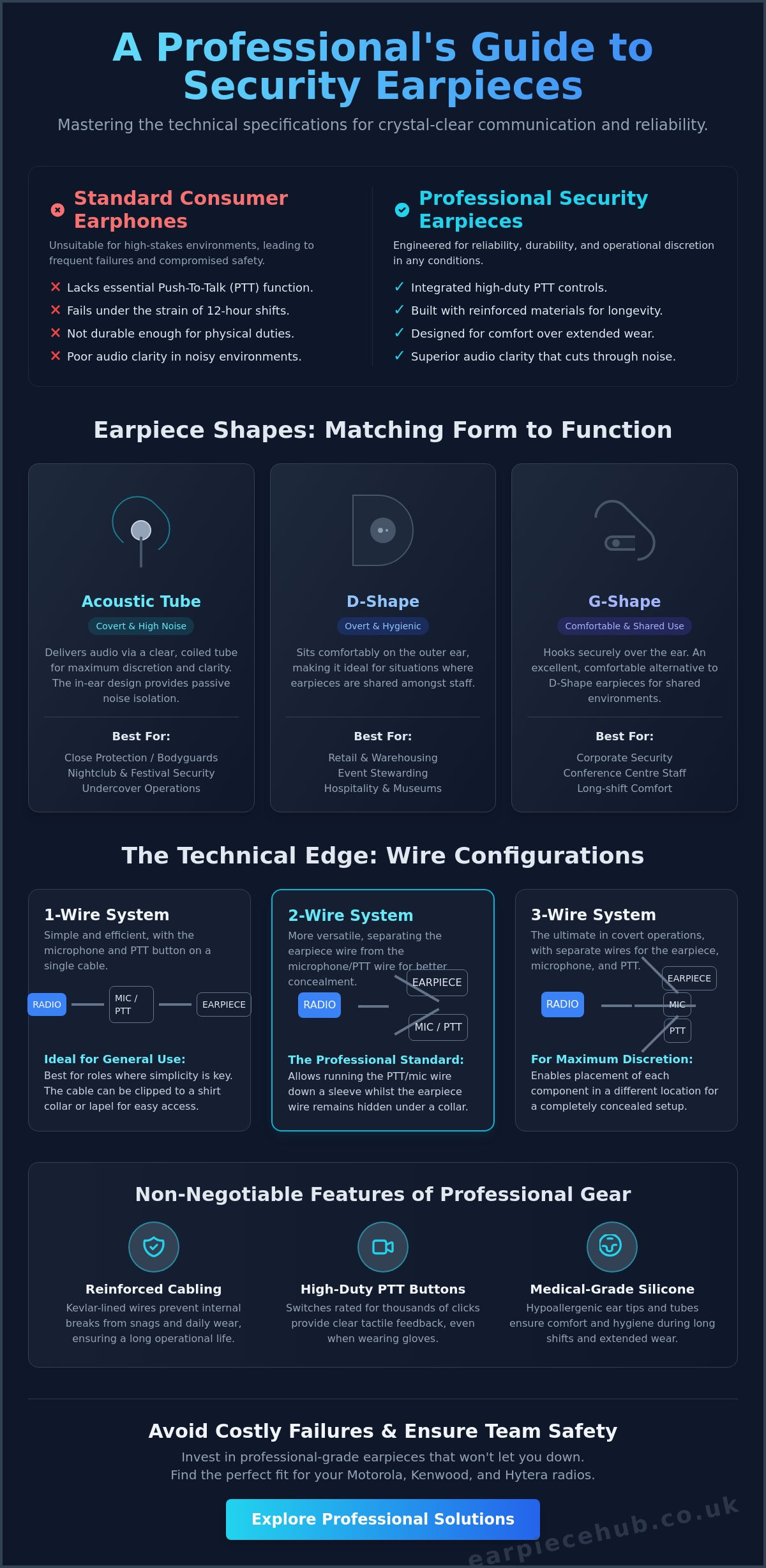
Choosing the wrong accessory often leads to audio failure during critical incidents. Consumer-grade buds lack the essential Push-To-Talk (PTT) functionality and fail under the strain of 12-hour shifts. They aren’t built to survive being snagged on door handles or exposed to heavy rain. Professional accessories use reinforced materials to ensure your message gets through every time, regardless of the environment. You must match your equipment to your specific role. A door supervisor at a loud venue needs high-volume output; a close protection officer requires a covert profile that remains invisible amongst the public.
The Role of Communication in Security Operations
Reliable audio is the bedrock of team safety whilst on duty. Instant information flow allows for rapid responses that prevent minor incidents from escalating into dangerous situations. Professional earpieces are designed to filter out the background chaos of busy venues or city centres, ensuring you hear the dispatcher clearly over the noise of a crowd. There is also a significant psychological impact. A visible, professional security radio earpiece signals a prepared and organised presence, which often acts as a deterrent to antisocial behaviour before an incident even begins.
Key Features of Professional-Grade Audio Accessories
Durability is non-negotiable for equipment used daily in tough conditions. Professional-grade accessories feature several technical advantages over cheaper alternatives:
- Reinforced cabling: Quality units utilise Kevlar-lined or thick-gauge wires to prevent internal breaks when cables are snagged on clothing or equipment.
- High-duty PTT buttons: These switches are designed for thousands of cycles and provide clear tactile feedback, even whilst wearing gloves.
- Medical-grade silicone: Ear tips and acoustic tubes should be made from hypoallergenic silicone to ensure comfort and hygiene during long-term wear.
Investing in specialist gear ensures that your communication remains crystal-clear when it matters most. Low-quality components lead to muffled sound and frequent replacements, costing more in the long run and compromising your team’s effectiveness.
Understanding Earpiece Shapes: Acoustic Tube, D-Shape, and G-Shape
Selecting the correct security radio earpiece architecture is a decision that impacts both your tactical effectiveness and your physical comfort. Whilst many retailers simply list products by brand, a specialist understands that the physical shape of the earpiece dictates its suitability for specific environments. The three primary designs—Acoustic Tube, D-Shape, and G-Shape—each offer distinct advantages depending on whether you are managing a quiet retail floor or a high-decibel festival stage.
Acoustic Tube Earpieces: The Covert Choice
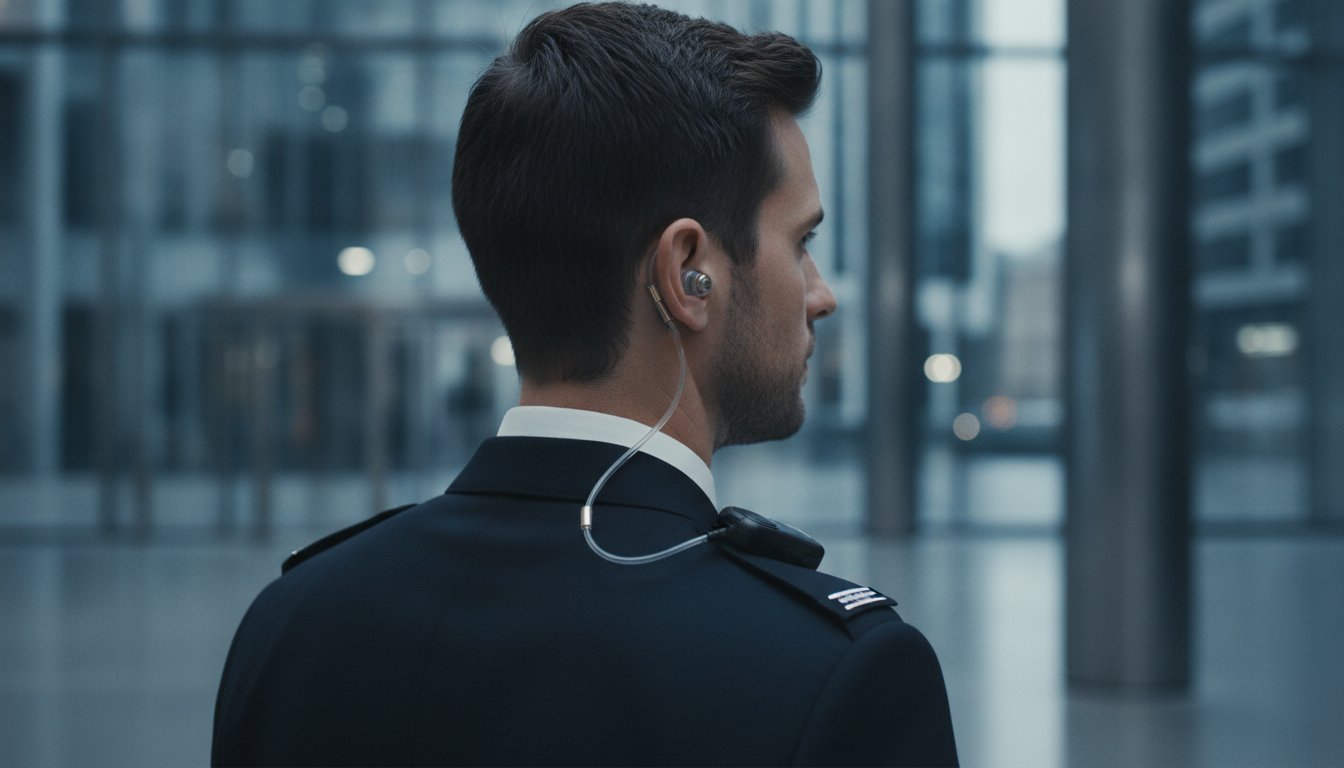
The Acoustic Tube is the industry standard for covert operations and high-noise environments. It works by delivering audio through a clear, coiled tube directly into the ear canal. This design is preferred for close protection and nightclub security because it remains nearly invisible to the public whilst providing exceptional clarity in loud spaces. Because the bud sits inside the ear, it provides a level of passive noise isolation. However, professionals must be mindful of OSHA’s noise exposure limits when working in sustained loud environments; ensuring your radio volume is set correctly is vital for long-term hearing health. If you require a discreet profile that blends into professional attire, our Acoustic Tube Earpiece for Motorola Radios offers the professional finish required for high-end security.
D-Shape and G-Shape: Overt and Shared Use
Overt earpieces like the D-shape and G-shape are designed to sit on the outer ear rather than inside the canal. This makes them the superior choice for hygiene-conscious teams where equipment might be shared amongst staff across different shifts. These shapes don’t block the ear canal, which is a major benefit for situational awareness.
The D-shape is a firm favourite for retail security and light patrols. It features a large, rubberised loop that hooks over the ear. It stays put during walking patrols but is easy to remove. Because the speaker sits outside the ear, you can hear ambient sounds and conversations clearly whilst monitoring your radio. This balance is critical for staff who need to interact with the public whilst staying connected to their team.
The G-shape, often called the “C-ring” or “Swivel” earpiece, is favoured for comfort during extended 12-hour shifts. It uses a soft, adjustable loop that wraps securely around the ear. This design is particularly effective during physical movement or confrontations. It is less likely to be dislodged than an internal bud. For those using Kenwood or Hytera systems, choosing between a D-shape or G-shape often comes down to personal preference for ear-loop tension and how the device interacts with glasses or headgear.
The Technical Edge: 1-Wire, 2-Wire, and 3-Wire Configurations
Understanding “wire” counts is essential for matching gear to your specific operational environment. In the specialist language of Earpiece Hub, these terms describe the number of separate cables exiting the radio connector. Choosing the correct configuration prevents unnecessary cable clutter and ensures your security radio earpiece remains functional during physical activity. Whilst the earpiece shapes discussed previously handle comfort, the wire configuration dictates how you actually wear the device with your uniform.
A 1-wire system is the most common all-in-one solution. It features a single cable that houses the earpiece, microphone, and Push-To-Talk (PTT) button. It’s the simplest setup for quick deployment. A 2-wire system splits the leads; one goes to the ear whilst the other carries the PTT and microphone. This allows for more tactical placement. For the highest level of discretion, a 3-wire system provides three separate leads for the ear, microphone, and PTT button. This configuration offers maximum control for covert surveillance. Regardless of the wire count, ensure your team adheres to OSHA standard 1910.95 regarding noise exposure to protect their long-term hearing health during extended shifts.
1-Wire vs 2-Wire: Which is Right for Your Team?
The 1-wire system is favoured by retail security and event staff because of its simplicity. It’s easy to put on and take off at the start of a shift. However, the PTT button is usually located on the chest, which can be awkward if you’re wearing heavy outer gear. The 2-wire setup is the preferred choice for door supervisors and patrol officers. By separating the PTT, you can run the second wire down a sleeve and clip the button to a cuff. This allows you to communicate discreetly by speaking into your wrist, reducing the “snag risk” that occurs when cables are exposed on the front of a uniform.
Surveillance Kits: The Power of 3-Wire Systems
Surveillance kits using 3-wire architecture are the gold standard for close protection and undercover work. These systems separate the microphone from the PTT button. This allows a bodyguard to hide the microphone under a lapel whilst keeping the PTT button in a pocket or clipped to a belt. Professional bodyguards prefer this level of cable control because it prevents the radio from being seen by the public. These kits integrate perfectly with covert radio harnesses, ensuring that your communication remains completely invisible whilst providing the reliability needed for VIP protection.
Ensuring Compatibility and Extending Equipment Lifespan
The most common reason a security radio earpiece fails to perform isn’t a manufacturing defect; it’s a simple lack of compatibility. Buying an earpiece that doesn’t fit your specific radio model is a waste of resources and can leave your team without communication at a vital moment. You must identify the precise connector type required for your handsets before placing an order. Even within a single brand like Motorola, the physical connection can vary significantly between entry-level and high-tier models.
Checking the pin count and connector shape is the only way to guarantee a secure fit. A loose connection causes intermittent audio or “hot mic” situations where the radio transmits without the PTT being pressed. This is why specialists categorise accessories by their specific radio series rather than just the brand name. If you are managing a diverse team with different hardware, you can shop our universal earpieces and headset range to find versatile solutions that work across mixed fleets with the right adapters.
Matching Connectors to Major Radio Brands
Motorola radios are the industry standard, but they use several different interfaces. The Motorola DP1400 typically utilises a side-mounted 2-pin connector, whereas the DP4400 and DP4800 series use a larger, multi-pin “Mototrbo” connector that screws into place for extra security. Kenwood and Hytera models also have their own specific 2-pin configurations that differ slightly in pin spacing. Always verify if your radio requires a “K1” (Kenwood) or “M1” (Motorola 2-pin) style lead. For organisations using various radio brands, earpiece adapters are a cost-effective way to make your existing accessories compatible with new radio models.
Maintenance: Preventing Audio Failure
Maintenance is the key to avoiding the “bubbling” sound or muffled audio that plagues many security teams. Condensation often builds up inside the clear acoustic tube during cold weather shifts or high-intensity activity. To maintain clear audio, clean your acoustic tube by flushing it with warm soapy water to remove debris and earwax buildup. Ensure the tube is completely dry before reattaching it to the transducer to prevent moisture from damaging the electronics.
Hygiene is equally important for team health. You should replace ear tips and acoustic tubes every three to six months, especially in shared-use environments. Proper storage also extends the life of your gear. Don’t wrap the cables tightly around the radio handset, as this causes internal wire fatigue and eventual failure at the connector point. Instead, coil the wires loosely and store them in a cool, dry place to keep the silicone supple and the internal copper strands intact.
Why Professionals Choose Earpiece Hub for Communication Accessories
Earpiece Hub stands as the UK’s primary destination for high-performance communication peripherals. We aren’t a generalist electronics store; we’re specialists who understand the high-stakes nature of your work. Every security radio earpiece we supply is selected for its ability to perform under pressure. Whether you’re managing a small retail team or a large-scale close protection operation, we provide the technical expertise you need to stay connected whilst on duty.
We act as a central resource for the industry. It’s not just about the earpiece. We provide the full ecosystem, from a Six-Way Multi-Unit Charger for large teams to a Replacement Battery for Motorola DP1400 units. If your radio fleet uses a mix of Motorola, Hytera, or Kenwood hardware, we have the specific adapters and accessories to keep your comms unified. Our role as a specialist hub ensures you don’t have to hunt across multiple retailers to find compatible gear for your entire team.
Security incidents don’t wait for convenient business hours. That’s why we offer 24/7 support and next-day shipping for your urgent requirements. If a cable breaks during a Friday night shift, you need a replacement on your doorstep by Saturday morning. We prioritise speed and reliability because we know your team’s safety depends on consistent, clear communication. Our global reach and commitment to service make us a dependable partner for security firms across the country and worldwide.
The Earpiece Hub Advantage
Our team possesses deep specialised knowledge in both covert and overt communications. We don’t just shift boxes. We rigorously test all accessories to ensure they meet professional reliability standards before they reach your kit bag. This means reinforced cabling and high-duty PTT buttons that won’t fail when you need them most. We also maintain competitive pricing on essential bulk items like multi-unit chargers and replacement batteries, ensuring you can scale your operations without compromising on quality or performance.
Ready to Upgrade Your Comms?
Finding the right gear shouldn’t be a guessing game. Our site is organised logically by radio model and connector type, making it easy to find the exact match for your equipment amongst our extensive stock. Don’t settle for muffled audio or uncomfortable ear tips that distract you from your duty. Upgrade to professional-grade accessories designed by experts who understand the field. Explore our collection today to ensure your team is equipped with the best tools for the job.
Shop the full range of Security Radio Earpieces at Earpiece Hub
Equip Your Team for Operational Success
Selecting the right security radio earpiece is a critical decision that impacts both team safety and professional appearance. By understanding the functional differences between Acoustic Tube, D-Shape, and G-Shape architectures, you can provide your staff with the comfort they need for demanding shifts. Choosing the correct 1, 2, or 3-wire configuration further ensures that your communication setup remains discreet and snag-free in any tactical environment. Consistent maintenance and precise connector matching remain the best defences against unexpected audio failure.
Earpiece Hub serves as your dedicated partner in professional communications. As a UK Specialist Retailer, we offer Next Day Shipping Available and 24/7 Professional Support to keep your operations running smoothly. We understand the high-stakes nature of security work and provide only the most reliable, field-tested accessories for your radio fleet. Take the guesswork out of your equipment procurement and rely on our technical expertise to keep your message clear.
Browse our Professional Security Radio Earpieces and ensure your team is ready for any challenge 2026 brings.
Frequently Asked Questions
What is the best radio earpiece for door supervisors?
The acoustic tube earpiece is generally considered the best choice for door supervisors working in loud environments. Its design delivers audio directly into the ear canal, providing passive noise isolation whilst maintaining a discreet, professional appearance. If hygiene and situational awareness are the priority, a G-shape earpiece is a reliable alternative that sits comfortably outside the ear during long shifts.
How do I know if an earpiece is compatible with my Motorola radio?
You must verify the specific connector type used by your Motorola radio series. For example, the DP1400 uses a side-mounted 2-pin M1 connector, whilst the DP4400 series requires a larger multi-pin Mototrbo connector. Always match the “M-number” (such as M1 or M7) to your radio model’s technical specifications to ensure a secure, functional fit without audio loss.
What is the difference between an acoustic tube and a D-shape earpiece?
The primary difference lies in how they sit on the ear. An acoustic tube delivers sound via a clear silicone bud inside the ear canal, offering superior noise isolation for covert tasks. Conversely, a D-shape earpiece features a rubberised loop that hooks over the outer ear. This makes the D-shape more hygienic for shared use and allows the user to hear ambient sounds more clearly.
Can I use a Kenwood earpiece on a Motorola radio with an adapter?
Yes, you can use a Kenwood 2-pin earpiece on a Motorola radio by using a dedicated earpiece adapter. These adapters bridge the gap between different pin spacings and connector shapes. This is a cost-effective solution for teams transitioning between radio brands or those managing a mixed fleet of handsets, ensuring your existing audio accessories remain functional across different hardware.
How often should I replace my acoustic tube earpiece?
You should replace your acoustic tube and ear tip every three to six months to maintain hygiene and audio clarity. Over time, silicone tubes can discolour, harden, or become blocked with moisture and debris. Regular replacement prevents muffled sound and ensures the device remains comfortable against the skin during the long shifts common in the security industry.
What does 2-wire mean in a security radio earpiece?
A 2-wire configuration means the security radio earpiece has two separate cables exiting the radio connector. One cable leads to the earphone, whilst the second cable carries the microphone and Push-To-Talk (PTT) button. This setup allows for more tactical cable management, such as running the PTT lead down a sleeve to be clipped to a cuff for discreet communication.
Why is my radio earpiece audio so quiet or muffled?
Muffled audio is often caused by a blockage in the acoustic tube or a buildup of condensation within the coil. Check the tube for earwax or debris and clear any moisture by flushing it with warm soapy water. If the tube is clear, the issue may be a loose connection at the radio jack or internal wire fatigue caused by wrapping cables too tightly during storage.
Are these earpieces suitable for loud music environments like nightclubs?
Professional earpieces are specifically designed for high-noise environments like nightclubs. Acoustic tube models are particularly effective because they deliver audio directly into the ear canal, cutting through heavy bass and crowd noise. For maximum protection, some staff use noise-cancelling overhead headsets, but a high-quality in-ear security radio earpiece remains the standard for those requiring a balance of clarity and discretion.
