





Uncategorized
Choosing the Best Two Way Radio Earpiece in the UK: A Professional Buying Guide (2026)

Jun
Imagine you’re mid-shift in a high-pressure security environment when your audio suddenly cuts out due to a flimsy connector or a pinched wire. It isn’t just a minor nuisance; it’s a genuine safety risk that can compromise your entire team’s coordination. Selecting the right two way radio earpiece UK professionals can depend on involves more than just finding a low price. You need specialist equipment that withstands the rigours of daily use whilst providing absolute communication clarity.
We understand that technical jargon like 1-wire versus 2-wire systems is often confusing, especially when you’re trying to ensure perfect compatibility across a Motorola or Hytera fleet. You shouldn’t have to tolerate ear fatigue or equipment failure during critical moments. This guide will help you master the technical specifications, comfort styles, and essential wiring requirements to select the perfect radio earpiece for your professional environment. We’ll break down the latest 2026 UKCA standards and help you identify the most durable, high-performance gear to ensure your communications remain crystal clear from the start of your shift to the very end.
Key Takeaways
- Understand the functional differences between 1-wire, 2-wire, and 3-wire systems to choose the correct wiring for your specific operational role.
- Identify the precise connector for your Motorola, Hytera, or Kenwood fleet to ensure your two way radio earpiece UK investment is fully compatible.
- Compare the ergonomic benefits of Acoustic Tube, D-Shape, and G-Shape styles to maximise user comfort during demanding 8-hour shifts.
- Master a simple maintenance routine to eliminate moisture and debris, preventing the primary cause of audio failure in professional equipment.
- Learn how universal earpieces and adapters can simplify communication across diverse radio fleets whilst maintaining high audio standards.
Understanding the Fundamentals of Professional Two Way Radio Earpieces
A professional two way radio earpiece UK specialists rely on is far more than a simple audio accessory. It serves as the critical interface between the operator and the radio unit, ensuring that vital information is transmitted without delay. In high-stakes environments like event security or industrial site management, the earpiece is a tool of the trade. It allows for hands-free operation whilst maintaining a constant connection to the wider team. Without a high-quality earpiece, a radio is merely a loudspeaker that compromises privacy and situational awareness.
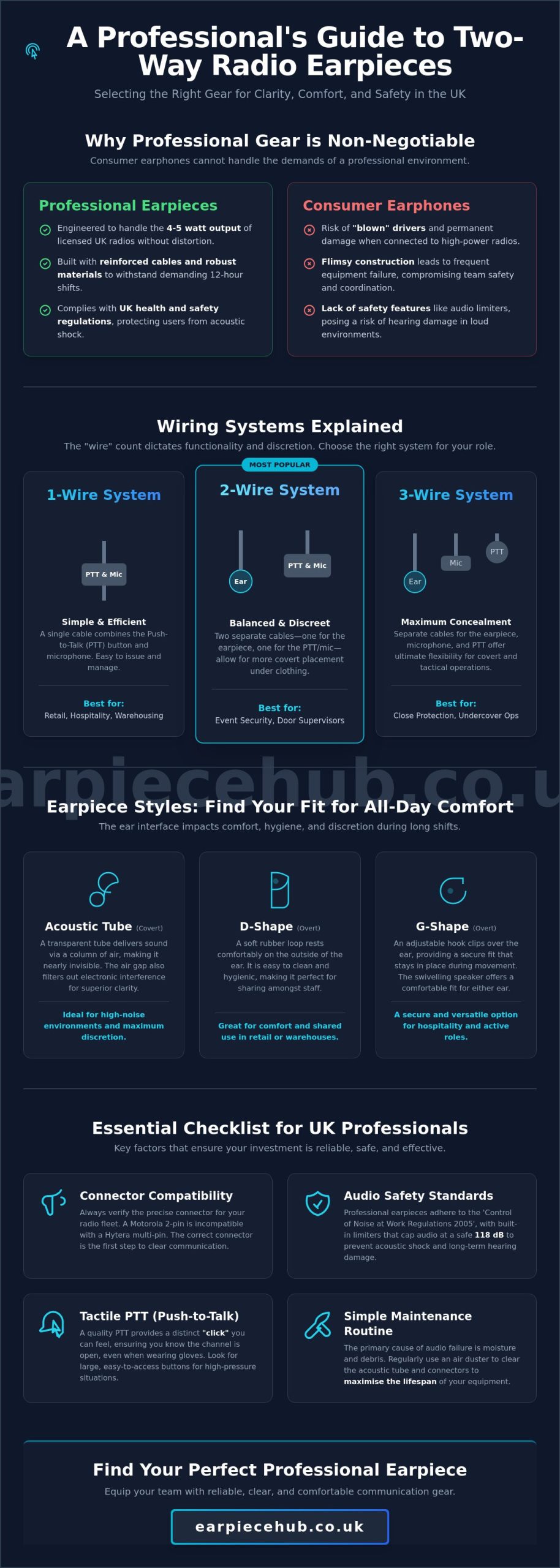
Every professional earpiece consists of four core components that must work in perfect unison. The connector is the first point of contact, plugging directly into the radio chassis. Understanding different audio connector types is essential because a Motorola 2-pin plug won’t fit a Hytera multi-pin socket. Next is the wiring, which can be configured in 1, 2, or 3-wire systems depending on the required complexity. The Push-to-Talk (PTT) button houses the microphone and transmission switch, whilst the ear interface (such as an acoustic tube or D-shell) delivers the incoming audio to the user.
Don’t make the mistake of using consumer-grade earphones with professional equipment. Standard buds designed for smartphones operate on different impedances and voltages. Professional licensed radios in the UK typically output between 4 and 5 watts of power. This higher energy can easily blow the delicate drivers in consumer earphones or cause significant signal distortion. Professional gear is specifically engineered to handle these technical requirements whilst offering the durability needed for 12-hour shifts.
UK professionals generally categorise their equipment into covert or overt communication styles. Covert earpieces, such as acoustic tube models, use transparent components to remain nearly invisible to the public. These are the standard for close protection and undercover security. Overt styles, including G-shape or D-shape hooks, are visible and rugged. These are often preferred in retail, hospitality, or warehouse settings where ease of fit and hygiene are the primary concerns for staff sharing equipment.
The Role of the PTT (Push-to-Talk) Mechanism
The PTT switch is the most used part of any earpiece. Its placement dictates how quickly you can respond to an alert. Inline PTT units sit on the chest or lapel for easy access. For tactical or specialist roles, a remote finger PTT allows the user to transmit without moving their hands away from their equipment. High-quality PTT buttons provide distinct tactile feedback. You need to feel a positive “click” to know the channel is open, even whilst wearing thick duty gloves in cold conditions.
Audio Quality and Noise Suppression
Clear audio is a fundamental health and safety requirement in loud UK workplaces. Under the Control of Noise at Work Regulations 2005, employers must protect staff from acoustic shock. Professional earpieces include built-in limiters that ensure noise levels never exceed 118 dB. Most users require transceiver earpieces that both send and receive audio. Acoustic tubes are particularly effective in noisy environments. They use a column of air to deliver sound, which naturally filters out the electronic interference and background hum often found in busy city centres or industrial plants.
Deciphering Technical Specs: Connectors, Wiring, and Compatibility
Selecting the correct two way radio earpiece UK professionals can trust depends entirely on the technical architecture of your radio fleet. Compatibility isn’t just about the physical plug; it’s about how the wiring supports your specific operational workflow. If you get this wrong, you risk audio distortion or total equipment failure during a critical shift. Understanding these specifications ensures your equipment remains a reliable asset rather than a technical hurdle.
1-Wire vs 2-Wire vs 3-Wire Systems
The “wire” count refers to how many separate cables lead from the radio connector to the user’s interface. A 1-wire system is the standard for retail and general hospitality. It features a single cable where the PTT and microphone are combined in one unit. It’s simple and easy to manage for staff who don’t require complex concealment.
For door supervisors and event security, 2-wire systems are often the preferred choice. These feature two separate cables: one leading to the earpiece and another leading to a combined PTT and microphone. This allows the mic to be clipped to a lapel or threaded down a sleeve for more discreet communication. The 3-wire “VIP” setup offers maximum concealment for close protection. With separate cables for the ear, mic, and PTT button, you can hide the microphone under a tie and run the PTT switch down to your palm.
Matching the Connector to Your Radio Fleet
The most common UK connectors vary significantly by brand and model. Motorola units like the DP1400 typically use a 2-pin (M1) plug, whilst high-end digital models like the DP4400 or the MTP series for TETRA users require complex multi-pin interfaces. Hytera PD-series radios use specific multi-pin connectors designed for enhanced weather sealing and durability. Kenwood professional models often utilise their own 2-pin or multi-pin configurations that aren’t interchangeable with other brands. Connector pin-out compatibility ensures that the electrical signals for the microphone, speaker, and PTT switch align perfectly between the accessory and the radio chassis.
High-end Motorola accessories often feature IMPRES audio technology. This system allows the radio to communicate with the accessory to optimise audio levels and suppress background noise automatically. If you’re managing a mixed fleet with different brands, a specialist earpiece adapter can bridge the gap and save on replacement costs. Ensuring your gear meets the Control of Noise at Work Regulations 2005 is a legal necessity for UK employers. Choosing the right technical setup ensures your team stays safe whilst maintaining clear communication in any environment.
Comparing Earpiece Styles for UK Professional Sectors
Selecting the right two way radio earpiece UK professionals use isn’t just about technical compatibility. The physical design of the interface determines how well a team performs over a demanding shift. If an earpiece is uncomfortable or unhygienic, staff will stop wearing it, leading to dangerous communication breakdowns. We categorise these styles into three main types: Acoustic Tube, D-Shape, and G-Shape. Your choice should balance three critical factors: user comfort, hygiene requirements, and the level of discreetness your role demands.
The Acoustic Tube: The Professional Standard
The acoustic tube is the undisputed industry standard for security and covert operations. Its transparent design makes it nearly invisible, which is vital for close protection or undercover work in busy city centres. These units use a surgical-grade silicone ear tip that provides a secure fit even during physical activity or rapid movement. The audio is delivered via a column of air, which helps eliminate electronic hum and provides clear reception in noisy environments.
Some users experience the “occlusion effect,” that muffled, “head-in-a-bucket” feeling caused by blocking the ear canal. You can mitigate this by switching to an open ear insert. These specialised tips allow ambient sound to enter the ear alongside the radio transmission, ensuring you maintain full situational awareness whilst staying connected to your team. It’s a small adjustment that makes a significant difference during long surveillance shifts.
D-Shape and G-Shape: Comfort and Shared Use
In retail and hospitality, the D-shape is often the favourite choice for long-duration wear. It features a soft, non-invasive loop that sits comfortably outside the ear canal. This design is ideal for staff who need to hear customers or colleagues in person whilst simultaneously monitoring radio traffic. It doesn’t put pressure on the inner ear, which reduces fatigue during 8 or 12-hour shifts. It’s the go-to for front-of-house teams who require a professional but approachable appearance.
For environments where equipment is shared amongst different team members, the G-shape (or ear hook) is the superior choice for hygiene. Because the speaker sits on the outer ear rather than inside the canal, it’s much easier to sanitise and reduces the risk of cross-contamination between staff members. While acoustic tubes provide better sound isolation, the rugged plastic construction of D and G-shape hooks often proves more durable in demanding warehouse or industrial settings. They don’t have delicate tubes that can kink or trap moisture, making them a reliable workhorse for high-turnover environments. If your fleet includes various brands, remember that a universal earpiece can often be fitted with these different ear interfaces to suit your specific sector needs.
Maximising the Lifespan of Your Radio Accessories
Even the most robust two way radio earpiece UK professionals rely on requires consistent maintenance to survive the rigours of daily shifts. Most equipment failures aren’t complex electrical breakdowns; they’re mechanical issues caused by poor handling or a lack of basic hygiene. By implementing a simple care routine, you can extend the operational life of your peripherals and ensure your team stays connected without the cost of frequent replacements.
The primary cause of earpiece failure is the accumulation of moisture and debris within the acoustic tube. Over time, body heat and external temperatures create condensation that forms a “water plug” inside the clear plastic. Audio failure is often a physical blockage, not an electronic fault. If your audio sounds muffled or has cut out entirely, check the tube for tiny droplets or earwax before assuming the unit is broken. Proper cable management is equally vital. Avoid “cable tug” by ensuring the wiring is clipped securely to your clothing with enough slack for head movement. Never wrap cables tightly around the radio unit for storage, as this causes internal copper fatigue and eventually snaps the wires near the connector.
Preventing Audio Failure and “Silent Radio”
To keep your audio crystal clear, follow a weekly cleaning routine. Disconnect the acoustic tube from the transducer and use a dedicated air blower to force out any trapped moisture. You should wash silicone ear tips and clear tubes in warm, soapy water, ensuring they are completely dry before reassembly. We recommend replacing the acoustic tube every 3 to 4 months, or sooner if the plastic becomes yellow or brittle. You only need to replace the entire earpiece wiring if the PTT button fails or the outer jacketing shows signs of fraying.
Battery Health and Power Management
Your radio’s power source directly impacts the performance of your accessories. A weak or ageing battery doesn’t just reduce your transmission range; it also degrades the audio output delivered to your earpiece. If you notice crackling or faint reception, it may be time to upgrade your power cell. High-capacity replacement batteries for the Motorola DP1400 provide the consistent voltage required to drive earpiece speakers at professional volumes. For teams managing large fleets, using six-way multi-unit chargers helps organise equipment and ensures every radio is properly conditioned for the next shift. Maintaining a healthy battery ensures your earpiece has the power it needs to cut through background noise in high-pressure environments.
Need to refresh your current gear? Shop replacement acoustic tubes and ear tips to restore your audio clarity today.
Why Earpiece Hub is the UK Specialist Resource for Communication Peripherals
Earpiece Hub serves as the central authority for professionals who cannot afford communication downtime. We aren’t just a retailer; we’re a dedicated partner for the security, hospitality, and industrial sectors across Britain. Finding a high-quality two way radio earpiece UK teams can trust requires more than just a generic product list. It demands technical expertise and a deep inventory of brand-specific accessories for Motorola, Hytera, and Kenwood fleets.
We provide a comprehensive range of equipment, from covert acoustic tubes to rugged G-shape hooks and noise-cancelling headsets. If you manage a mixed fleet, our universal earpieces and specialised adapters ensure you don’t have to replace your entire radio stock to achieve audio clarity. Our Reliable Specialist approach means we prioritise your operational needs with 24/7 support and next-day UK shipping. We understand that in the security world, waiting for equipment isn’t an option. You need gear that arrives fast and works immediately.
Sustainability is a core part of our philosophy. Instead of encouraging the disposal of entire units, we stock a massive inventory of replacement ear tips and acoustic tubes. This allows you to maintain hygiene and performance whilst reducing waste and operational costs. Whether you need a single replacement battery for a Motorola DP1400 or a complete fleet overhaul, we provide the technical precision you require with minimal fuss.
Expert Support for UK Businesses
Managing large-scale procurement for a national security firm or a busy event venue is complex. Our team assists with rigorous compatibility checking to ensure every accessory matches your specific radio models perfectly. We take a no-nonsense approach to technical specifications. We won’t bury you in jargon; we’ll give you the exact information needed to make an informed decision. Browse our full range of two way radio earpieces today and experience the difference that specialist knowledge makes.
A Central Hub for Maintenance and Spares
Efficiency comes from having a single, reliable source for all your communication peripherals. We are the “Hub” for the UK communication community, providing everything from six-way multi-unit chargers to high-capacity batteries. This streamlined approach saves you time and ensures consistent quality across your entire kit. We’re here to support your team’s safety and effectiveness 24 hours a day. Contact our specialist team for a bulk quote to secure the best value for your organisation.
Elevate Your Team’s Communication Standards
Selecting a professional two way radio earpiece UK teams can rely on requires a balance of technical precision and ergonomic comfort. You’ve mastered how to match connectors to your specific Motorola or Hytera fleet and why the right wiring system is essential for your operational role. Clear, uninterrupted communication is a health and safety requirement. Proactive maintenance and choosing sector-specific styles like acoustic tubes or G-shape hooks ensure your team remains connected throughout the most demanding shifts.
Earpiece Hub has been a specialist UK stockist since 2015. We provide expert compatibility support for all major brands, ensuring you get the right gear the first time. With next-day UK delivery available, you won’t have to wait to upgrade your communications. It’s time to invest in durable equipment that withstands daily professional use with minimal fuss. Our goal is to keep your communication crystal clear so you can focus on the task at hand.
Shop the UK’s most reliable range of radio earpieces at Earpiece Hub
Frequently Asked Questions
How do I know which earpiece connector fits my Motorola radio?
Identify your radio model number first. Motorola uses several distinct connector types, such as the 2-pin M1 for DP1400 or the multi-pin interface for DP4400 digital units. You’ll find these technical designations listed in our product descriptions. If you’re unsure, check the physical side port of your radio or contact our support team for a compatibility check. Getting the right two way radio earpiece UK professionals need starts with this physical match.
What is the difference between a 1-wire and a 2-wire earpiece?
The difference lies in the number of cables leading from the radio connector. A 1-wire system features a single cable where the microphone and PTT button are combined. It’s ideal for general retail use. A 2-wire earpiece has two separate cables, allowing you to run the PTT and microphone to a lapel or down a sleeve. This setup provides greater flexibility and discreetness for security roles whilst reducing cable strain.
Can I use a Kenwood earpiece with a Motorola radio using an adapter?
You can achieve this by using a dedicated earpiece adapter. These devices convert the pin-out of one brand to match the socket of another. It’s a highly efficient way to manage a mixed fleet of Motorola and Kenwood radios without purchasing entirely new sets of accessories. Just ensure the adapter is specifically designed for your radio’s model series to maintain full PTT and audio functionality across your entire fleet.
How often should I replace the acoustic tube on my earpiece?
We recommend replacing your acoustic tube every 3 to 4 months for hygiene and performance. Over time, the clear plastic can become yellow, brittle, or clogged with moisture and debris. Regular replacement ensures the audio remains crisp and prevents the buildup of bacteria. If you work in a particularly humid or active environment, you might need to swap the tube more frequently to avoid “water plugs” that block sound.
Are D-shape earpieces better than acoustic tubes for retail staff?
D-shape earpieces are often preferred in retail because they sit on the outer ear. Unlike acoustic tubes, they don’t block the ear canal, allowing staff to hear customers clearly whilst monitoring radio traffic. They’re also easier to clean, making them a better choice for shared-user environments. If your team prioritises long-shift comfort and situational awareness, the D-shape is the superior functional choice over covert tubes in a front-of-house setting.
Why is my radio earpiece audio muffled or silent?
Audio issues are usually caused by a physical blockage rather than an electronic failure. Check the acoustic tube and silicone ear tip for moisture, condensation, or debris. Body heat often creates tiny water droplets inside the tube that act as a sound barrier. Disconnect the tube and use an air blower to clear it. If the problem persists, check your radio battery levels or the connector pins for dirt and corrosion.
What is the best earpiece for a door supervisor in a noisy club?
A 2-wire acoustic tube earpiece is the industry standard for high-noise environments like clubs. The acoustic tube provides excellent sound isolation by delivering audio directly into the ear canal via an air column. The 2-wire configuration is crucial because it allows you to clip the microphone to your lapel, keeping it close to your mouth. This ensures your transmissions aren’t drowned out by loud music or background chatter during critical moments.
Are these earpieces compatible with licence-free PMR446 radios?
Many professional earpieces are compatible with licence-free PMR446 radios. Most of these units, like the Motorola TLK or XT series, use standard 2-pin connectors. Using a professional-grade two way radio earpiece UK specialists provide will significantly improve audio clarity and durability compared to the basic earphones included in the box. Always double-check your radio’s specific connector type before purchasing to ensure a perfect fit for your licence-free equipment.
