





Uncategorized
Best Two-Way Radio Swivel Earpiece: 2026 Buyer’s Guide
Sep
The traditional in-ear acoustic tube might look discreet, but forcing invasive rubber tips into ear canals across twelve-hour rotations is the quickest route to staff discomfort and hygiene complaints. Active frontline teams know the frustration all too well: earpieces slipping loose during movement, frayed wires causing communication dropouts, and the unpleasant reality of sharing ear inserts between shift changes. That’s why investing in a dependable swivel earpiece for two-way radio fleets has become an operational priority. By resting flat over the ear rather than wedging inside it, these designs pivot smoothly for left- or right-ear wear while offering immediate, wipe-clean hygiene across multiple users.
This buyer’s guide shows you how to select the ideal swivel earpiece for your two-way radio fleet, balancing shift-long comfort, hygiene, and long-term durability. We’ll examine essential connector compatibilities across leading radio brands, explore robust push-to-talk switches that withstand heavy handling, and reveal how commercial-grade cabling helps you minimise annual replacement costs.
Key Takeaways
- Understand why deploying an over-ear swivel earpiece for two-way radio hardware enhances shift-long comfort whilst eliminating ear canal fatigue.
- Discover how commercial reinforcement materials and durable strain relief prevent wiring failures under heavy frontline use.
- Learn to match multi-pin and two-pin connector interfaces accurately to guarantee plug-and-play audio clarity across your fleet.
- Master proper coiling methods and rapid sanitisation routines to extend accessory lifespan and cut fleet replacement overheads.
Understanding the Swivel Earpiece Design for Two-Way Radios
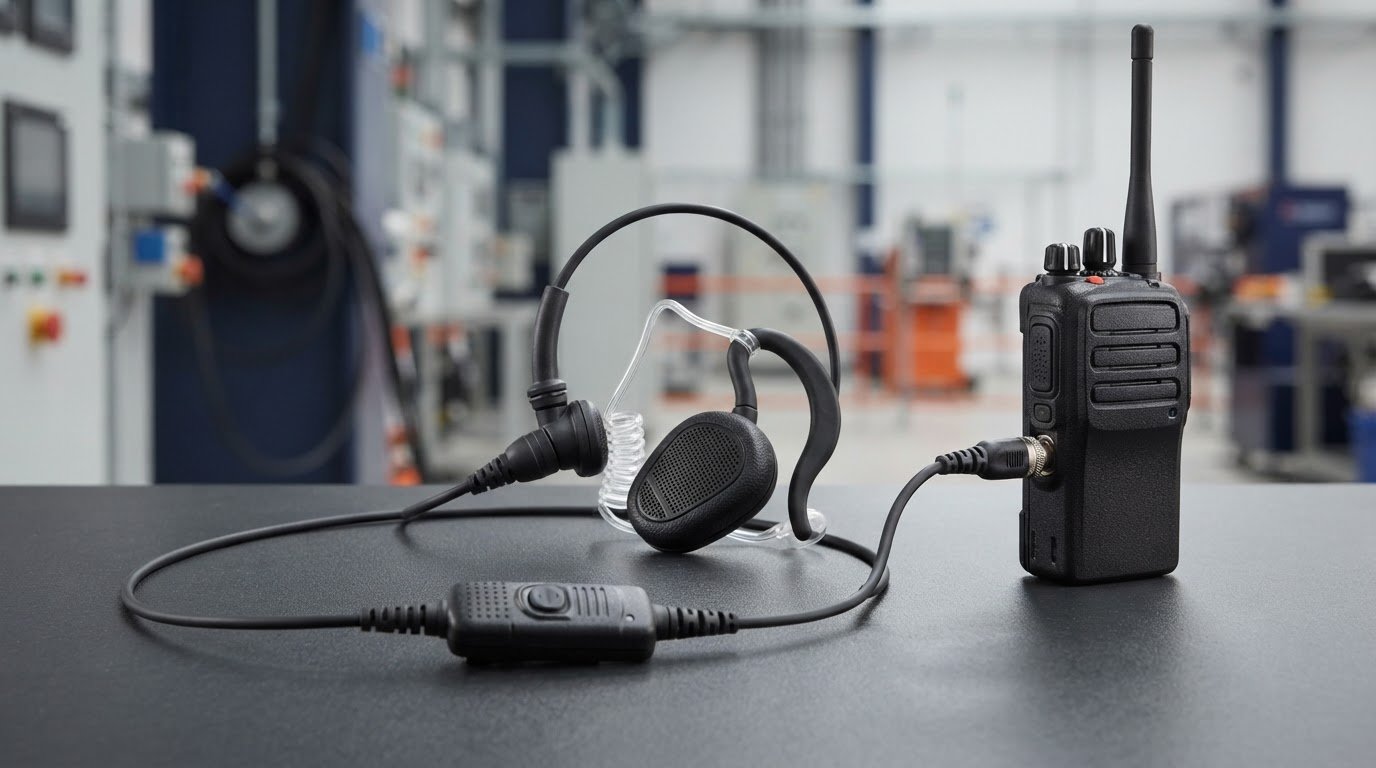
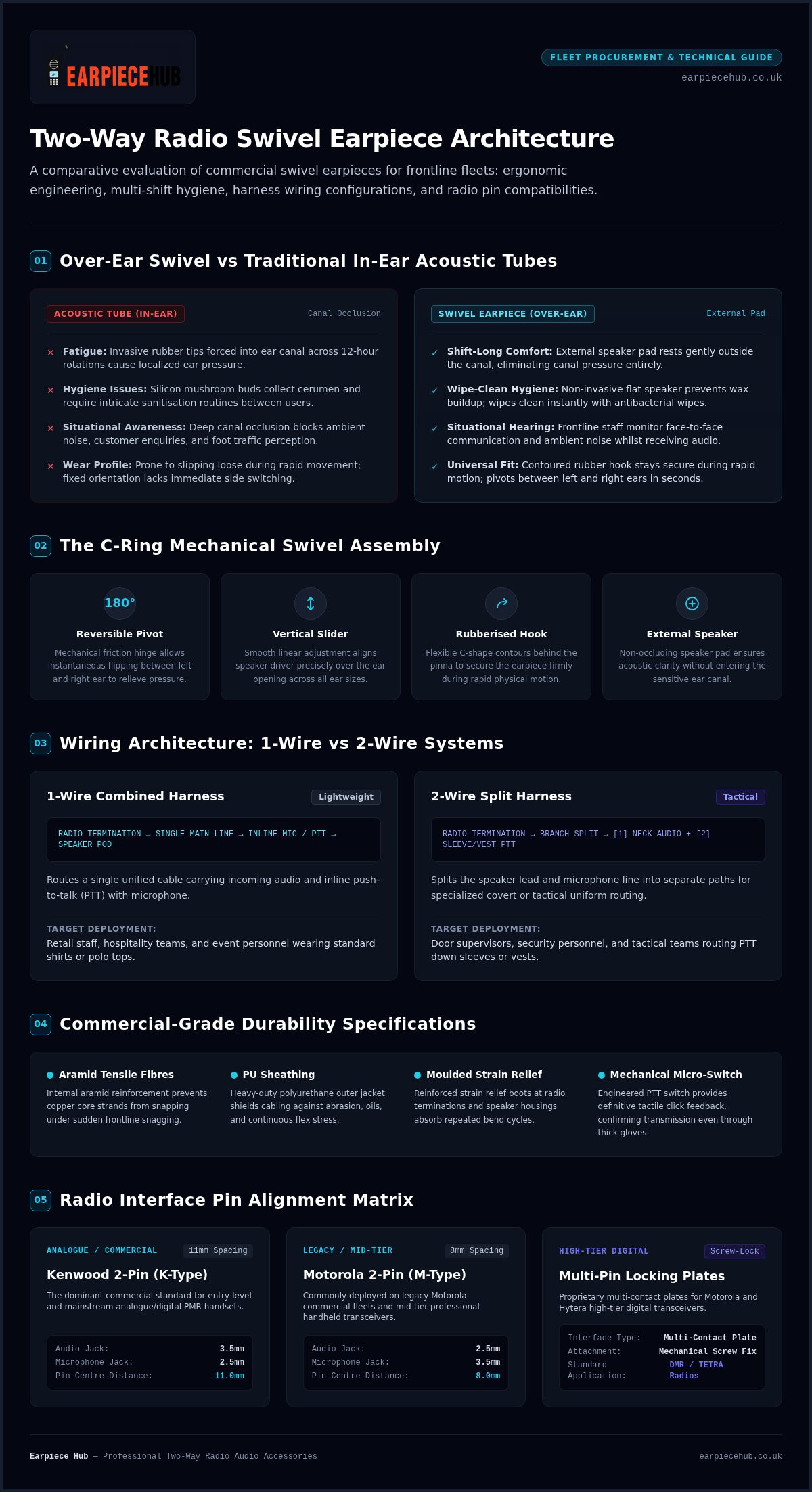
A swivel earpiece is an adjustable, over-ear audio unit engineered for frontline communication. Unlike covert acoustic tubes that channel audio directly into the ear canal via silicon tips, a swivel earpiece features an external speaker pad that rests gently against the outer ear. This design ensures that high-tempo teams using Professional Mobile Radio (PMR) systems avoid the physical fatigue and ear pressure caused by deep canal occlusion during extended shifts.
How the C-Ring Swivel Mechanism Operates
The core of this accessory is its mechanical friction hinge. It allows the speaker pod to rotate 180 degrees horizontally and adjust vertically along the ear loop:
- Flexible rubberised hook: Contours behind the pinna to secure the unit firmly during rapid physical movement.
- Smooth vertical slider: Aligns the speaker driver directly over the ear opening regardless of ear size.
- Reversible pivot: Allows users to flip the assembly in seconds, switching from left to right ear to relieve localised pressure.
Hygiene and Comfort Benefits for Shared Fleets
Deploying a quality swivel earpiece for two-way radio hardware transforms fleet hygiene across multi-user environments. Standard acoustic mushroom buds collect cerumen and require intricate cleaning routines. In contrast, non-invasive flat speakers sit outside the canal, preventing wax transfer and bacterial buildup between different users.
Between rotating shifts, staff can wipe down the smooth speaker face using standard antibacterial wipes. This exterior placement also preserves natural situational awareness. Frontline retail, event, and security personnel can hear critical two-way radio transmissions clearly whilst monitoring ambient noise, surrounding foot traffic, and face-to-face customer enquiries without obstruction.
Evaluating Key Features: Audio Quality, Wiring, and Durability
Selecting an effective swivel earpiece for two-way radio hardware requires looking beyond basic ear comfort. Clear transmission depends on tuned speaker impedance, high-sensitivity omnidirectional microphones, and reliable environmental sealing against light rain during outdoor duties. A muffled speaker or a sticky switch instantly compromises team safety and operational control.
Comparing 1-Wire and 2-Wire Harness Configurations
Wiring architecture determines how an accessory integrates with operational uniforms:
- 1-Wire systems: Route a single cable carrying both incoming audio and an inline microphone with push-to-talk (PTT). This lightweight setup suits retail, events, and hospitality staff wearing standard shirts or polo tops.
- 2-Wire systems: Split the speaker lead and microphone line into separate paths. Door supervisors and security personnel can route the audio behind the neck whilst feeding the PTT switch down a jacket sleeve or securing it to a tactical vest.
Cable Reinforcement and Strain Relief Standards
Workplace snagging quickly destroys consumer-grade leads. High-grade professional assemblies incorporate internal aramid tensile fibres beneath heavy-duty polyurethane sheathing, preventing internal copper strands from snapping during sudden physical strain. Moulded strain relief boots at the radio termination and speaker housing absorb continuous bending without tearing.
Mechanical micro-switches inside the PTT casing provide a definitive tactile click, confirming transmission even through thick gloves. For fleet managers looking to replace vulnerable equipment with reliable hardware, you can browse durable commercial options at Earpiece Hub tailored to rigorous daily shifts.
Selecting the Right Swivel Earpiece for Radio Compatibility
Audio accessories are never universally interchangeable out of the box. Pin alignments, socket depths, and internal driver impedance vary significantly across brands. Pairing an unsuitable swivel earpiece for two-way radio gear leads to faint volume, persistent mic humming, or physically damaged socket housings.
Pin Connections Across Major Radio Manufacturers
Handheld transceivers use distinctive accessory socket standards that demand precise verification:
- Kenwood 2-Pin (K-Type): Features a 3.5mm audio jack and a 2.5mm mic jack spaced 11mm apart. It remains the dominant standard for entry-level and commercial analogue handsets.
- Motorola 2-Pin (M-Type): Utilises 2.5mm audio and 3.5mm mic pins spaced 8mm apart, requiring specific alignment for legacy and mid-tier models.
- Multi-Pin Locking Ports: High-tier Motorola and Hytera digital radios use proprietary multi-contact side plates. These use a knurled locking screw to ensure electrical contact remains stable under severe mechanical vibration.
Adapters for Multi-Brand Fleet Integration
Managing mixed hardware across security or logistics departments doesn’t require maintaining multiple distinct accessory types. Heavy-duty earpiece adapters solve this problem by converting proprietary radio side connectors into standard multi-pin or modular sockets. Hardened mounting screws fasten the adapter directly against the radio chassis, eliminating signal dropouts when cables catch.
This modular approach preserves existing peripheral fleets during staged radio upgrades. If you manage mixed hardware batches, order radio adapters and universal earpieces from Earpiece Hub to keep your frontline team connected without unnecessary inventory overheads.
Practical Care and Deployment for Maximum Operational Life
A structured maintenance protocol protects frontline communication equipment from premature failure. Even a ruggedised swivel earpiece for two-way radio use will degrade quickly if staff bundle leads haphazardly or leave dirt on contact terminals. Establishing simple preventative habits keeps audio clear and drastically reduces accessory replacement costs.
Routine Cleaning and Preventive Maintenance Protocols
Daily cleaning takes seconds and extends the lifespan of your audio accessories:
- Sanitise contact surfaces: Clean the speaker face and rubberised ear hook with alcohol-free disinfectant wipes. Standard alcohol solutions can dry out synthetic rubbers, causing premature brittleness and cracking.
- Clear microphone sound ports: Inspect the mic grille at the end of each rotation. Dislodge accumulated dust, lint, or makeup using a dry, soft-bristle brush to avoid muffled transmissions.
- Use loose loop coiling: Train operators to coil cables loosely in natural ovals. Tightly wrapping leads around the radio body bends internal copper strands past their fatigue limit, snapping wires at the base.
- Terminal inspection: Check connector pins for corrosion or bent prongs before deployment to prevent intermittent audio cutouts.
Equipping Your Team with Commercial-Grade Peripherals
Fleet efficiency relies on three core checks: non-invasive user comfort, correct wiring harness layout, and exact socket matching. Equipping personnel with a dedicated swivel earpiece for two-way radio hardware guarantees uninterrupted team coordination during critical operations.
Sourcing your accessories from an established UK communications specialist gives you immediate access to tested, commercial-grade hardware and expert technical guidance. Rapid nationwide dispatch keeps frontline operations fully equipped without operational disruption.
Equip Your Fleet with Dependable Swivel Peripherals
Upgrading your team’s audio gear directly protects staff focus and operational reliability. Selecting the right swivel earpiece for two-way radio fleets eliminates painful ear canal fatigue, resolves shared-shift hygiene challenges, and prevents costly communication cutouts caused by flimsy consumer wiring. When you match precise connector types to your transceivers and reinforce handling protocols, your frontline communication stays crystal clear round the clock.
As an established UK specialist retailer since 2015, Earpiece Hub delivers professional-grade communication accessories engineered for demanding commercial environments. Whether your fleet operates on Motorola, Hytera, or Kenwood hardware, we stock robust peripherals designed for rigorous multi-shift duty. Explore professional swivel earpieces and accessories at Earpiece Hub to outfit your operational team with reliable, shift-ready hardware today.
Frequently Asked Questions
Can a swivel earpiece be worn on either ear?
Yes, a swivel earpiece is designed for ambidextrous wear. The speaker pod rotates 180 degrees on a central friction hinge, allowing users to flip the rubberised ear hook from left to right in seconds. Frontline operators frequently alternate ears throughout long shifts to relieve pressure, ensuring balanced comfort without needing multiple accessories for different team members.
Is a swivel earpiece better than an acoustic tube earpiece?
It depends on your operational environment. Acoustic tubes excel at covert security where discretion is critical, but internal ear tips can cause moisture buildup and fatigue. A swivel earpiece for two-way radio fleets rests over the outer ear, making it superior for multi-shift hygiene, all-day comfort, and maintaining ambient awareness in retail, event, or warehouse settings.
What happens if the earpiece connector does not match my radio?
An incompatible connector will not transmit audio properly and risks damaging your radio’s accessory socket. Forcing incorrect two-pin spacings or incompatible multi-pin plates can bend internal contact pins and strip retention screw threads. Always verify your specific transceiver model before purchasing, or deploy a dedicated earpiece adapter to bridge different hardware interfaces safely across your mixed radio inventory.
How do you clean and sanitise swivel earpieces between shifts?
Sanitise the speaker face and rubberised ear loop using alcohol-free antibacterial wipes between shifts. Avoid standard alcohol sprays, as repeated exposure dries out synthetic rubber compounds and leads to surface cracking. Gently wipe down the plastic housing, and clear dust or makeup from the microphone acoustic port with a dry, soft-bristle brush rather than sharp tools that damage diaphragms.
Can swivel earpieces be used in high-noise environments?
A swivel earpiece for two-way radio use performs best in low to moderate noise environments like retail floors, warehouses, and event grounds. Because the speaker sits outside the canal without creating an acoustic seal, extreme background racket can drown out messages. For industrial plants or loud music venues, high-noise environments require specialised noise-cancelling overhead headsets instead.
