





Uncategorized
Covert Earpieces: The Professional’s Guide to Discreet Radio Comms 2026
Sep
A single visible wire or a crackle of static at the wrong moment can compromise an entire operation. In high-stakes security, finding the right earpiece covert solution is about more than just hiding a cable; it is about maintaining operational integrity for the duration of a 12-hour shift. You likely know the frustration of an acoustic tube failing due to moisture build-up or an earpiece that becomes a painful distraction after hours of constant wear. These aren’t just minor inconveniences; they are critical points of failure that can jeopardise your team’s safety and professional reputation.
We’ll help you master the technical nuances of discreet communication gear to ensure your team remains connected and completely hidden in any professional environment. This guide explores the essential differences between 1-wire and 3-wire systems whilst providing the technical expertise needed to prevent audio failure. From managing wax build-up to choosing the correct configuration for your Motorola or Kenwood radio, you will gain the specialist knowledge required for 2026’s demanding operational landscape.
Key Takeaways
- Understand how acoustic tubes use air pressure to deliver crystal-clear audio whilst remaining virtually invisible to the public.
- Identify the specific operational benefits of 1-wire, 2-wire, and 3-wire systems to find the perfect earpiece covert setup for your team.
- Learn how to choose between mushroom tips and open-ear moulds to maintain comfort during long shifts and ensure your gear stays secure.
- Gain specialist insights into preventing common audio failures through proper maintenance of your acoustic tubes and ear tips.
What Defines a Professional Covert Earpiece?
A professional earpiece covert setup must facilitate seamless radio traffic without drawing unwanted attention. While standard headsets are bulky and obvious, covert kits prioritise a low profile that allows you to operate in plain sight. Professionals distinguish these from broader covert listening devices because they are purpose-built for two-way transmission rather than just passive monitoring. You need a balance between visual stealth and the ruggedness required for high-pressure security environments.
Standard covert systems typically use a clear acoustic tube. In contrast, “deep covert” operations might require induction neck loops paired with wireless micro-buds. These advanced setups offer maximum concealment but often involve higher costs and technical complexity. For the majority of UK security roles, the standard acoustic tube remains the industry benchmark for reliability and clear audio delivery.
The Role of the Clear Acoustic Tube
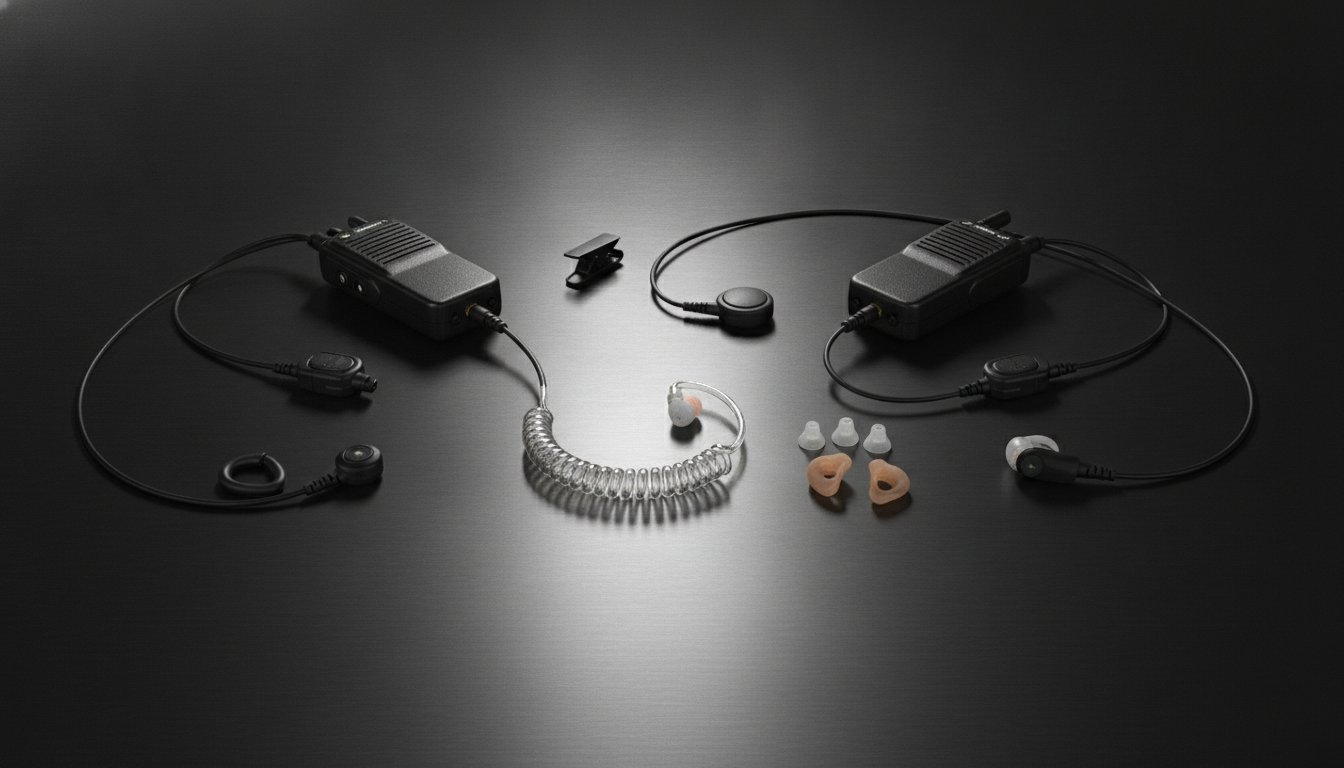
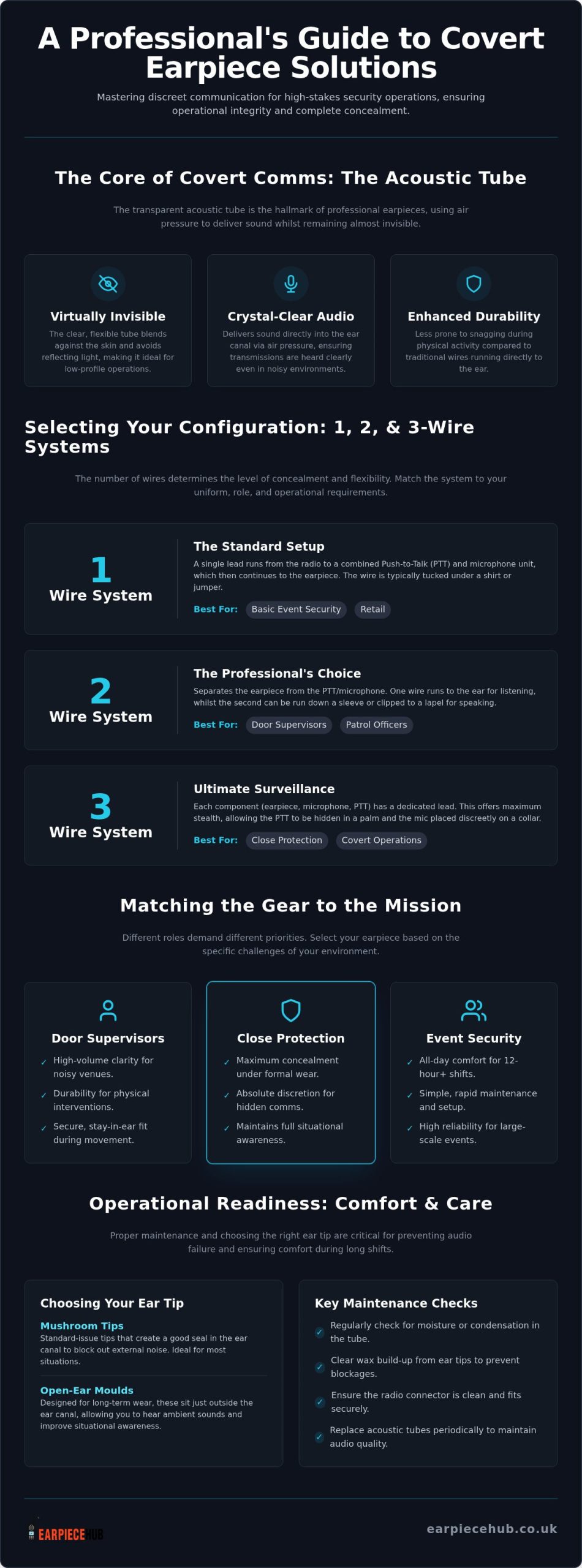
The transparent acoustic tube is the hallmark of professional discreet comms. It uses air pressure to deliver sound from a transducer directly into the ear canal. This design allows the device to blend against the skin or vanish beneath a shirt collar. Air-filled tubes are preferred over traditional wires for the final visible section. They don’t reflect light easily. They are also less prone to snagging during physical activity.
Situational Suitability for UK Security
Matching your earpiece covert style to your specific role is vital for operational success. Door supervisors in busy UK venues need “stay-in-ear” comfort during physical interventions or crowd management. Close protection officers require absolute discretion whilst maintaining full situational awareness of their surroundings. Every environment demands a specific technical approach.
- Door Supervisors: Prioritise durability and high-volume clarity for noisy environments.
- Close Protection: Focus on maximum concealment and low-profile wiring under suits.
- Event Security: Require comfort for 12-hour shifts and simple, rapid maintenance.
Selecting Your Configuration: 1-Wire, 2-Wire, and 3-Wire Systems
Selecting your configuration is a technical decision that impacts both comfort and concealment. The right earpiece covert system must match your uniform and the level of discretion your role requires. Standard professional kits are categorised by the number of wires or leads originating from the radio connector. Understanding these differences ensures your team remains connected without revealing their equipment.
1-Wire Systems: These are the most straightforward. A single lead runs from the radio to a combined PTT and microphone unit, which then continues to the earpiece. It’s ideal for environments where a radio is worn on the belt and the wire can be tucked neatly under a shirt or jumper.
2-Wire Systems: This setup separates the earpiece from the PTT and microphone. You can run one wire to your ear and the other down a sleeve or to a lapel. This provides better flexibility for movement and allows for more natural communication whilst on the move.
3-Wire Systems: These offer the ultimate surveillance configuration. Each component, the earpiece, microphone, and PTT, has its own dedicated lead. This allows for maximum stealth, such as hiding a PTT button inside a palm or sleeve for completely unnoticed transmissions.
Which Wire Setup Do You Need?
1-wire setups suit basic retail or event roles. They’re easy to kit up and take off at the end of a shift. 2-wire kits are the favourite for door supervisors. They allow the microphone to sit closer to the collar whilst keeping the PTT discreet. Specialists in close protection often demand 3-wire systems. These allow for a PTT button to be threaded through a sleeve, enabling communication without reaching for a chest-mounted microphone.
Connector Compatibility for Major Brands
Hardware must match your fleet. Whether you use the Motorola DP1400, Kenwood, or Hytera radios, the pin connection is critical. Using the wrong connector can damage the radio’s accessory port. If you manage a mixed fleet, using an earpiece adapter can save costs and simplify logistics. You can find a wide range of specialist radio peripherals at Earpiece Hub to suit any professional radio model.
Concealment, Comfort, and Maintenance whilst on Duty
Stealth is compromised the moment you reach to adjust a slipping or painful earpiece. Effective use of an earpiece covert system relies on it staying secure during high-movement incidents. If your gear snags amongst layers of clothing, you risk losing communication at a critical moment. Proper wire routing and secure clothing clips are essential to prevent drag on the ear and ensure the device remains hidden.
The choice of ear tip dictates your situational awareness. Standard mushroom tips provide excellent audio isolation in noisy environments. However, many professionals prefer open-ear moulds. These allow ambient sound to enter the ear canal naturally; this is vital for detecting threats in a crowd. You must match the tip to your specific operational environment to maintain both safety and discretion.
Hygiene and Acoustic Tube Care
Silent earpiece syndrome is a common failure caused by moisture or wax blockages. You should regularly inspect your kit for “yellowing” or brittle plastic. These signs indicate the tube is reaching the end of its life and may soon crack or muffle audio. Replacing these parts ensures crystal-clear transmission. You can buy replacement acoustic tubes and ear tips to keep your equipment in peak condition.
Ergonomics for Extended Shifts
For those who find in-ear tubes uncomfortable during 12-hour shifts, G-shape or D-shape earpieces offer a reliable alternative. These styles sit around the outer ear rather than inside the canal. When configuring your earpiece covert setup, position your clothing clip so the wire has enough slack for head rotation. This prevents the wire from pulling when you move. Small adjustments in positioning make a significant difference to long-term comfort.
Professional Covert Solutions from Earpiece Hub
Earpiece Hub serves as the central resource for UK security specialists and radio professionals. We provide high-performance gear designed to meet rigorous operational standards. Whether you need a standard 1-wire acoustic tube for retail or an advanced 3-wire surveillance kit for close protection, our range ensures your team stays connected whilst remaining completely discreet. We prioritise reliability above all else. Our accessories are fully compatible with industry leaders like Motorola and Kenwood, ensuring seamless integration with your existing fleet, including the popular Motorola DP1400.
Why Specialist Gear Matters
There is a significant difference between professional-grade components and cheap marketplace alternatives. Budget options often suffer from brittle tubes or poor-quality transducers that muffle audio at the worst possible moments. Every earpiece covert solution at the Hub is vetted to be “security-ready” before it reaches you. This means reinforced cabling and high-impact materials that won’t fail during a critical intervention or a demanding 12-hour shift. We understand that in security, equipment failure isn’t just an inconvenience; it’s a risk to your operational integrity.
Next Steps for Your Fleet
If you are managing large security teams or event staff, bulk purchasing is the most efficient way to standardise your communications. We can provide bespoke technical advice on connectors or specialised earpiece adapters for mixed fleets. Our specialists are industry veterans who provide exactly what you need with minimal fuss, reflecting our no-nonsense approach. With our seasonal promotions and 30% Off deals, there is never a better time to upgrade your kit. We back every purchase with 24/7 support and rapid next-day shipping across the UK to keep your operations moving without delay.
Browse our full range of professional covert earpieces today
Equip Your Team for Operational Success
Mastering professional communication requires a precise technical setup and a commitment to regular maintenance. Selecting the correct 1-wire, 2-wire, or 3-wire configuration allows your team to match their equipment to specific uniform and movement needs. You’ll avoid the frustration of audio failure by prioritising the replacement of acoustic tubes and ear tips before they become brittle or blocked. Investing in a high-quality earpiece covert system ensures that your transmissions remain crystal clear whilst your presence stays completely undetected in the field.
As a UK specialist retailer, Earpiece Hub provides the rugged, professional-grade hardware your fleet demands. We back our range with 24/7 expert support and next-day shipping to ensure your team is always operational. Don’t let inferior gear compromise your security. Shop Professional Covert Earpieces at Earpiece Hub and secure your communications today. You have the technical knowledge; now equip yourself with the best tools for the job.
Frequently Asked Questions
What is the difference between a 1-wire and a 2-wire covert earpiece?
The primary difference lies in the number of cables running from the radio connector. A 1-wire system uses a single lead for both the microphone and earpiece, making it easy to fit. In contrast, a 2-wire system splits the microphone and PTT from the earpiece lead. This allows you to run the mic down a sleeve or clip it to a lapel whilst keeping the earpiece wire hidden.
Can I use the same covert earpiece for both Motorola and Kenwood radios?
No, you cannot typically use the same earpiece for both brands because they use different pin configurations. Motorola often uses a 2-pin or multi-pin connector, whilst Kenwood typically requires a specific 2-pin side-mount. To use one earpiece across a mixed fleet, you must use an earpiece adapter. These specialised adapters ensure your hardware remains compatible with various radio ports without damaging the sensitive internal pins.
How often should I replace the clear acoustic tube on my earpiece?
You should aim to replace your clear acoustic tube every three to six months, depending on the intensity of your shifts. Over time, the plastic becomes brittle and discoloured. If you notice a yellowing tint or a decrease in audio clarity, it’s time for a change. Regular replacement prevents the build-up of moisture and wax that can lead to total audio failure during a critical operation.
Why has my covert earpiece stopped receiving audio even though the radio is on?
Audio failure is often caused by a blockage within the acoustic tube rather than a radio fault. Check for moisture or wax build-up inside the tube and ear tip. If the tube is clear, ensure the transducer connection is secure. Using a high-quality earpiece covert kit reduces these issues; however, you should always carry a spare tube to resolve sudden blockages whilst on duty.
Are covert earpieces comfortable enough to wear for a 12-hour security shift?
Yes, a professional earpiece covert setup is designed for long-term wear. To maximise comfort during a 12-hour shift, many specialists swap standard mushroom tips for open-ear moulds. These reduce pressure in the ear canal and allow for better airflow. If in-ear styles remain uncomfortable, switching to a G-shape or D-shape earpiece provides a secure fit that sits around the outer ear instead of inside it.
