





Uncategorized
Two-Way Radio Multi-Unit Chargers: Guide for UK Fleets
Sep
Imagine your security team arriving for a night shift only to find a bird’s nest of tangled cables and three radios with empty batteries. It’s a common frustration for UK fleet managers who rely on individual plug-in leads that clutter the comms room and fail to provide a reliable charge. You know that operational readiness depends entirely on your equipment being ready to go the moment it’s picked up. Switching to a professional two way radio multi-unit charger eliminates this chaos while ensuring every handset is ready for the next rotation.
Investing in this hardware is more than just a storage choice; it’s a vital strategy for fleet longevity. We promise to show you how to streamline your communications, protect your battery life, and organise your workspace with the right hardware. This guide explores the benefits of centralised charging stations, the impact of intelligent charging on battery health, and the essential UK safety markings you need to look for to keep your team connected and your equipment in top condition.
Key Takeaways
- Eliminate cable clutter in your comms room by replacing individual leads with a centralised station that charges multiple units from a single UK mains plug.
- Protect your investment by using a two way radio multi-unit charger with intelligent overcharge protection to prevent battery heat damage and memory effects.
- Ensure total compatibility for your Motorola, Kenwood, or Hytera fleet by selecting the correct pocket dimensions and matching your specific battery chemistry.
- Optimise daily operations with a structured inventory management system using labelled pockets and a formalised equipment check-out process.
What is a Two-Way Radio Multi-Unit Charger?
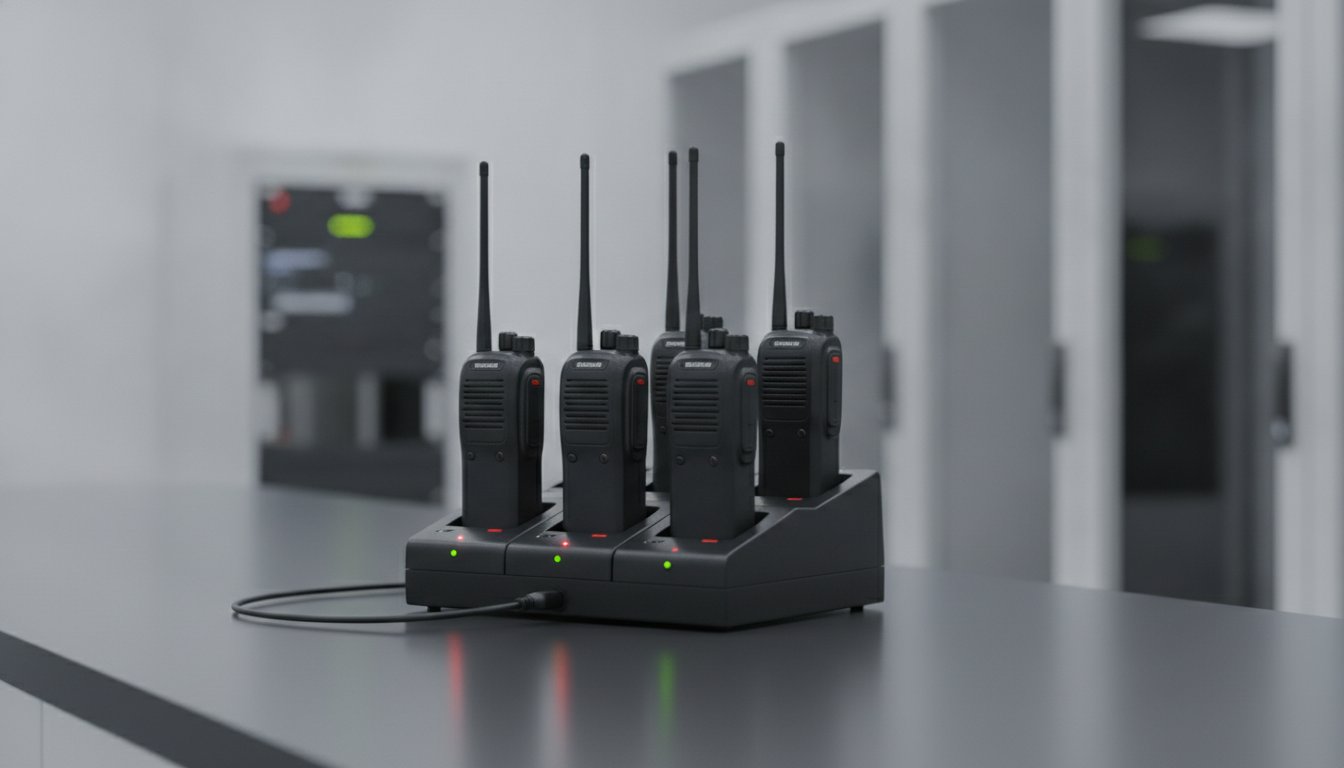
A two way radio multi-unit charger is a centralised station designed to power multiple radio units simultaneously from a single UK mains plug. Most professional models, such as the Six-Way Multi-Unit Charger, accommodate six handsets at once. This hardware serves as a workflow optimiser for professional radio fleets by streamlining the daily check-in and check-out process. It effectively replaces the “nest of cables” that typically plagues comms rooms using individual “drop-in” chargers. For organisations amongst the security, retail, and hospitality sectors, where rapid staff turnover is constant, these stations are essential for maintaining 24/7 operational readiness.
Multi-Unit vs. Single Drop-in Chargers
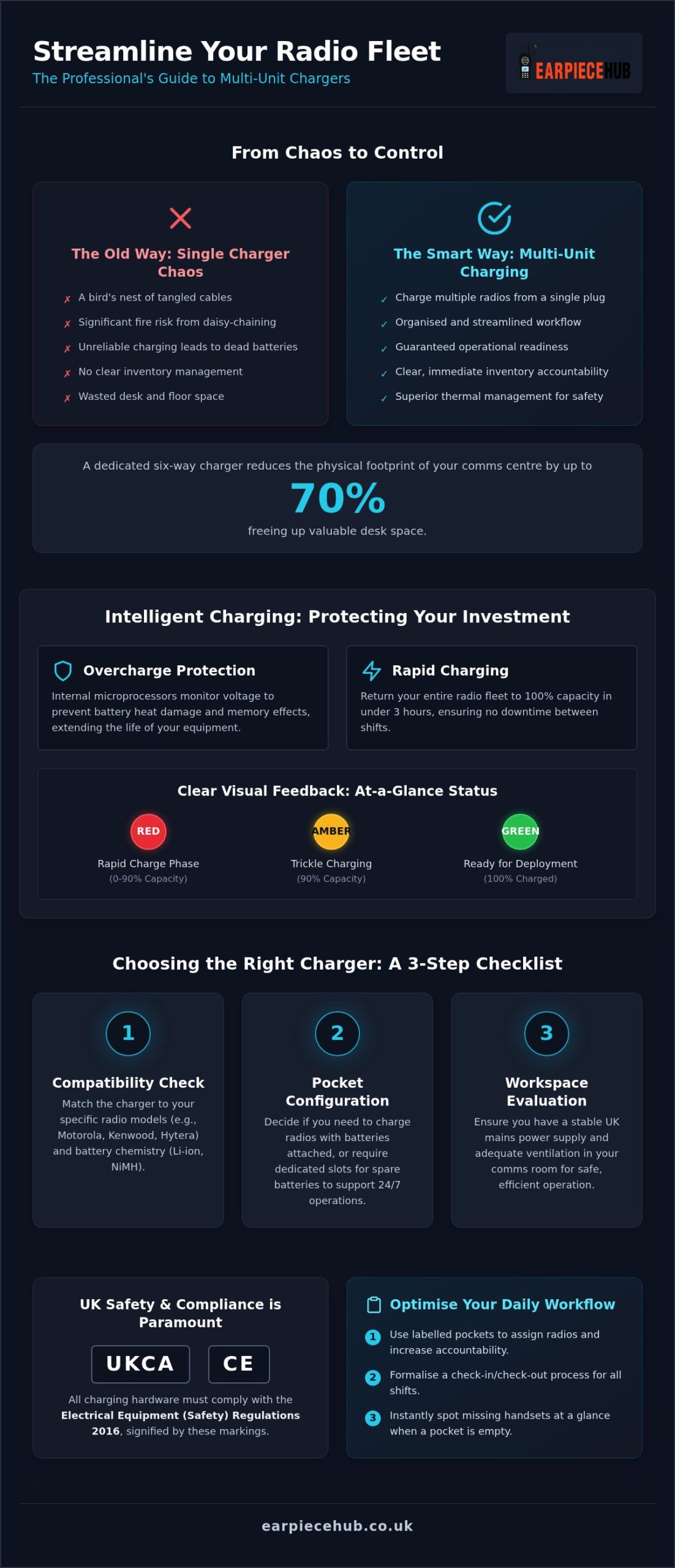
Relying on power strips and daisy-chained single chargers creates a significant fire risk and a logistical nightmare. These makeshift setups often lead to blown fuses or disconnected cables, leaving radios uncharged when a shift starts. A dedicated six-way charger reduces the physical footprint of your comms centre by up to 70%, freeing up valuable desk space for other essential technical equipment.
Beyond power, these units act as a robust inventory management tool. It’s immediately obvious if a radio is missing at the end of a shift when a pocket remains empty. This level of accountability is difficult to achieve with scattered individual leads. Modern units utilise advanced battery charging technology to ensure that each radio receives the correct voltage without the risk of overheating. High-stakes environments like event security or busy retail floors cannot afford the downtime caused by poor charging habits. Centralising your power source guarantees that every handset is accounted for and fully operational.
The Technical Advantages of Intelligent Multi-Unit Chargers
Modern communications demand more than simple power delivery. A professional two way radio multi-unit charger utilises internal microprocessors to monitor battery voltage in real time. This technology allows the unit to terminate the charging cycle precisely when the cell reaches its optimal capacity. By preventing overcharging, these units eliminate the risk of “memory effect” in NiMH batteries and stop destructive heat build-up in Li-ion cells. Most units deliver rapid charging capabilities, returning your entire fleet to 100% capacity in under 3 hours whilst maintaining long-term cell integrity.
Visual feedback is immediate and clear. Colour-coded LED systems remove the guesswork from fleet management. A solid red light typically signals the rapid charge phase, whilst amber indicates the battery has reached 90% and is trickle-charging. A green light confirms the handset is ready for deployment. This system ensures that staff don’t accidentally take partially charged radios onto a long shift.
Extending the Life of Your Motorola DP1400 Batteries
The Motorola DP1400 remains the UK industry standard for security and hospitality teams. Its batteries respond best to the controlled current delivery found in a high-quality two way radio multi-unit charger. Safeguarding your investment through intelligent charging reduces the frequency of battery replacements. If you are managing a large rotation, ensure you have a reliable Replacement Battery for Motorola DP1400 on hand to keep your team operational during peak periods.
Safety Standards and UK Compliance
Workplace safety is paramount. All charging hardware must comply with the Electrical Equipment (Safety) Regulations 2016, signified by CE or UKCA markings. Professional multi-unit stations offer superior thermal management compared to six individual chargers. By consolidating the power supply, these units dissipate heat more effectively through integrated cooling paths. This design choice is a critical factor for Lithium-ion battery safety, especially in confined comms centres where multiple devices operate simultaneously.
How to Choose the Right Charger for Your Radio Fleet
Selecting a two way radio multi-unit charger requires a systematic approach to ensure long-term fleet efficiency. First, match the charger to your specific radio model and battery chemistry. Whether you operate Motorola, Kenwood, or Hytera units, the charging profile must be compatible with the battery’s internal cells. Next, determine your pocket requirements. Some teams prefer charging the radio with the battery attached for quick deployment, whilst others require dedicated slots for spare batteries to support back-to-back shifts.
Evaluate your workspace constraints. High-capacity two way radio multi-unit charger stations require a stable power supply and adequate ventilation. Look for hardware with interchangeable pods or “cups.” These allow you to adapt the base unit for different radio models in the future, providing a future-proof solution if you upgrade your fleet.
Compatibility and Interchangeable Pockets
Universal charger bases offer excellent value by using model-specific cups. This flexibility means you don’t have to replace the entire station if you switch from Motorola to Kenwood units. Always verify the physical dimensions of the pocket. A secure fit is essential, especially if your staff keep belt clips attached to the handsets during charging. This prevents poor contact and ensures every device receives a consistent charge.
Power Supply and Portability
Six-way units draw significant power from a single UK mains lead. Consider whether wall-mounting or a desktop placement suits your comms centre best. Wall-mounting maximises floor space and keeps cables off the ground, reducing trip hazards in busy environments. If you need a professional-grade solution today, shop our Six-Way Multi-Unit Charger for guaranteed compatibility and rapid delivery.
Optimising Your Charging Station Workflow
Implementing a structured workflow transforms a simple power source into a robust management tool. A formal “Check-in, Check-out” system ensures total accountability across your team. If a pocket in your two way radio multi-unit charger remains empty at the end of a shift, you can immediately identify which handset is missing. Labelling each charging pocket to correspond with specific teams or individual staff members further simplifies this process. This routine is also the ideal time to inspect your equipment. Integrating Earpiece Hub accessories, such as replacement ear tips and acoustic tubes, into your weekly maintenance routine ensures that your fleet remains hygienic and provides crystal-clear audio during high-pressure situations.
Maintenance for Long-Term Reliability
Regular maintenance prevents communication failures during critical incidents. Clean the gold-plated contacts on both the radio and the two way radio multi-unit charger every 30 days using a lint-free cloth and a small amount of isopropyl alcohol. This prevents the buildup of oils and dust that cause audio interference or charging failures. Identifying a failing battery is easy with an intelligent charger; watch for status indicators that stay amber or flash red, signalling that the cell can no longer hold a stable charge and requires replacement.
Creating a Centralised Comms Hub
Position your charging station in a secure, climate-controlled area that allows for easy staff access whilst maintaining equipment security. A well-organised comms centre professionalises your operation, moving away from cluttered desks to a sleek, functional environment. Using a six-way charger as the heart of this hub ensures that every radio is fully charged, accounted for, and ready for deployment at a moment’s notice. This level of organisation is a hallmark of seasoned security and event operations.
Streamline Your Fleet Operations Today
Transitioning to a professional two way radio multi-unit charger is an investment in your team’s operational readiness. By centralising your power source, you eliminate cable clutter whilst ensuring every handset is accounted for at the end of every shift. Intelligent charging technology protects your battery life by preventing overcharging and heat damage; this is essential for maintaining a reliable Motorola or Kenwood fleet. These stations don’t just provide power; they professionalise your workspace and simplify inventory management.
As a specialist UK radio accessory retailer, Earpiece Hub provides the professional-grade hardware your security or hospitality team needs. We offer expert technical support to ensure total compatibility with your existing equipment. With next day shipping available for urgent fleet requirements, you can upgrade your comms hub without delay. Shop our range of professional Six-Way Multi-Unit Chargers at Earpiece Hub and take control of your communications. Keep your team connected and your equipment in peak condition.
Frequently Asked Questions
Can I charge different brands of radios in the same multi-unit charger?
You can only do this if your charging station features interchangeable pockets or “cups” designed for different brands. Most standard units are configured for a single brand, such as Motorola or Kenwood, to ensure a precise voltage match. Using a two way radio multi-unit charger with the wrong pods can damage the battery terminals. Always verify that the specific cups installed in the base unit match the handsets your team is currently using.
How long does it take for a six-way charger to fully charge a Motorola DP1400?
A professional rapid charger typically returns a Motorola DP1400 to 100% capacity in under 3 hours. Whilst standard individual leads might take up to 12 hours, the higher current delivery of a six-way station significantly reduces downtime. This speed is vital for back-to-back shifts in security or hospitality. Cell health is maintained through internal sensors that prevent the battery from overheating during this high-speed cycle, ensuring long-term reliability.
Is it safe to leave radios in the multi-unit charger overnight?
It is safe to leave your fleet in an intelligent two way radio multi-unit charger overnight. These units feature automatic shut-off and overcharge protection to prevent cell damage. Once the battery reaches full capacity, the charger switches to a maintenance or “trickle” mode. This ensures your radios are ready for the morning shift without the risk of the heat buildup often associated with cheaper, non-intelligent charging alternatives found on the market.
Do I need to remove my earpiece or belt clip before placing the radio in the charger?
You don’t usually need to remove belt clips, as most professional pockets are designed with a recess to accommodate them. However, you should detach earpieces or remote speaker microphones if they cover the charging contacts on the base or side of the radio. Ensuring a clean, unobstructed connection between the handset and the charger pins is essential for a reliable power cycle and prevents unnecessary mechanical wear on the accessory ports.
What do the different LED light colours mean on a multi-unit charging station?
Colour-coded LEDs provide immediate status updates for each handset. A solid red light indicates the rapid charging phase is active, whilst a solid green light confirms the battery is at 100% capacity. An amber or yellow light typically means the unit is in standby or a reconditioning cycle. If you see a flashing red light, it signals a fault, such as a damaged battery or a poorly seated radio handset.
