





Uncategorized
Remote Speaker Microphone UK: The Professional Buyer’s Guide for 2026

Aug
A remote speaker microphone is not just an accessory; it is a safety-critical lifeline that determines whether your team stays connected or falls silent during a crisis. Selecting the right remote speaker microphone UK requires more than just picking a brand; it demands a technical understanding of your specific operational environment. You likely already know the frustration of audio failing in a noisy crowd or a handset becoming useless after a sudden British downpour. These failures are often the result of mismatched specifications or poor ingress protection.
This guide ensures you master the technical specifications and compatibility requirements needed to secure the most reliable hardware for your radio fleet. Whether you manage Motorola DP1400 units or Kenwood systems, we provide the expertise to avoid incorrect connector pins and fragile builds. We will preview the essential IP ratings for 2026, explain the shift towards modular Hirose connectors, and detail how to achieve crystal clear audio transmission in any environment whilst maintaining long-term durability.
Key Takeaways
- Understand the safety implications of hands-free communication and why holstered radios often fail to deliver clear audio in high-pressure environments.
- Identify the specific IP ratings and connector standards required to ensure your remote speaker microphone UK withstands harsh British weather and industrial conditions.
- Learn how to navigate the complex landscape of radio connectors to ensure perfect compatibility across Motorola, Kenwood, and Hytera hardware.
- Discover professional maintenance strategies and accessory integration tips to prevent equipment corrosion and maximise the long-term ROI of your radio fleet.
The Role of the Remote Speaker Microphone in UK Professional Comms
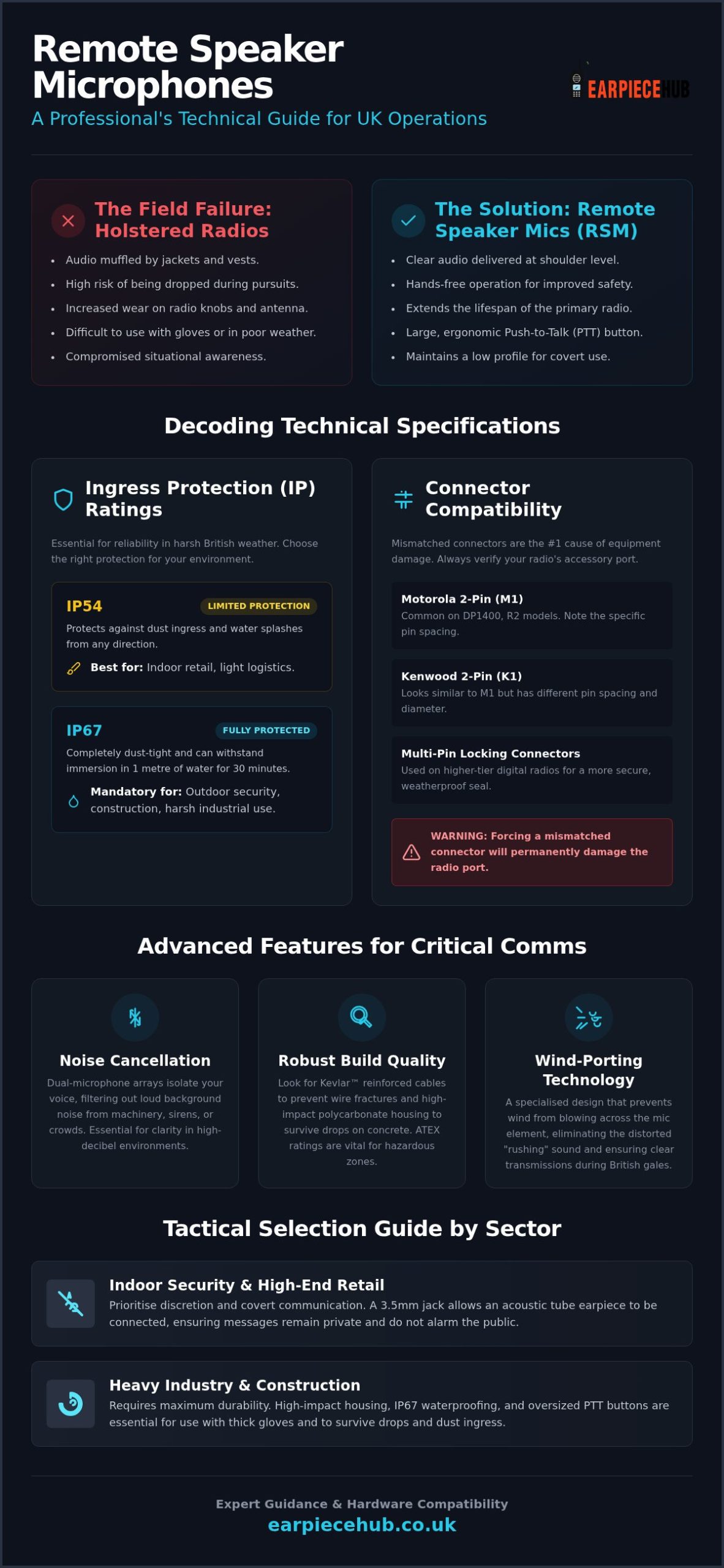
Handheld radios often fail in the field because they remain holstered on a belt, where audio is muffled by heavy jackets or high-visibility vests. For a professional using a remote speaker microphone UK, this barrier disappears. By relocating the speaker and push-to-talk button to the shoulder, users receive clear transmissions without unholstering their device. This setup is vital for security and logistics sectors where hands-free communication isn’t just a convenience; it’s a safety requirement.
Constantly grabbing a radio to speak increases wear on the volume knobs and antenna. An RSM extends the lifespan of your primary hardware by reducing direct handling. While standard shoulder mics provide basic relay, specialised noise-cancelling variants use dual-microphone arrays to filter out ambient sirens or machinery roar, ensuring only the operator’s voice reaches the control room.
Improving Operational Efficiency and Safety
Security personnel involved in high-intensity movements face a constant “drop risk” when manipulating unattached radios during a foot pursuit or crowd control. Attaching a remote speaker microphone UK to the lapel keeps the radio secure on the belt, maintaining a low profile whilst ensuring audio is closer to the ear. This proximity enhances situational awareness, allowing operators to monitor quiet chatter without alerting nearby members of the public or compromising a covert position.
For users in heavy PPE or thick gloves, the oversized PTT buttons on an RSM provide an essential ergonomic advantage that standard radio interfaces cannot match. This simple hardware addition ensures that communication remains reliable even when manual dexterity is limited by protective gear or harsh weather conditions.
Decoding Technical Specs: IP Ratings and Connector Standards
Choosing a remote speaker microphone UK involves navigating a technical minefield where the wrong choice leads to equipment failure. IP ratings are your first line of defence. An IP54 rating offers basic protection against dust and splashes, which is suitable for indoor retail environments. However, for outdoor security or construction in the UK, IP67 is mandatory. This ensures the unit remains functional even after being submerged in one metre of water for thirty minutes, a vital feature given the unpredictable British weather.
Connector compatibility remains the biggest hurdle for fleet managers. Motorola 2-pin (M1) connectors look remarkably similar to Kenwood 2-pin (K1) versions, but the pin spacing and diameter differ. Attempting to force a mismatched plug will damage the radio’s accessory port. For hazardous environments like fuel depots or chemical plants, ensure your RSM carries an ATEX “Intrinsically Safe” rating to prevent spark ignition. High-quality units also feature Kevlar-reinforced cabling to prevent internal wire fractures during heavy, repetitive use.
The Compatibility Guide for Major UK Radio Brands
Avoid “wrong-pin” ordering by verifying your radio’s accessory port before purchase. The Motorola DP1400 and R2 models utilise the standard 2-pin side port, whereas higher-tier digital models require multi-pin locking connectors. If you’re unsure which variant fits your hardware, you can browse our specialist RSM range to match your specific model and ensure a secure fit.
Noise Cancellation and Audio Clarity
In high-decibel environments like construction sites, standard microphones pick up too much background roar. Noise-cancelling RSMs use internal circuitry to isolate your voice from machinery. Outdoor operators should also look for wind-porting technology. This design prevents wind from blowing directly across the microphone element, which otherwise creates the distorted “rushing” sound that makes transmissions unintelligible during a British gale.
A Tactical Selection Guide for UK Security and Logistics
Selecting a remote speaker microphone UK depends on your operational theatre. One size doesn’t fit all. For indoor security and high-end retail, discretion and comfort are the primary drivers. These environments suit lightweight RSMs featuring a 3.5mm earpiece jack. This port allows you to connect an acoustic tube, converting the loud speaker into a private system. It ensures that sensitive communications remain between the user and control, avoiding public alarm in crowded shopping centres.
Heavy industry and construction demand a different approach. Here, high-impact polycarbonate housing is essential to survive drops onto concrete. Whilst we previously discussed IP67 waterproofing, these sectors specifically require units that can withstand grit and dust ingress. For event management, where staff often wear gloves or work in low light, a large, textured PTT button is non-negotiable. It provides tactile feedback that a transmission has started, even through thick fabric. Emergency services often prioritise models with a dedicated emergency button on the top of the unit, allowing for instant alerts without reaching for the radio chassis.
Matching the Mic to the Mission
Durability often trades off against microphone sensitivity. In high-noise environments, choose a mic tuned to ignore ambient machinery hum. Rotatable belt clips are another critical tactical feature; they allow for flexible mounting on various uniforms, from stab vests to suits. If you need to upgrade your fleet’s reliability, shop our professional remote speaker microphones to find the exact match for your sector’s demands.
- Sensitivity: High for quiet retail; noise-cancelling for construction.
- Mounting: 360-degree clips for shoulder or lapel attachment.
- Privacy: 3.5mm jacks for earpiece integration.
- Durability: Reinforced housing for high-impact environments.
Maximising ROI: Maintenance and Accessory Integration
Fleet longevity depends on consistent preventative care. To prevent connector corrosion, especially after exposure to the damp British climate, wipe the gold-plated pins with a dry, lint-free cloth at the end of every shift. Store your remote speaker microphone UK fleet in a dry, temperate environment rather than leaving units in a cold vehicle overnight. For teams in the North East, professional self storage Darlington offers the secure, climate-controlled environment required to protect electronic equipment from the elements. If audio becomes intermittent, test the radio with a different RSM first. This simple diagnostic check quickly identifies whether the fault lies in the cable’s internal copper strands or the radio’s own accessory port.
The Hybrid Setup: RSMs and Acoustic Tubes
Many fleet managers overlook the versatility of the integrated 3.5mm jack. By connecting a “Listen Only” acoustic tube, you convert an overt RSM into a semi-covert system. This allows sensitive communications to remain private whilst keeping the oversized PTT button easily accessible on the shoulder. To prevent snagging during physical activity, route the earpiece cable under your epaulette and inside the jacket. This configuration ensures that even during high-intensity movements, your communication line remains secure and out of reach of others.
Investing in Quality over Cheap Alternatives
Unbranded microphones often suffer from poor electromagnetic shielding. This leads to “buzzing” or interference when working near other electronic devices or power lines. They also utilise inferior plastics that can crack under the UV exposure and temperature fluctuations common in outdoor UK work. Choosing a specialist UK hub ensures you receive equipment with genuine warranty support and brisk technical turnaround. Don’t risk your team’s safety on unvetted hardware. Browse our expert-vetted range of Remote Speaker Microphones to secure your radio fleet today.
Secure Your Communications for 2026 and Beyond
Mastering IP ratings and connector standards is the only way to avoid equipment failure in the field. By matching your remote speaker microphone UK to your specific sector, whether that is high-noise construction or discrete retail security, you ensure your team remains connected and safe. Integrating maintenance best practices and 3.5mm earpiece jacks further protects your investment and enhances operational privacy.
As a dedicated UK specialist, Earpiece Hub provides the expert technical categorisation and 24/7 support your radio fleet requires. We understand that in high-stakes security and logistics, downtime is not an option. Our next-day shipping across the UK ensures you receive professional-grade hardware exactly when you need it. Take the guesswork out of your radio fleet management and invest in accessories that survive the British climate.
Find the Perfect Remote Speaker Microphone for Your Radio Fleet at Earpiece Hub
Equipping your team with the right tools is an investment in operational excellence. Stay connected, stay secure, and keep your fleet running at peak performance.
Frequently Asked Questions
Is a remote speaker microphone compatible with all two-way radios?
No; compatibility depends entirely on the physical connector and the radio’s electronic interface. While a remote speaker microphone UK might look universal, the pin configuration varies between brands like Motorola, Kenwood, and Hytera. Even within a single brand, professional digital models often use different multi-pin connectors than entry-level analogue units. Always verify the specific model number of your radio before purchasing to ensure a secure fit.
What is the difference between IP54 and IP67 ratings for microphones?
IP54 provides protection against dust and water splashes, making it suitable for indoor retail or warehouse use. In contrast, IP67 signifies the unit is dust-tight and waterproof when submerged in up to one metre of water for thirty minutes. For outdoor security or construction in the UK, an IP67 rating is essential to survive heavy rain and accidental drops into puddles without risking internal circuitry damage.
Can I use an earpiece with my remote speaker microphone?
Yes, provided your microphone includes a built-in 3.5mm audio jack. This allows you to connect a listen-only earpiece, such as an acoustic tube or D-shape variant. This setup redirects audio from the loud speaker directly to your ear, ensuring private communications in public spaces. It’s a standard requirement for security teams who need to maintain situational awareness without alerting bystanders to sensitive radio traffic.
Why is my remote speaker microphone picking up background noise?
Excessive background noise often indicates that your microphone lacks active noise-cancelling technology or wind-porting features. Standard microphones capture all ambient sound, whereas noise-cancelling variants use secondary mics to filter out machinery or wind roar. Positioning the unit too far from your mouth also forces the mic to gain more ambient sound. High-decibel environments like construction sites require specialised noise-cancelling hardware to ensure transmission clarity.
How do I know which connector pin type I need for my Motorola radio?
Identify your Motorola connector by checking the accessory port on the side of the radio. Common models like the Motorola DP1400 use the standard M1 2-pin connector, which features two distinct pins of different diameters. Higher-tier models like the DP4400 series use a multi-pin side connector with a locking screw. Consult our technical hub or match your radio’s exact model number to the compatibility list on the product page.
