





Uncategorized
Choosing the Best Radio Earpiece for Events Staff: A Professional 2026 Guide
Jul
What if the most sophisticated radio system on the market is rendered completely useless by a single, poorly chosen piece of plastic? It’s a scenario many organisers face when a radio earpiece for events staff fails at a critical moment or becomes too painful for a team member to wear during a long shift. Reliable communication is the lifeblood of any successful event. If your team can’t hear instructions or feels distracted by constant ear discomfort, your entire operation is at risk.
We understand that you need specialist gear that simply works, season after season. This 2026 guide will help you select the right technical specifications to find the perfect balance of durability, hygiene, and clarity. We’ll examine the specific benefits of acoustic tubes versus G-shape designs, explain why wire configurations matter for staff movement, and show you how to ensure total compatibility across your radio fleet to guarantee professional results every time.
Key Takeaways
- Select the most effective radio earpiece for events staff by weighing the trade-offs between total audio isolation and essential situational awareness.
- Master wire configurations to decide whether a 1-wire, 2-wire, or 3-wire system best suits your team’s visibility and movement requirements.
- Simplify fleet management by matching specific connectors for Motorola, Hytera, and Kenwood radios or utilising universal earpiece adapters.
- Maintain professional standards and hygiene with replaceable ear tips and acoustic tubes that ensure long-term durability across multiple event seasons.
- Partner with a specialist hub that understands the technical demands of high-stakes environments, from security to major festivals.
Why the Right Radio Earpiece for Events Staff is Critical
In high-stakes event management, a professional radio earpiece for events staff is far more than a simple accessory. It’s a primary safety tool. When you’re managing thousands of people at a festival or ensuring the security of a high-profile keynote, communication isn’t just about convenience; it’s about control. A single missed instruction or a garbled message can lead to crowd bottlenecks, delayed medical responses, or security breaches that compromise the entire operation.
Selecting the right radio earpiece for events staff also protects the atmosphere of your event. Consider the impact of “audio bleed” during a silent auction or a sombre ceremony. Low-quality headsets often leak sound, broadcasting sensitive security chatter or logistics updates to everyone in the vicinity. This doesn’t just look unprofessional; it can reveal confidential information. By choosing earpieces with superior audio isolation, your team stays connected whilst remaining completely discreet.
The Role of Communication in Event Safety
Clear audio is the first line of defence against incident escalation amongst large crowds. Staff need to hear every syllable over the roar of a concert or the hum of a trade show floor. Hands-free operation is equally vital. Whether a team member is scanning tickets, managing equipment, or assisting a guest, they can’t afford to fumble with a handheld radio. Whilst standard headsets often fail in high-decibel environments, specialised noise-cancelling overhead headsets or acoustic tube designs ensure that vital safety instructions are never lost in the noise.
Balancing Professionalism and Functionality
Your team’s appearance reflects your brand’s standards. Security personnel typically require a “covert” look, often opting for clear acoustic tubes that disappear against the skin. In contrast, production and technical crews may prefer the “active” look of a robust G-shape or D-shape earpiece. Reducing the clutter of tangled cables is essential for a sharp, professional team appearance. Beyond aesthetics, the right fit prevents staff fatigue. If an earpiece causes discomfort during a twelve-hour shift, staff are more likely to remove it, leading to slower response times and dangerous communication gaps.
Durability is the final piece of the puzzle. Events are physically demanding. Cables snag on equipment, and gear is often shared between shifts. Investing in professional-grade peripherals means your equipment survives multiple seasons. With features like AI-based noise suppression becoming the 2026 standard for high-end event comms, the gap between consumer-grade toys and professional tools has never been wider. Choosing specialist equipment ensures your team remains efficient, comfortable, and safe from the first guest’s arrival to the final pack-down.
Comparing Earpiece Styles: Which Suits Your Team?
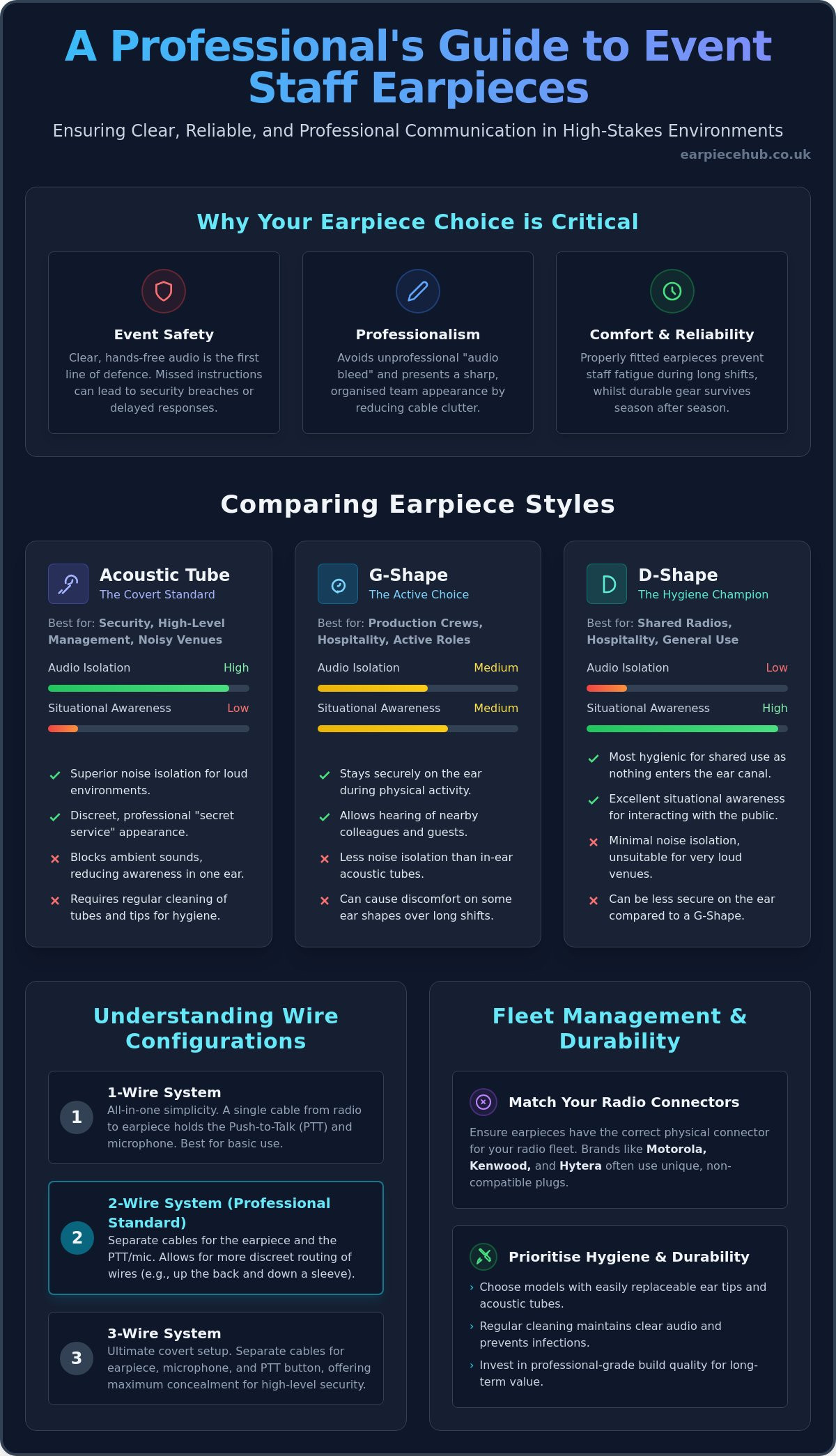
Selecting a radio earpiece for events staff requires a nuanced understanding of different operational roles. There is no single “best” style. Instead, the choice depends on the environment’s noise level, the staff member’s need for discretion, and the length of their shift. Most professional event teams rely on three primary designs: Acoustic Tube, D-Shape, and G-Shape. Each offers a specific balance between audio isolation and situational awareness.
For managers overseeing shared radio fleets, hygiene is a primary concern. “Hot-desking” radios between day and night shifts is common practice. In these scenarios, choosing styles that sit outside the ear canal is essential to prevent the spread of infections and reduce staff complaints. Before you buy, consider whether your team needs to block out the world or stay engaged with it.
Acoustic Tube Earpieces: The Security Favourite
The acoustic tube is the industry standard for security and high-level management. Its clear, coiled tube provides a discreet “secret service” appearance that blends into professional attire. Because the silicone earbud sits directly inside the ear canal, it offers superior audio isolation. This makes it the perfect choice for high-decibel environments like festivals or nightclub security. However, this level of isolation means users may struggle to hear ambient sounds in their “radio ear.” Maintenance is critical here. To keep these units functional and hygienic, you must regularly replace the ear tips and acoustic tubes, as they can become blocked with debris over time.
D-Shape and G-Shape Earpieces: Hospitality and Production
In hospitality and event production, staff often need to hear guests or colleagues whilst listening to radio traffic. The D-Shape earpiece is the most hygienic option for shared equipment. It loops around the outside of the ear, meaning no part of the device enters the ear canal. This makes it the preferred choice for teams who swap gear frequently between shifts. It’s robust, easy to clean, and stays secure even during physical activity.
The G-Shape (also known as the C-Ring) is designed for all-day comfort during 12-hour shifts. It features a soft, swivel ear-loop that fits snugly around the ear. It’s often the favourite amongst staff who find traditional earbuds uncomfortable or intrusive. Both the D-Shape and G-Shape allow for excellent situational awareness, as the ear remains “open” to environmental noise. This is vital for front-of-house staff who must remain approachable and responsive to the public whilst staying connected to the wider team.
Understanding Wire Configurations: 1-Wire vs. 2-Wire vs. 3-Wire
When sourcing a radio earpiece for events staff, the term “wire” often causes confusion amongst those new to professional comms. It simply refers to the number of cables running from the radio connector to the user’s head and torso. Choosing the right configuration is a matter of balancing staff movement, visibility, and the specific demands of the role. A mismatch here often leads to snagged cables or frustrated staff who can’t reach their PTT button quickly enough.
A 1-Wire system is the most straightforward and cost-effective option. It features a single cable leading to the earpiece, with the microphone and Push-To-Talk (PTT) button housed together on that same line. This setup is ideal for general hospitality, retail, or front-of-house roles where staff don’t need a complex rig and prefer a minimalist design. It’s quick to put on and easy to manage during a standard shift.
For more demanding roles, a 2-Wire system provides increased flexibility by splitting the cables. One wire leads to the earpiece, whilst the second carries the PTT and microphone. This allows staff to clip the PTT to a lapel or run it down a sleeve. For high-stakes security, the 3-Wire system is the ultimate covert solution. It separates the earpiece, microphone, and PTT into three distinct lines. This enables a “palm-held” PTT setup where the button is hidden in a sleeve, allowing for communication without ever reaching for the chest or neck.
Selecting the Right PTT (Push-To-Talk) Placement
Effective communication relies on the physical ease of transmitting. Lapel-mounted PTTs are the standard for production crews who need quick access whilst moving equipment or managing guests. However, palm-held PTTs are superior for security personnel who require a discreet profile. Regardless of the configuration, ensure the PTT housing is robust with a tactile “click.” This feedback is essential for staff wearing gloves or working in low-light conditions to prevent accidental transmissions or “dead air” during critical moments.
Cable Durability and Snag Prevention
The environment of a major festival or busy venue is unforgiving on equipment. Cables are the most common point of failure in any radio earpiece for events staff. Investing in professional-grade gear with Kevlar-reinforced cabling is essential to prevent internal wire breaks caused by constant stretching and pulling.
- Coiled sections: These are vital near the head and connector to allow for a full range of motion without pulling the earbud out or straining the radio jack.
- Straight sections: Best for routing under a blazer or uniform to minimise bulk and prevent the “cluttered” look mentioned earlier.
- Cable Routing: Always instruct staff to route cables under their clothing. This simple step prevents snags on door handles, equipment cases, or amongst dense crowds.
By matching the wire configuration to the staff member’s specific movement patterns, you reduce the risk of equipment failure and ensure your team remains focused on the event rather than their gear.
Practical Buying Guide: Compatibility and Fleet Management
Buying a radio earpiece for events staff isn’t just about the style. It’s about the technical fit. If the connector doesn’t match your radio fleet, the equipment is useless. Most UK event professionals rely on a mix of Motorola, Kenwood, and Hytera radios. Each brand uses specific pin configurations. Identifying these before purchase prevents costly returns and ensures your team is ready for the first shift. A mismatched pin can damage the radio’s accessory port, leading to expensive repairs that far exceed the cost of the earpiece itself.
Think beyond the initial purchase price. The “Total Cost of Ownership” includes the replacement of consumable parts. Ear tips, acoustic tubes, and batteries are all wear-and-tear items. A high-quality third-party earpiece often provides better durability than basic alternatives, saving you money over several seasons. To keep your fleet operational, shop our range of specialist earpieces and accessories to find the exact match for your hardware.
Ensuring Connector Compatibility
Most professional radios in the UK use standard pin types. The Motorola 2-pin (M1) and Kenwood 2-pin (K1) are the most common. Hytera (H1) and multi-pin Motorola connectors are also frequent in high-end fleets. Never force a connector. If it doesn’t seat perfectly with a firm click, the pins are likely misaligned. If you have a mixed fleet, use a universal earpiece adapter. These allow you to standardise your earpiece style whilst maintaining compatibility across different radio brands. This approach simplifies your inventory and ensures any staff member can grab any earpiece and get to work.
Maintaining Your Earpiece Fleet
Hygiene is the most overlooked aspect of fleet management. Implement a strict “personal ear tip” policy. Staff should be issued their own replacement ear tips and acoustic tubes. This prevents the spread of ear infections and significantly improves staff comfort during long shifts. Moisture and wax buildup inside acoustic tubes are the primary causes of muffled audio. Regular cleaning or replacement is essential to maintain crystal-clear comms.
Power management is equally vital. For teams using the Motorola DP1400, a replacement battery ensures the radio lasts through a full 12-hour shift without failing. To keep everything organised, use a six-way multi-unit charger. It reduces cable clutter in the comms room and guarantees that every radio is ready for the next shift. Proper organisation prevents lost equipment and speeds up staff check-in times during the morning rush.
Why Earpiece Hub is the UK’s Specialist for Event Comms
Earpiece Hub positions itself as the essential resource for professional radio peripherals. We aren’t just another retailer; we act as a technical partner for event managers across the UK. In high-stakes environments where communication is the difference between success and a safety incident, having a reliable radio earpiece for events staff is critical. Our team understands the nuances of different venues, from the echoing halls of a convention centre to the wind-swept fields of a summer festival. We provide the expertise needed to navigate technical specifications, ensuring your equipment matches your radio fleet perfectly.
Speed and reliability are the core of our operation. Event planning often involves last-minute adjustments and urgent requirements. We cater to this pace with UK-based specialist support and next-day shipping as standard. Whether you need a single replacement acoustic tube or a complete overhaul of your security team’s comms gear, we respond with urgency. Our inventory includes both brand-specific earpieces for industry leaders like Motorola and Hytera, alongside universal solutions that allow you to standardise your equipment across mixed fleets.
Specialist Knowledge for UK Event Teams
We assist event managers in selecting the ideal kit based on the specific movement and visibility requirements of their staff. Security personnel often require the discreet profile of our Kevlar-reinforced acoustic tube earpieces, which are built to withstand constant movement and potential snags. For production crews, we might recommend the situational awareness provided by a G-shape or D-shape design. Hygiene remains a top priority in our specialist advice. We provide easy access to replacement ear tips and tubes, allowing you to implement a clean-fleet policy that keeps staff comfortable and reduces the risk of shared-equipment issues.
Ready to Equip Your Team?
Equipping a large team requires a balance of quality and cost-effectiveness. We stock a wide variety of Motorola, Hytera, and Kenwood compatible earpieces, ensuring you can find the exact match for your existing radios. For large event security fleets, our bulk order discounts provide a professional-grade solution that survives multiple seasons, offering much better value than cheap, disposable alternatives. Our commitment is to provide the durability and clarity your team needs to stay safe and efficient throughout the longest shifts.
Shop our full range of events staff earpieces today
Equip Your Team for Success in 2026
Selecting the right radio earpiece for events staff is a strategic investment that directly impacts team safety and operational efficiency. You’ve now seen how matching earpiece styles to specific roles, such as choosing acoustic tubes for security or G-shape loops for hospitality, ensures all-day comfort. By understanding wire configurations and ensuring connector compatibility, you can eliminate the technical failures that often plague busy venues. Proper fleet management, including regular hygiene checks and battery maintenance, will keep your communications crystal clear throughout the longest shifts.
Reliability is non-negotiable in high-stakes environments. Our professional gear features Kevlar-reinforced cables designed to survive the rigours of multiple event seasons. When you partner with a specialist hub, you benefit from expert UK-based support and the urgency of next-day shipping for those critical last-minute requirements. Don’t let substandard equipment compromise your next production or festival.
Find the perfect earpiece for your events team at Earpiece Hub. We are ready to help you maintain seamless, professional communication from the first guest’s arrival until the final pack-down.
Frequently Asked Questions
What is the best radio earpiece for loud music events?
Acoustic tube earpieces or noise-cancelling overhead headsets are the most effective options for loud music environments. Acoustic tubes provide passive noise isolation by sealing the ear canal, whilst overhead headsets offer active protection in high-decibel areas like concert pits. For 2026, many professionals are moving towards AI-based noise suppression to ensure voice clarity remains high even against extreme background noise levels.
Are acoustic tube earpieces hygienic for multiple staff members?
Acoustic tube earpieces are only hygienic if you implement a policy of individual ear tip and tube replacement. Sharing the same silicone tip amongst multiple staff members is a significant health risk. We recommend issuing each team member their own replacement acoustic tubes and ear tips. This ensures the main electronic component can be shared whilst the parts in contact with the skin remain personal.
What is the difference between a 1-wire and a 2-wire earpiece for events?
The primary difference lies in the cable layout and how the staff member interacts with the PTT button. A 1-wire system uses a single cable for both the earpiece and the combined mic/PTT housing. A 2-wire radio earpiece for events staff separates these into two lines, allowing the PTT to be clipped to a lapel or run down a sleeve for more discreet and flexible operation during busy shifts.
How do I know if an earpiece is compatible with my Motorola radio?
You must match the specific pin configuration of your radio model, such as the standard M1 2-pin or the larger multi-pin connectors. Check the accessory port on the side of your Motorola handset before purchasing. If the connector doesn’t seat perfectly with a firm click, don’t force it. Using a universal earpiece adapter is often the safest way to ensure a perfect fit for mixed radio fleets.
Can I replace just the clear plastic tube if it becomes discoloured?
Yes, replacing just the clear acoustic tube is a standard maintenance task for professional event teams. These tubes are consumable items that naturally discolour due to UV exposure or become blocked with moisture and wax. Replacing the tube is far more cost-effective than buying a complete new earpiece. It’s a simple way to maintain high audio quality and professional appearance throughout the event season.
Do events staff need noise-cancelling earpieces?
Noise-cancelling technology is essential for staff working in high-decibel zones like front-of-house or stage security. Standard earpieces often struggle to cut through the roar of a crowd or a PA system. Using a radio earpiece for events staff with noise-cancelling features or AI-based suppression ensures that vital safety instructions are heard clearly without the user needing to turn their radio volume to dangerous levels.
How long do professional radio earpieces usually last?
A professional-grade earpiece with Kevlar-reinforced cabling should last for multiple event seasons with proper care. Whilst the electronic components are durable, the consumable parts like silicone ear tips and acoustic tubes typically require replacement every three to six months. Factors such as physical snags, moisture exposure, and how the gear is stored at the end of a shift will ultimately determine the overall lifespan of your equipment.
What are the benefits of using a D-shape earpiece for hospitality staff?
D-shape earpieces offer superior hygiene and situational awareness for hospitality teams. Because the earpiece loops around the outside of the ear rather than entering the canal, it’s the preferred choice for staff who find earbuds uncomfortable. It also allows ambient noise to reach the ear, which is vital for staff who need to listen to guests whilst staying connected to the internal radio channel.
