





Uncategorized
Best Noise Cancelling Remote Speaker Microphones & Earpieces: Professional UK Guide 2026
Jul
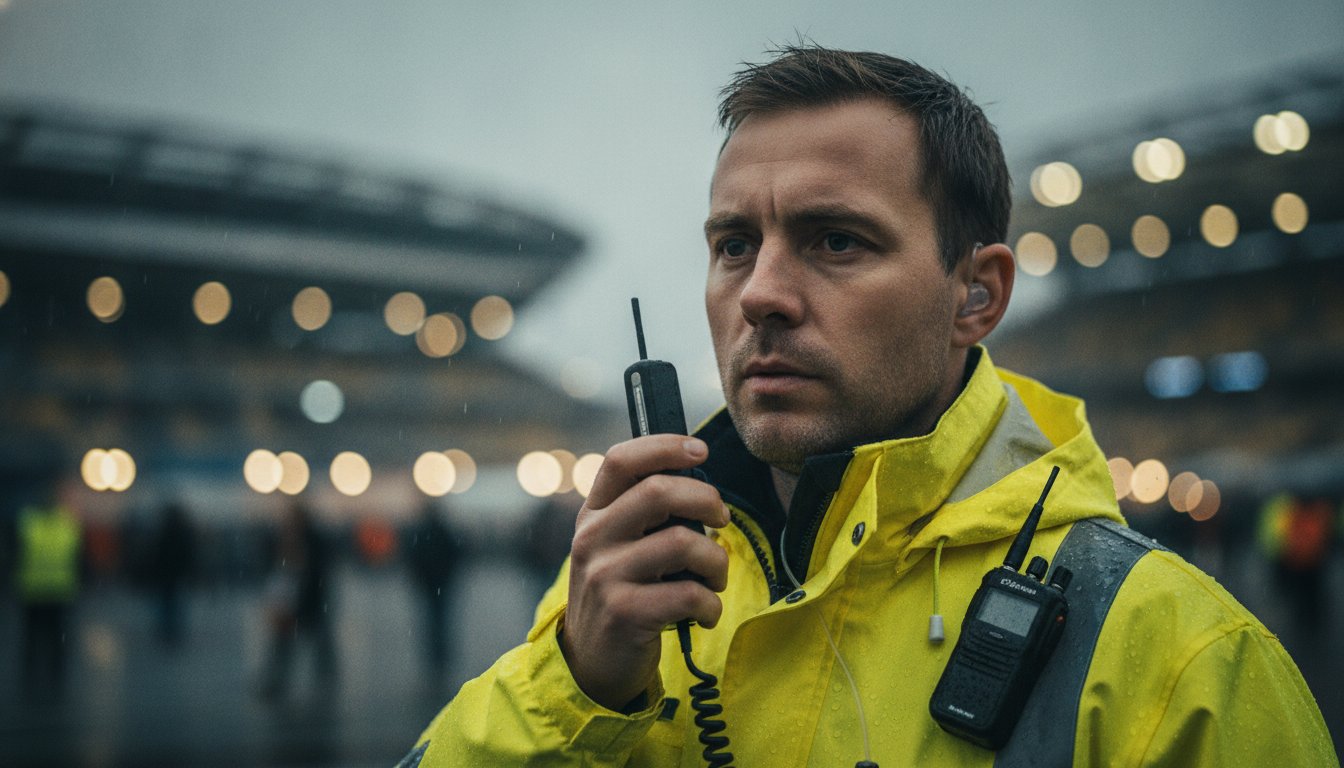
Imagine standing on a rain-slicked perimeter at a major UK event, trying to relay a critical security update whilst a 90-decibel crowd roars in the background. If your team only hears muffled static and wind, your equipment has already failed the mission. We understand that in high-stakes environments, a standard radio setup simply isn’t enough. You need a high-performance noise cancelling remote speaker microphone that can isolate your voice from the chaos of an industrial site or a crowded stadium. It is a common struggle to deal with ambient noise ruining clarity, especially when UK health and safety standards demand peak performance in loud settings.
You deserve crystal clear two-way audio that survives the British weather and physical scuffles during 12-hour shifts. This guide will help you master your communications by identifying the most reliable hardware for the UK security and industrial sectors. We’ll examine the best earpieces for Motorola, Hytera, and Kenwood fleets, explaining the vital difference between active noise cancellation and passive sound isolation to ensure your team stays connected when it matters most.
Key Takeaways
- Understand how “audio masking” in loud environments leads to missed instructions and safety risks in professional UK workspaces.
- Learn to choose between digital active noise cancellation for filtering background hum and passive isolation for physical sound blocking.
- Determine when to deploy a noise cancelling remote speaker microphone for heavy industry versus using covert kits for event security.
- Master hardware compatibility by identifying the correct connectors for Motorola DP series, Hytera, and Kenwood radio fleets.
- Discover how to reduce ear fatigue and maintain communication clarity throughout intensive 12-hour shifts with specialist-tested gear.
Navigating High-Decibel Workspaces: Why Standard Radio Gear Fails
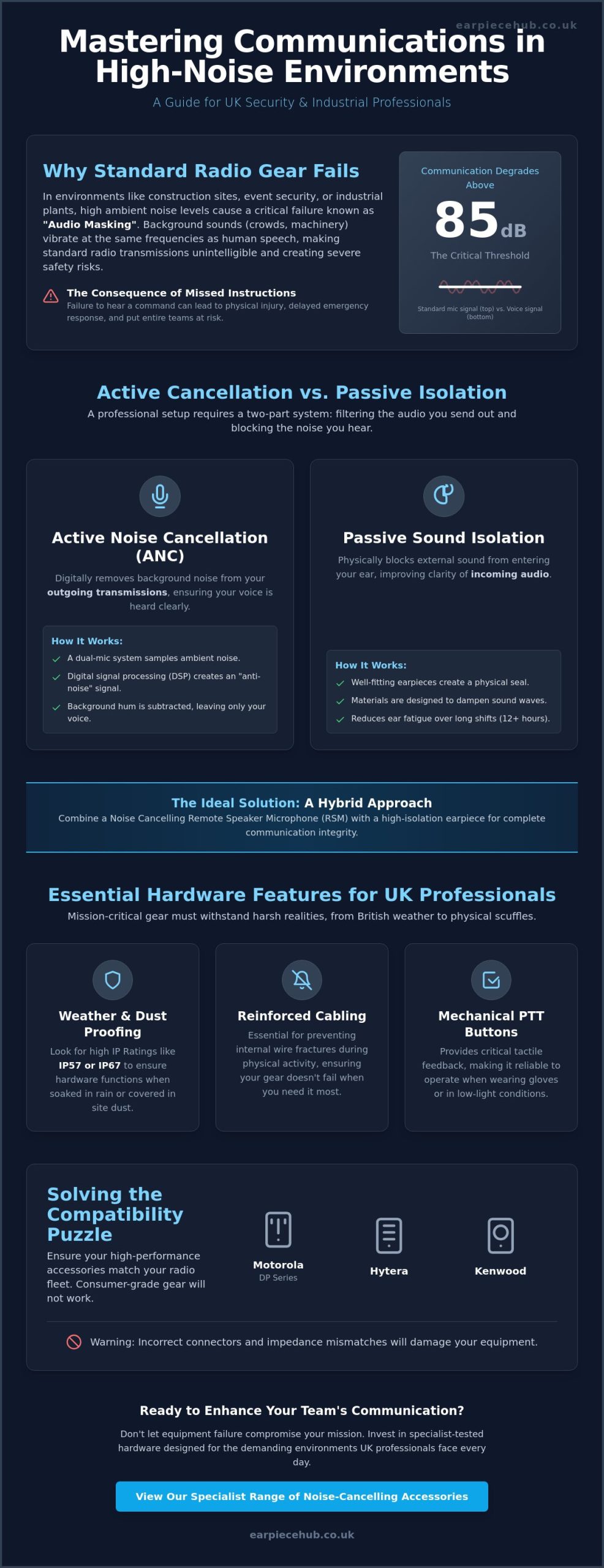
High-decibel environments are the primary enemy of clear communication. In sectors like nightclub security, construction centres, and airport tarmac ground crews, the ambient noise levels often exceed the capacity of basic equipment. This leads to a phenomenon known as “Audio Masking,” where background chatter, heavy machinery, or loud music vibrates at the same frequencies as human speech. When this happens, standard radio accessories fail to distinguish between your voice and the surrounding chaos. For a professional, investing in a professional noise cancelling remote speaker microphone is an operational necessity to ensure messages aren’t lost in the roar.
The safety implications of missed instructions are severe. In a busy construction hub, a missed “stop” command can lead to physical injury. For security teams, failing to hear a call for backup during a scuffle puts every officer at risk. You might be tempted to use consumer-grade “noise-cancelling” earbuds, but these devices are built for music, not mission-critical radio fleets. They lack the specific impedance and connector types required to interface with professional radios like the Motorola DP1400. Consumer gear simply cannot handle the high-voltage Push-to-Talk (PTT) requirements of an industrial two-way system.
The Decibel Challenge amongst UK Security Teams
Communication reliability typically begins to degrade once ambient noise hits the 85dB threshold. At this level, users often change their PTT behaviour, shouting into the mic and causing audio clipping. Foundational noise-cancelling microphone technology utilises dual-port designs to sample ambient noise and subtract it from the primary audio feed. Without this, standard microphones pick up a distorted slurry of background “mud” that renders the user’s voice unintelligible. Relying on a high-quality noise cancelling remote speaker microphone ensures that only the intended message reaches the control room, regardless of the surrounding volume.
Durability in the Field: Beyond Audio Quality
Professional gear must be organised around the harsh realities of the British weather. We prioritise equipment with high IP ratings, such as IP57 or IP67, which ensures your hardware continues to function whilst soaked by rain or covered in site dust. Durability also extends to the physical build of the unit. Reinforced cabling is essential for preventing internal wire fractures during physical activity or scuffles. A “Reliable Specialist” always chooses mechanical PTT buttons over touch-sensitive alternatives, as they provide tactile feedback that is essential when wearing gloves or operating in low-light conditions. This focus on mechanical reliability is why our specialist-tested hardware remains the standard for UK professionals who cannot afford equipment failure.
Active Noise Cancellation vs Passive Isolation: Choosing Your Shield
Professional clarity in high-decibel environments is a two-part system. You must filter the transmission going out and the audio coming in. Active Noise Cancellation (ANC) focuses on the digital side, using signal processing to strip away background hum. Passive isolation relies on the physical design of your gear to block sound waves from entering the ear canal. For many UK security professionals, the ideal setup involves a hybrid approach, combining a noise cancelling remote speaker microphone with a high-quality earpiece. This ensures that your voice is heard clearly by others whilst you receive instructions without straining against the crowd.
Whilst total silence might seem attractive, it often creates a safety risk. Door supervisors and site managers need environmental awareness to detect approaching vehicles or verbal threats. Striking the right balance is essential. High-end hardware allows you to hear your team clearly without losing touch with your surroundings. When reviewing safety protocols, following OSHA guidelines on noise-cancelling technology helps ensure your equipment provides adequate hearing protection without compromising operational safety. If you are unsure which setup fits your radio fleet, you can view our specialist range of noise-cancelling accessories to find the right match.
How Noise-Cancelling Microphones Filter Your Voice
Most professional microphones use a dual-mic system. One microphone captures your voice whilst the second samples the ambient environment. Digital signal processing then compares these feeds and subtracts the noise from the transmission. In radio communications, “suppression” merely reduces the volume of background noise, whereas “cancellation” actively eliminates specific frequencies to ensure your voice remains the only thing your team hears. This digital filtering is the only way to maintain transmission clarity amongst the heavy machinery of industrial centres. Using a dedicated noise cancelling remote speaker microphone is the most effective way to achieve this level of isolation in the field.
The Role of the Acoustic Tube in High-Noise Reception
Receiving a clear message is just as important as sending one. A standard earpiece often fails because ambient noise leaks around the speaker. Acoustic tubes solve this by delivering sound directly into the ear canal via a sealed air column. The choice of ear tip is critical here; mushroom tips offer all-day comfort, but triple-flange tips provide maximum physical isolation in extreme noise. Maintaining these tubes is vital, especially in humid UK weather. Moisture build-up can block the air column, so regular cleaning and replacement of the inner tube is necessary to keep your comms sharp and your hardware in top condition.
The Best Professional Hardware for Noisy Environments 2026
Selecting the right equipment depends on your specific role and the level of ambient interference you face daily. Whilst heavy industry requires ruggedised, high-output tools, event security prioritises discretion and comfort. A high-quality noise cancelling remote speaker microphone serves as the backbone for teams operating in the loudest environments, such as construction centres or music festivals. For those needing a balance of protection and communication, incorporating workplace hearing protection standards into your gear selection is a critical step for long-term health and operational efficiency. Beyond microphones, professionals often deploy noise-cancelling overhead headsets for tarmac work or G-shape and D-shape earpieces for roles requiring high movement in moderately loud areas.
Top Choice for Transmission: The Heavy-Duty RSM
The noise cancelling remote speaker microphone is often the most effective tool for site managers and industrial workers. By mounting the unit on the shoulder, the microphone is positioned closer to the user’s mouth, which naturally improves the signal-to-noise ratio before digital processing begins. This placement allows you to hear incoming transmissions clearly through the high-output speaker without removing the radio from your belt. Many professional RSMs also feature a 3.5mm jack, allowing you to add a “listen-only” earpiece for private communications in sensitive situations. Given the unpredictability of the UK weather, an IP67 rating is non-negotiable; it ensures your microphone survives a sudden British downpour or a dusty industrial site without audio degradation.
Top Choice for Discretion: Professional Acoustic Tubes
For door supervisors and event security, the 2-wire system remains the industry favourite. This setup separates the earpiece from the microphone and PTT unit, allowing you to run the wires under a jacket for a professional, covert appearance. The technical advantage here is the separate PTT/Mic unit, which can be clipped to a lapel or held in the hand during high-noise incidents for better voice capture. We recommend the Acoustic Tube Earpiece for Motorola Radios as a reliable starting point for any security professional using the DP series. These kits provide excellent passive isolation whilst remaining comfortable for full 12-hour shifts. For even greater control, 3-wire kits add a separate barrel PTT that can be hidden down a sleeve, providing the ultimate level of discretion and functional speed.
In areas with extreme decibel levels, such as airport tarmacs or heavy demolition zones, a noise-cancelling overhead headset is the gold standard. These provide maximum physical blocking of external sound whilst delivering clear audio through high-fidelity speakers. For roles involving significant physical movement, G-Shape and D-Shape earpieces offer a more secure fit. These wrap around the outer ear, ensuring the speaker stays in place during scuffles or rapid movement. Every piece of hardware we supply is tested for the rigours of the UK security industry, focusing on mechanical reliability and clear communication.
Solving the Compatibility Puzzle: Motorola, Hytera, and Kenwood
Radio compatibility is often the most frustrating part of upgrading your fleet. A high-performance noise cancelling remote speaker microphone is useless if the pin configuration doesn’t match your handset. Whilst some manufacturers claim you must use their proprietary accessories, the reality of the UK market involves mixed fleets and legacy equipment. Understanding the specific requirements for Motorola, Hytera, and Kenwood ensures your team remains connected without unnecessary expenditure on entirely new radio systems. It’s about finding hardware that bridges the gap between different generations of technology whilst maintaining professional audio standards.
The Motorola DP1400 remains the industry standard for many UK security and industrial centres. Supporting this workhorse requires specific attention to power and connectivity. Active noise cancellation is a power-hungry feature; it requires stable voltage to process digital signals effectively. If your battery is reaching the end of its life cycle, you may notice the ANC performance degrading before the radio actually dies. Ensuring you have a high-capacity power source is the first step in maintaining transmission clarity in loud environments. If your current fleet is struggling to keep up, you can shop our range of specialist radio accessories to restore your team’s communication performance.
Matching the Right Pin to Your Radio
UK security firms primarily rely on three main connector types. Motorola uses a 2-pin (M1) for entry-level models, whilst the professional DP series requires a side-mounted multipin connector. Hytera accessories often utilise the PD series connectors, which are physically incompatible with other brands. A loose or incorrect connection causes intermittent static that mimics background noise, often leading users to wrongly blame their microphone. To maintain peak performance, ensure your power source is up to the task. A high-quality Replacement Battery for Motorola DP1400 provides the consistent voltage required to run modern ANC circuitry without audio drops or signal distortion.
The “Hub” Strategy for Fleet Management
Managing a large fleet of radios across multiple sites requires a logical approach to accessories. Centralising your procurement through a specialist allows you to implement a “Hub” strategy, where universal earpieces are paired with brand-specific earpiece adapters. This flexibility is vital when a contract requires you to interface with a client’s existing Kenwood or Hytera system. Using adapters allows you to maintain high audio gain and microphone sensitivity across different hardware. It also simplifies your inventory of spare parts, such as acoustic tubes and ear tips, ensuring your operations never stall due to a broken connector. This organised approach reduces downtime and ensures every noise cancelling remote speaker microphone in your inventory is ready for deployment at a moment’s notice.
Why UK Professionals Choose Earpiece Hub for High-Noise Gear
Since 2015, Earpiece Hub has operated as a dedicated specialist in the two-way radio accessory market. Unlike general electronics retailers, we focus exclusively on the technical components that keep your team connected. We understand that a noise cancelling remote speaker microphone is not just an add-on; it is a critical piece of safety equipment. Every product in our inventory is selected based on its ability to perform in the high-stakes environments of UK security and heavy industry. We don’t deal in fluff or decorative features. We provide functional, authoritative solutions for professionals who require absolute audio clarity.
Reliability is our standard. We recognise that security contracts and industrial projects often start on short notice, which is why we prioritise next-day shipping and 24/7 support for our professional partners. Every noise cancelling remote speaker microphone and earpiece we stock undergoes testing to ensure it meets the rigours of the UK climate and the physical demands of the field. By acting as a central “Hub,” we provide a single, dependable source for everything from replacement acoustic tubes to six-way multi-unit chargers, ensuring your fleet management is as efficient as possible.
Supporting the UK Security and Event Landscape
Our expertise is rooted in a deep understanding of the specific challenges faced by door supervisors and site managers. Cheap online alternatives often fail when exposed to the British rain or the constant friction of a 12-hour shift. We commit to providing durable gear that outlasts these disposable options, reducing your long-term costs and preventing communication blackouts during critical incidents. Whether you are managing a festival perimeter or a busy construction centre, our hardware is organised to withstand physical scuffles and environmental stress. Shop our professional noise-cancelling range today to upgrade your operational capacity.
Expert Advice for Complex Comms Requirements
The technical jargon of Active Noise Cancellation (ANC) and digital signal processing can be confusing when you are trying to kit out a large team. Our specialists are here to help you navigate these specifications, ensuring your accessories are perfectly matched to your radio’s voltage and connector type. We treat your communications as a critical safety system, not just a retail transaction. If you are managing a mixed fleet of Motorola, Hytera, or Kenwood radios, we can provide the specific adapters and high-capacity batteries needed to maintain peak performance. Contact the Earpiece Hub experts for fleet advice and ensure your team is equipped with the best noise-cancelling technology available in 2026.
Secure Your Operational Clarity
Mastering your comms in high-noise environments comes down to choosing hardware that balances digital processing with physical durability. You now understand that a high-performance noise cancelling remote speaker microphone is essential for transmission, whilst acoustic tubes provide the passive isolation needed to hear your team amongst the chaos. Whether you are managing a nightclub door or a busy industrial hub, your equipment must survive the British rain and the physical demands of every shift. Reliable communication isn’t just a convenience; it’s a critical safety system that requires specialist-tested hardware.
As a UK specialist retailer established in 2015, we provide the specialised 2-wire and 3-wire covert kits needed for the most demanding security roles. Our commitment to next-day UK shipping on all in-stock items means you don’t have to wait to upgrade your team’s performance. Don’t let background noise compromise your safety or operational speed in the field. View our range of professional earpieces for noisy environments and secure your fleet’s future today. We are ready to help you achieve absolute clarity when it matters most.
Frequently Asked Questions
What is the best earpiece for a door supervisor working in a loud nightclub?
A 2-wire or 3-wire acoustic tube earpiece is the most effective choice for nightclub security. The surgical-grade ear tip provides vital passive sound isolation to block out loud music, whilst the separate microphone allows for clear transmission. For even more control in high-volume environments, a 3-wire kit offers a separate barrel PTT that you can run down your sleeve for rapid, discreet communication during an incident.
Can I use a standard mobile phone headset with my professional radio?
You cannot use a standard mobile phone headset with a professional two-way radio without a specific adapter. Consumer headphones have different impedance levels and wiring configurations that don’t support the high-voltage Push-to-Talk (PTT) systems used by radio fleets. Using the wrong equipment can lead to distorted audio or even damage the radio’s internal circuitry. Always use accessories designed specifically for your radio model to ensure safety.
How do I clean an acoustic tube earpiece to keep the audio clear?
To clean your acoustic tube, detach the clear plastic section from the transducer and blow out any moisture using an air duster. If there is visible debris or earwax, wash the tube and ear tip in warm, soapy water and ensure they are completely dry before reattaching. Regular maintenance prevents moisture build-up from blocking the air column, which is a common cause of audio loss in humid UK conditions.
What is the difference between a 1-wire, 2-wire, and 3-wire earpiece kit?
A 1-wire kit has the earpiece, microphone, and PTT on a single cable, which is best for light-duty roles. A 2-wire kit separates the earpiece from the mic/PTT unit, allowing for more discreet wiring under a jacket. A 3-wire kit is the most professional option, providing three separate lines for the earpiece, microphone, and a dedicated barrel PTT for maximum operational flexibility in high-stakes security and industrial centres.
Does a noise-cancelling remote speaker microphone require a special radio?
A noise cancelling remote speaker microphone does not usually require a special radio, but it must have the correct connector and sufficient battery voltage. The noise-cancelling circuitry relies on the radio’s power to process digital signals effectively. If you are using an older radio with a degraded battery, the noise-cancelling performance may be inconsistent. Always check that your radio’s firmware is updated to support modern digital accessories.
How do I know if an earpiece is compatible with my Motorola DP1400?
To ensure compatibility with a Motorola DP1400, you must select an earpiece with the specific Motorola multipin side connector. This radio does not use the standard 2-pin M1 connector found on entry-level models. Always look for “DP series compatible” in the technical specifications. If you are kitting out a mixed fleet, using a brand-specific adapter can help you interface universal earpieces with your DP1400 handsets.
Why is my radio audio muffled even when the volume is at maximum?
Muffled audio is often caused by a physical blockage in the acoustic tube or a depleted battery that can’t drive the speaker effectively. Check the clear tube for condensation or earwax, as even a small amount of moisture can significantly dampen sound waves. If the hardware is clear, the issue may be “audio masking” from extreme background noise, which requires upgrading to a setup with better passive isolation or active cancellation.
Are overhead headsets better than acoustic tubes for construction site noise?
Overhead headsets are superior for extreme construction noise because they provide full ear coverage and higher decibel protection. They are designed for tarmac and demolition environments where hearing protection is as important as communication. Acoustic tubes are better suited for roles that require discretion or moderate noise isolation, but they don’t offer the same level of physical sound blocking as a dedicated noise cancelling remote speaker microphone paired with a headset.
