





Uncategorized
Kenwood Two Way Radio Headset: The Ultimate Professional Buying Guide
Jun
The most advanced radio on the market is only as reliable as the earpiece connected to it. You already know that audio failure or physical discomfort during a long shift isn’t just a nuisance; it is a genuine operational risk. Choosing the right Kenwood two way radio headset requires more than just picking a style. It demands a precise understanding of connector types and wiring configurations to prevent technical dropouts when they matter most.
We will help you master these technical nuances to ensure crystal-clear communication in any professional environment. This guide provides the expertise you need to identify the correct connector for your specific radio model instantly. We’ll compare G-shape, D-shape, and acoustic tube styles to help you balance all-day comfort with high-fidelity audio. You’ll also learn how to find a reliable UK supplier that offers the next-day shipping and specialist support your role demands.
Key Takeaways
- Identify the exact connector type for your radio fleet to avoid the common mistake of purchasing incompatible hardware.
- Discover which physical design—G-Shape, D-Shape, or Acoustic Tube—best suits your specific shift length and hygiene requirements.
- Understand the tactical differences between 1-wire, 2-wire, and 3-wire setups when selecting your Kenwood two way radio headset.
- Master the balance between situational awareness and audio isolation by matching your audio gear to your workplace noise levels.
- Access specialist UK-based technical support and fast shipping to ensure your communication equipment is mission-ready without delay.
Choosing the Right Kenwood Two-Way Radio Headset: Compatibility First
Matching the connector to your specific radio model is the most critical step in the procurement process. A high-quality Kenwood two way radio headset becomes a liability if it fails to interface correctly with your hardware. Kenwood audio standards have been a mainstay of the UK communications industry for decades. Over this time, the brand has transitioned through various technical specifications. This means a legacy earpiece from an older fleet likely won’t meet the requirements of modern digital units. Professionals must verify their connector type before ordering to avoid the frustration of equipment that doesn’t fit on the day it’s needed.
Using the wrong adapter or forcing a near-fit often leads to severe audio degradation. This isn’t merely a volume issue; it’s a matter of impedance matching and electrical integrity. A poor connection introduces line noise, reduces microphone sensitivity, and can even cause the PTT (Push-to-Talk) to trigger accidentally. Because a two-way radio relies on a clear signal path to function as a safety tool, compromise is not an option. Our specialist testing ensures that every peripheral we supply maintains the high-fidelity audio Kenwood users expect.
The Classic Kenwood 2-Pin Connector
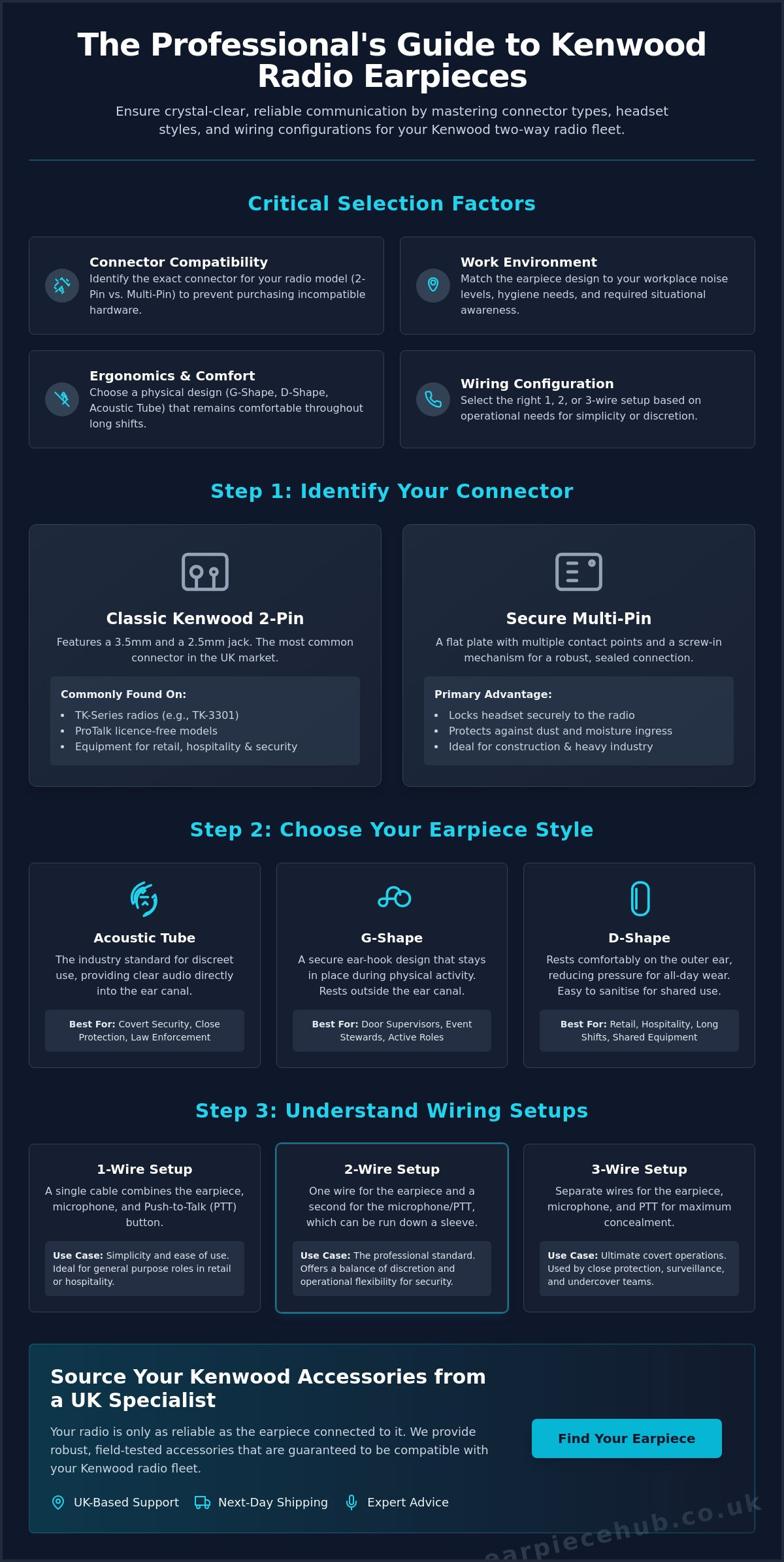
The 2-pin configuration remains the most recognisable interface in the UK market. It features a 3.5mm jack and a 2.5mm jack spaced precisely apart. This design is the standard for the venerable TK-series and the popular ProTalk licence-free models used across retail and hospitality sectors. UK security firms favour this setup because it’s lightweight and reliable. It provides a stable connection for 1-wire and 2-wire earpieces. If your radio has two circular ports on the side, this is almost certainly the connection you require for your Kenwood two way radio headset.
Kenwood Multi-Pin and Specialist Connectors
High-tier digital (DMR) radios, particularly the NX-series, often utilise a multi-pin interface. These connectors feature a side-mounted plate with several small contact points rather than traditional jacks. The primary advantage here is the secure, screw-in mechanism. In rugged environments like construction sites or heavy manufacturing, a standard 2-pin can be snagged and pulled out. Multi-pin connectors lock the headset into place, ensuring the seal remains intact against dust and moisture. If your radio has a screw hole next to the accessory port, you’ll need this specific professional-grade solution to ensure consistent performance in the field.
Understanding Headset Styles: G-Shape, D-Shape, and Acoustic Tubes
Selecting the correct physical form for your Kenwood two way radio headset is a decision that impacts both operational efficiency and staff morale. If an earpiece is uncomfortable, users will inevitably remove it, leading to missed calls and security breaches. Beyond ergonomics, durability is a primary concern for professional fleets. High-quality peripherals feature Kevlar reinforcement and robust strain relief at the connector and earpiece junctions. These technical additions prevent the internal copper wires from snapping during the physical rigours of a patrol or emergency response.
Audio clarity varies significantly between designs. In-ear options provide better isolation in loud environments, which is essential for meeting the OSHA noise standard in industrial settings. However, hygiene becomes a factor for shared equipment. Over-ear designs like the D-shape are preferable for rotating shifts in retail or events. Since they don’t enter the ear canal, they are far easier to sanitise between users compared to in-ear alternatives.
Acoustic Tube Earpieces for Covert Operations
The transparent acoustic tube is the industry standard for covert security and close protection. Its low-profile design ensures the equipment remains discreet whilst providing clear audio directly into the ear. For a bespoke fit, you can trim the plastic tube to the exact length required for your height and neck size. A common technical issue is audio muffling caused by condensation within the tube. To fix this, simply disconnect the tube from the transducer and clear the moisture with a quick burst of compressed air.
G-Shape and D-Shape: The Workhorses of Hospitality
G-shape earpieces are the preferred choice for active roles such as door supervisors or event stewards. The secure ear-hook design ensures the unit stays in place even during physical activity or sudden movements. In contrast, the D-shape earpiece is often the favourite for retail environments where comfort is the priority. It rests gently on the outer ear, reducing the pressure points that often cause fatigue during 12-hour shifts. This design also allows for better situational awareness, as it doesn’t completely block out ambient sounds. If you’re managing a large team, you might want to browse our full range of earpieces to find the best balance of comfort and durability for your specific fleet.
Technical Configurations: 1-Wire, 2-Wire, and 3-Wire Explained
Understanding the technical shorthand of 1-wire, 2-wire, and 3-wire configurations is essential for any professional procurement officer. These terms don’t refer to the internal copper strands but rather to the number of separate cables exiting the radio connector. Choosing the right configuration for your Kenwood two way radio headset determines how effectively your team can communicate whilst remaining mobile or discreet. Whilst it might seem that fewer wires lead to less clutter, the tactical advantages of multi-wire setups often outweigh the simplicity of a single lead.
Reliability in the field is often a trade-off between simplicity and functionality. A 1-wire headset has fewer points of failure, but it is more susceptible to snagging if not managed correctly. Multi-wire configurations, when properly routed under a uniform or jacket, are actually more secure because the cables are protected from the environment. Our Kenwood-compatible kits use reinforced cabling to ensure that even a complex 3-wire setup remains durable under pressure. Professionals should consult FCC regulations or local UK equivalents to ensure their radio system and accessories meet the required power and licensing standards for their specific sector.
1-Wire and 2-Wire Setups
A 1-wire setup is the most straightforward solution. It features a single cable that runs from the radio to the earpiece, with an inline PTT and microphone housing located at chest level. This is ideal for general retail or warehouse use where covertness isn’t a priority. However, for professional security, a 2-wire kit is the standard. This separates the earpiece from the PTT and microphone. This allow you to run the earpiece cable over your shoulder whilst the PTT sits on your lapel or inside a sleeve. It provides better ergonomics and prevents the earpiece from being pulled out when you turn your head.
3-Wire Kits for High-Stakes Environments
For close protection and high-stakes surveillance, 3-wire kits are the undisputed favourite amongst industry veterans. These kits provide three distinct leads: one for the earpiece, one for the microphone, and a third for the PTT button. This configuration offers the ultimate tactical advantage. You can hide the microphone behind a lapel and run the PTT button down your sleeve to your palm. This allows for silent communication where you can trigger the radio without reaching for your chest. Managing these leads requires discipline, but the covertness gained is unmatched. When you organise your kit, use cable ties or medical tape to secure excess lead length to your body. This prevents loops that could be grabbed or caught during a physical intervention.
Selecting Your Headset Based on the Working Environment
The working environment is the ultimate test for any Kenwood two way radio headset. A busy warehouse floor presents vastly different challenges compared to a high-end retail boutique. Professionals must balance the need for audio isolation with the necessity of situational awareness. In industrial settings, hearing a warning siren or a moving vehicle is just as important as receiving a radio transmission. Conversely, in hospitality, the gear must remain discreet and lightweight to ensure staff can provide service without looking overly tactical. Each setting requires a specific technical approach to ensure the equipment aids rather than hinders the user.
Weatherproofing is another critical consideration for UK-based operations. Communicating effectively in the British rain requires peripherals that can withstand moisture without short-circuiting. Look for connectors with rubber gaskets and reinforced cabling to maintain electrical integrity in damp conditions. PPE also plays a role in your selection. If your team wears hard hats or masks, a standard overhead headset might not be feasible. In these cases, a behind-the-head style or a low-profile earpiece is the only logical choice to ensure the gear doesn’t interfere with essential safety equipment.
High-Noise Environments: Logistics and Events
In logistics hubs and large-scale events, ambient noise can easily drown out standard earpieces. Noise-cancelling overhead headsets are the standard solution here. They provide physical ear protection whilst delivering clear audio directly to the user. For those who find full headsets too bulky, a Remote Speaker Microphone (RSM) is a versatile alternative. These units clip to the shoulder, allowing the user to hear transmissions closer to their ear. The oversized PTT buttons on RSMs are particularly useful for staff wearing heavy work gloves. They eliminate the need to fumble with small inline switches during critical tasks.
Customer-Facing Roles: Retail and Hospitality
Retail and hospitality roles require a more subtle approach to communication. Discreet gear allows staff to coordinate without alerting guests or customers to internal issues. Lightweight designs are essential to prevent the ear fatigue that often sets in during long, 12-hour shifts. The G-shape earpiece is a perennial favourite for hotel staff because it offers a secure fit without the clinical look of an acoustic tube. It sits comfortably on the outer ear, allowing for natural conversation with guests whilst keeping the radio link active. To ensure your team is equipped for any environment, shop our professional range of Kenwood-compatible audio gear today.
Why Professionals Choose Earpiece Hub for Kenwood Accessories
Earpiece Hub operates as more than a retail storefront. We position ourselves as a central, essential resource for the UK security and communications community. This “Hub” philosophy means we prioritise technical expertise and operational reliability over simple transactions. When you source a Kenwood two way radio headset from us, you aren’t just buying a peripheral. You’re gaining a dependable partner that understands the high-stakes nature of professional radio communication. Our team consists of industry veterans who know exactly which specifications are required for specific sectors, from close protection to large-scale logistics.
Quality control is the heartbeat of our operation. Every Kenwood-compatible peripheral we stock undergoes a rigorous testing process to ensure it meets our specialist standards for audio fidelity and mechanical durability. We verify the integrity of the PTT switches, the clarity of the microphones, and the strength of the reinforced cabling. Rapid dispatch is equally vital. Security firms often require equipment on short notice to cover new contracts or replace damaged gear. Our commitment to next-day shipping ensures your team remains mission-ready without unnecessary downtime. We understand that in your industry, a delay in communication is a compromise in safety.
Guaranteed Compatibility and Support
Finding the right fit for an older or specialised radio fleet can be challenging. We remove this friction by offering earpiece adapters for any radio model, ensuring your hardware remains functional regardless of its age or interface. If you encounter audio issues or configuration hurdles, our UK-based technical support is available to provide immediate troubleshooting. We also support large-scale operations with bulk order discounts. Whether you’re equipping a small retail team or a national security fleet, we provide the logistical scale and technical depth your organisation demands.
Ready to Upgrade Your Comms?
Mastering your audio setup requires a focus on three key criteria: the connector type, the physical style, and the wiring configuration. By matching these to your specific working environment, you ensure crystal-clear communication and all-day comfort for your staff. Don’t settle for generic alternatives that fail when the pressure is on. Choose a specialised Kenwood two way radio headset that is built for the rigours of the professional UK market. Browse our collection today to find the exact configuration your fleet requires.
Shop the full range of Kenwood-compatible earpieces at Earpiece Hub
Optimise Your Fleet Communications Today
Mastering the technical specifications of your audio equipment is the only way to guarantee operational success. By prioritising connector compatibility and selecting the right wiring configuration, you eliminate the risk of audio failure during critical shifts. Whether you require the discreet profile of an acoustic tube or the hygienic benefits of a D-shape earpiece, your choice of Kenwood two way radio headset must reflect the specific demands of your working environment. Proper maintenance and environmental matching ensure that your team remains focused on the task at hand rather than struggling with equipment.
Earpiece Hub has served as a specialist UK retailer since 2015, providing the expertise required to keep professional teams connected. We offer next-day shipping on all professional gear to ensure you never face a communication gap. Our fleet managers also benefit from 24/7 technical support, helping you resolve audio issues the moment they arise. Don’t leave your team’s safety to chance with generic accessories that aren’t built for the rigours of the field.
Browse our Professional Kenwood Earpiece Collection and equip your staff with the reliable tools they deserve to stay safe and efficient.
Frequently Asked Questions
Will a Kenwood headset work with a Baofeng radio?
Yes, most Baofeng models like the UV-5R utilise the standard Kenwood 2-pin interface. This makes a Kenwood two way radio headset a versatile choice for fleets that mix different hardware brands. You must ensure the pin spacing is exactly 12mm between centres to guarantee a secure electrical connection. Using a high-quality Kenwood-compatible earpiece on a Baofeng unit often provides a significant upgrade in microphone clarity compared to factory-supplied accessories.
What is the difference between an acoustic tube and a D-shape earpiece?
An acoustic tube delivers audio via a clear plastic pipe directly into the ear canal, providing a discreet, covert appearance. In contrast, a D-shape earpiece features a soft rubber loop that rests around the outer ear. The acoustic tube is the industry standard for close protection, whilst the D-shape is the hygienic favourite for shared retail fleets. D-shape designs are easier to wipe down between shifts and don’t require internal ear tips.
How do I know if my Kenwood radio is 2-pin or multi-pin?
Check the accessory port on the side of your radio. If you see two circular ports of different sizes, your radio uses the classic 2-pin connector. If you see a flat plate with multiple gold contact points and a screw-hole, it’s a multi-pin model. High-tier digital radios like the NX-series often use multi-pin for a more rugged, weatherproof seal. Identifying this correctly ensures your Kenwood two way radio headset locks securely during active duty.
Can I replace just the ear tip or acoustic tube if it gets dirty?
You can absolutely replace these components individually to maintain hygiene and audio performance. We supply replacement acoustic tubes and ear tips specifically for this purpose. Swapping a discoloured tube or a lost ear tip is far more cost-effective than purchasing a completely new headset. Regular replacement of these parts prevents the buildup of moisture and debris, which is the most common cause of muffled audio in professional environments.
What does “PTT” stand for and why is the button placement important?
PTT stands for Push-to-Talk, which is the switch that activates your radio’s transmitter. Button placement is vital because it determines your reaction speed and covertness. A lapel-mounted PTT is easy to find in an emergency, whilst a sleeve-mounted button allows for silent activation during surveillance. Choosing the right placement ensures you don’t have to look away from a subject or fumble with your uniform to send a critical message.
Are these headsets compatible with both analogue and digital Kenwood radios?
Compatibility is determined by the physical connector rather than the radio’s signal type. Our headsets work seamlessly with both analogue and digital Kenwood systems, including DMR and NXDN models. The audio accessories handle the analogue signal from the radio’s internal vocoder, so the digital nature of the transmission doesn’t affect headset performance. Always prioritise matching the pin configuration to your specific radio model to ensure full PTT and microphone functionality.
How long do professional radio headsets typically last?
A professional-grade headset typically lasts between 12 and 24 months under daily operational conditions. Factors like Kevlar reinforcement and robust strain relief significantly extend this lifespan compared to consumer-grade alternatives. However, cables are considered consumable items because they undergo constant flexing and tension. To maximise the life of your equipment, avoid wrapping the cable tightly around the radio and store your headsets in a cool, dry place when they are not in use.
Do you offer next-day delivery within the UK for urgent replacements?
We provide Next Day Shipping for all urgent replacements within the UK to ensure your operations never stall. We understand that a broken earpiece can compromise the safety of an entire security team. Orders placed before our daily cutoff are dispatched immediately from our UK warehouse. This rapid service is a core part of our commitment to being a reliable specialist partner for professional communication fleets across the country.
