





Uncategorized
Motorola Radio Earpiece Compatible Buying Guide 2026
Jun
Why pay a premium for a brand logo when the technical performance of a Motorola radio earpiece compatible alternative can meet or even exceed the original? Most security professionals and fleet managers feel stuck between the high cost of genuine parts and the risk of buying a cheap connector that fails mid-shift. It’s a common frustration to unbox a new delivery only to find the pins don’t match or the audio is muffled. We understand that in high-stakes environments, your communication gear isn’t just an accessory; it’s a lifeline that must function perfectly every time you press the button.
Finding the right fit doesn’t have to be a gamble. This guide will help you master the technical specifications of your Motorola fleet, from the classic 2-pin connectors to the latest multi-pin blocks found on the R7 series. You’ll learn the practical differences between 1-wire and 2-wire systems whilst discovering how to achieve crystal clear audio without the inflated price tag. We’ll examine the specific connector types and durability standards you need to ensure your team stays connected throughout 2026. By the end of this article, you’ll be able to organise your equipment procurement with total confidence and precision.
Key Takeaways
- Identify specific Motorola connector types like M1 (2-pin) and Multi-pin blocks to guarantee a perfect physical fit for your radio port.
- Master the technical specifications required to find a high-performance Motorola radio earpiece compatible solution that matches OEM standards whilst reducing fleet costs.
- Evaluate the ergonomic and hygiene benefits of different styles, including Acoustic Tube and D-Shape, to suit your specific professional environment.
- Ensure seamless communication across your entire fleet by matching the correct accessories to popular models like the DP1400 and the newer R7 series.
- Understand why specialist features such as Kevlar-reinforced cabling are essential for maintaining audio integrity during critical shifts.
Choosing the Right Compatible Earpiece for Your Motorola Radio
A compatible Motorola earpiece is more than just a generic accessory. It is a third-party component designed to match the exact electrical and physical specifications of original equipment. For a Motorola radio earpiece compatible unit to be effective, it must replicate the connector tolerances and impedance levels required by the radio’s circuitry. In 2026, UK professionals are increasingly shifting towards these compatible options for fleet management. The primary driver is the exceptional cost-to-performance ratio. You can now equip an entire security team with high-performance gear for a fraction of the cost of OEM parts, all whilst maintaining professional audio fidelity.
Sourcing these parts requires a Reliable Specialist. It isn’t enough to just find a plug that fits; you need equipment that withstands the rigours of daily use. Modern Two-way radio technology relies on stable connections to prevent signal loss. By choosing specialist-grade compatible accessories, you ensure your communication remains uninterrupted during critical shifts. This transition to non-branded equipment is successful only when the manufacturer prioritises the same durability standards as the original radio brand.
Covert vs Overt Audio: Which Do You Need?
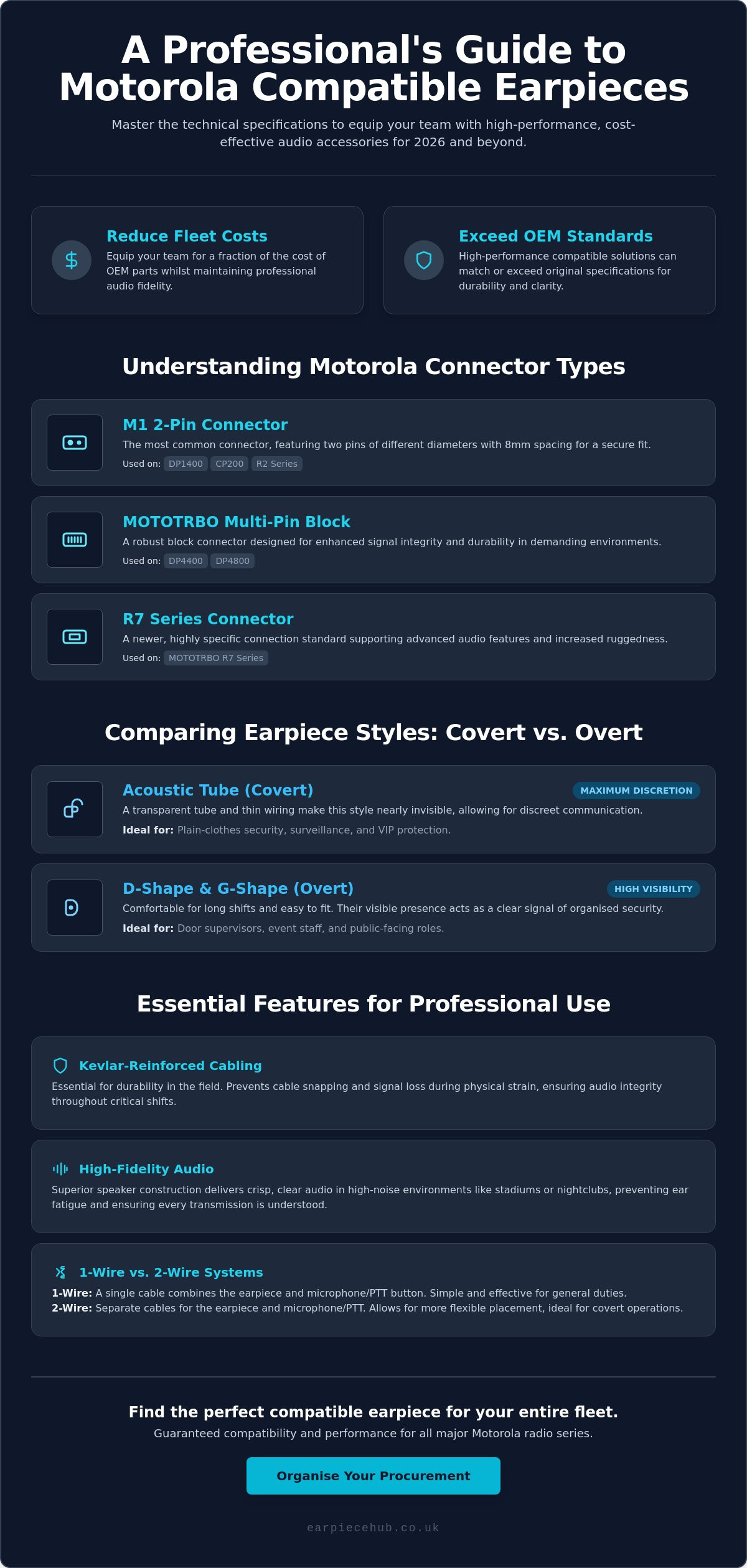
The choice between covert and overt audio depends entirely on your operational environment. Covert audio setups typically utilise transparent acoustic tubes and thin wiring that remains hidden beneath clothing. This is the standard for plain-clothes security and surveillance operations where blending into the crowd is vital. If your role involves VIP protection or undercover work, discretion is your priority. It allows you to receive instructions without alerting those around you.
Overt audio, such as D-shape or G-shape earpieces, is designed for high-visibility roles. Door supervisors and event staff often prefer these styles because they are easy to fit and comfortable for long shifts. There is also a psychological element at play. Visible radio equipment acts as a clear signal of authority and professional behaviour. This presence can often de-escalate potential conflicts before they begin, as it shows the staff are organised and connected.
The Importance of Audio Fidelity in High-Noise Environments
UK nightclubs and stadiums present a unique challenge for clear communication. In these high-noise environments, ambient sound can easily drown out incoming transmissions. A high-quality Motorola radio earpiece compatible accessory must manage this noise through superior speaker construction and snug-fitting ear tips that provide a degree of passive isolation.
Poorly made earpieces often result in muffled sound, forcing users to turn up the volume to dangerous levels. This leads to ear fatigue and potential long-term hearing issues during an eight-hour shift. High-fidelity speakers provide crisp, clear audio even at lower volumes. This is a non-negotiable feature for door supervisors managing safety in crowded venues. Reliable gear ensures that every command is heard the first time, preventing costly delays in response.
Understanding Motorola Connector Types and Wiring Configurations
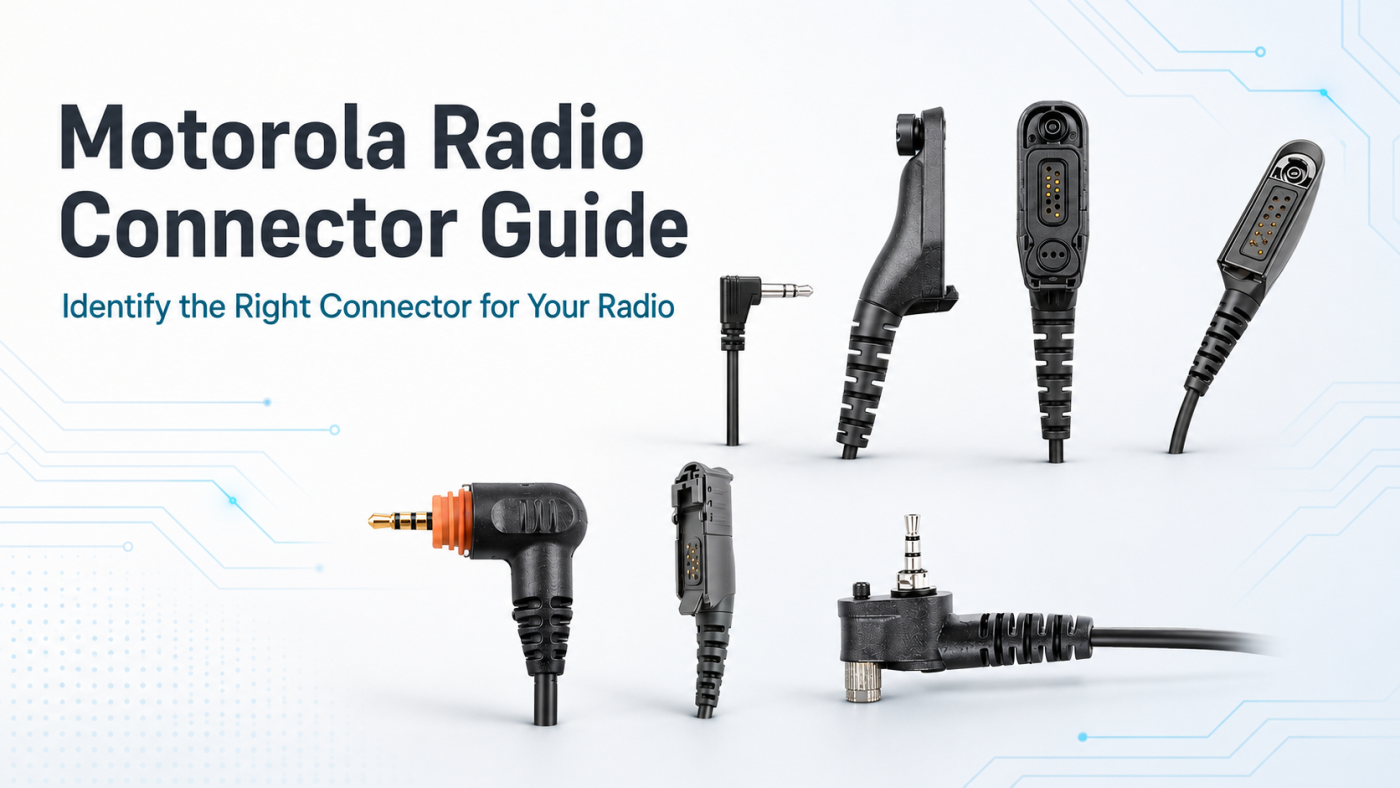
Identifying the correct Motorola radio earpiece compatible accessory starts with a visual inspection of your radio’s accessory port. Motorola utilises several proprietary connector designs that are not interchangeable. The M1 2-pin connector is the most recognisable, featuring two pins of different diameters (1.1 cm and 1.5 cm) with 8mm spacing. It remains a staple for models like the CP200 and the newer R2 series. In contrast, the M2 connector is a larger multi-pin side attachment frequently seen on legacy GP340 units. Modern MOTOTRBO handsets, such as the DP4400 and DP4800, use a robust multi-pin block connector designed for enhanced signal integrity in demanding environments.
The transition to the MOTOTRBO R7 series has introduced even more specific connection requirements. These newer handsets move away from older standards to support advanced audio features and increased ruggedness. If you’re managing a mixed fleet of older and newer devices, you don’t necessarily need to replace every accessory. Using a high-quality earpiece adapter for any radios allows you to bridge the gap between older M1 accessories and newer multi-pin handsets. This flexibility is essential for maintaining operational continuity whilst gradually upgrading your hardware.
1-Wire, 2-Wire, and 3-Wire Systems Explained
Wiring configurations dictate how you wear and use your equipment. Understanding these terms is vital for matching the gear to your specific role:
- 1-Wire Systems: A single cable runs from the radio to the earpiece, with the microphone and PTT button combined inline. This is a simple, cost-effective solution for retail staff and light security.
- 2-Wire Systems: The professional standard. One wire leads to the earpiece, whilst a second wire carries the microphone and PTT. This allows you to route the microphone down a sleeve or clip it to a lapel for more discreet operation.
- 3-Wire Systems: The ultimate covert setup. It features three separate lines for the earpiece, microphone, and PTT. This configuration is preferred for high-level surveillance where the PTT can be hidden in a palm or pocket.
Push-to-Talk (PTT) Button Variations
The PTT button is your primary interface. Standard inline PTTs are sufficient for most users, but certain environments require specialised hardware. For example, if your team operates in cold climates or industrial settings, large, glove-friendly PTT buttons are essential. These provide a larger surface area that is easy to locate by touch alone. Whilst these earpieces deliver clear audio, professionals must also remain aware of OSHA hearing protection requirements to prevent long-term damage in high-decibel environments like festivals or construction sites.
Tactile feedback is another critical factor. You need a button that offers a distinct “click” when pressed, ensuring you know exactly when your channel is open. Placement strategies also vary. Whilst most prefer a lapel clip, some surveillance roles require a palm-held PTT for maximum discretion. Choosing a Motorola radio earpiece compatible unit with the right PTT configuration ensures your team can communicate effectively under pressure without fumbling for controls.
Comparing Earpiece Styles: Acoustic Tube, D-Shape, and G-Shape
Selecting the correct Motorola radio earpiece compatible style is a decision that impacts both user comfort and operational efficiency. Whilst previous sections focused on connectors and wiring, the physical shape of the earpiece determines how well a staff member can perform over an eight-hour shift. Hygiene has become a primary concern for UK fleet managers in 2026. Shared equipment can lead to ear infections if not managed correctly. Choosing styles with easily replaceable components, such as Replacement Acoustic Tubes and Ear Tips, or non-invasive designs is essential for maintaining a healthy workforce.
The three primary designs; Acoustic Tube, D-Shape, and G-Shape, each offer distinct acoustic properties. In-ear designs provide better noise isolation, whilst over-ear speakers allow for greater situational awareness. Your choice should reflect the specific noise levels and physical demands of the job role. Use this quick-reference guide for style selection:
- Acoustic Tube: Best for covert surveillance and high-noise environments requiring isolation.
- D-Shape: Ideal for retail and hospitality where users frequently share headsets.
- G-Shape: The preferred choice for active security and event staff who need a secure, wrap-around fit.
The Acoustic Tube: The Professional Security Choice
The transparent acoustic tube is the undisputed industry standard for covert communication. It works by delivering sound through an air-filled tube rather than a wire leading directly to the ear. This physics-based approach provides exceptional clarity for voice transmissions. It also makes the earpiece nearly invisible to the public, which is vital for plain-clothes operations. Maintenance is critical for these units. You must regularly inspect the tube centre to prevent moisture buildup, which can muffle sound. Simply detaching the tube and using a small air blower can keep the audio path clear and functional.
D-Shape and G-Shape: Comfort for Long Shifts
The D-Shape earpiece features a “sit-on-the-ear” design. It is highly favoured by users who dislike the feeling of in-ear tips. Because the speaker sits outside the ear canal, it is the most hygienic option for teams where earpieces might be swapped between staff members. However, this design allows for more audio leakage, meaning bystanders in very quiet environments might hear radio traffic. It’s a trade-off between absolute discretion and user comfort.
For more active roles, the G-Shape earpiece provides a secure fit that won’t budge during physical activity. The “C” or “G” hook wraps firmly around the outer ear, making it perfect for door supervisors who may need to move quickly. Like the D-shape, it uses an over-ear speaker, but the fit is much tighter. When choosing a Motorola radio earpiece compatible accessory for a dynamic environment, the stability of the G-shape often outweighs the slightly more invasive feel of the hook. Both styles ensure that your team stays connected without the constant need to readjust their gear during a busy shift.
Compatibility Guide for Popular Motorola Series: DP, GP, and R7
Selecting a Motorola radio earpiece compatible solution requires precise knowledge of your handset’s model number. In the UK, the Motorola DP1400 remains the primary workhorse for many security and facilities management teams. This model relies on the classic M1 2-pin connector, which has been a standard for decades. However, as fleets grow and evolve, managers often introduce more advanced MOTOTRBO units without realising the connection requirements have changed. Misidentifying a port leads to costly returns and downtime during critical operations.
Legacy support is equally important for many UK businesses still operating the GP340 or GP300 series. These older devices are incredibly durable and remain active amongst many warehouse and event teams. Whilst the GP300 shares the 2-pin style, the GP340 requires a larger M2 multi-pin side connector. Keeping these legacy units functional with modern accessories is a smart way to extend the life of your hardware investment. Before you place a bulk order, use this checklist to verify your requirements:
- Locate the model number, typically found on a white label behind the battery.
- Identify the side-port type: is it a 2-pin socket or a multi-pin block?
- Confirm if your team requires 1-wire, 2-wire, or 3-wire configurations based on their specific roles.
- Check if you need a Replacement Battery for Motorola DP1400 to ensure your fleet stays powered throughout the shift.
Matching the DP1400 and DP2400 Series
The DP series is where most compatibility errors occur. The DP1400 uses the standard M1 2-pin connector. In contrast, the DP2400 and DP3441 models utilise a specific multi-pin block connector that is physically smaller than the one found on the DP4000 series. If you manage a mixed fleet, you must differentiate between these two block types. Ordering a “DP Series Earpiece” without specifying the model often results in a connector that is either too large or lacks the necessary pin alignment for your specific handset.
Transitioning to the Motorola R7 and Ion Series
The latest Motorola R7 series represents a significant shift in accessory design. These handsets feature the GCAI-mini connector, which is more compact and robust than previous versions. If you are upgrading from the DP4000 series to the R7, your older accessories won’t fit directly. You’ll need to invest in R7-specific peripherals or high-quality adapters to maintain compatibility. Future-proofing your fleet now by selecting R7-compatible gear ensures you won’t be caught out as older DP models are phased out of production. Professionals who move to the R7 series immediately notice the improved audio clarity, provided they use a high-performance Motorola radio earpiece compatible unit designed for the GCAI-mini port.
Ready to upgrade your team’s communication gear? Shop now at Earpiece Hub for guaranteed compatibility across all Motorola series.
Why Professional Radio Users Choose Earpiece Hub for Reliable Accessories
Reliability is the cornerstone of professional communication. As the UK’s specialist centre for radio peripherals, we understand that a Motorola radio earpiece compatible accessory must do more than just function; it must endure. Unlike generic retailers, we focus exclusively on the technical demands of the security and emergency sectors. Every component we supply undergoes a rigorous testing programme to ensure it meets the electrical tolerances required by high-end Motorola handsets. This no-nonsense approach to quality control is why fleet managers across the country trust us to keep their teams connected.
Logistics and support are equally vital for professional operations. We recognise that equipment failure often happens at the most inconvenient times. To address this, we maintain a commitment to next-day shipping for our UK customers, ensuring that replacement gear arrives before your next critical shift. Our 24/7 support structure provides a steadying beat for our clients, offering technical expertise whenever it’s needed. By positioning ourselves as a dependable partner rather than just a shop, we help businesses maintain their communication infrastructure with minimal fuss.
Durability Features: Beyond the Standard Wire
The most common failure point in any radio accessory is the cable. To combat this, our Motorola radio earpiece compatible range utilises Kevlar-reinforced cabling. This material provides exceptional tensile strength, preventing the internal copper strands from snapping under sudden tension. We also incorporate heavy-duty strain relief at the connector and microphone housings. These reinforced sections distribute the physical load, protecting the delicate solder joints that often fail on cheaper alternatives.
Comfort is a technical requirement, not a luxury. We use medical-grade silicone for all our ear tips and acoustic tubes. This material is hypoallergenic and maintains its flexibility whilst resisting the yellowing and hardening caused by skin oils and sweat. Our noise-cancelling microphones are engineered to match the frequency response of expensive OEM versions, ensuring your voice remains clear even in the centre of a crowded stadium or nightclub. These specialist features ensure that our accessories provide a superior cost-to-performance ratio without sacrificing audio integrity.
Fleet Management and Bulk Support
Managing a large-scale deployment for national UK events requires a partner who understands the logistics of scale. We specialise in supporting these high-stakes environments through comprehensive fleet management solutions. Beyond individual earpieces, we provide the essential infrastructure needed for 24-hour operations. This includes six-way multi-unit chargers that keep your handsets organised and ready for the next rotation. Our replacement battery programmes also ensure that your older DP1400 or GP series units don’t fail due to diminished cell capacity.
Choosing the right partner for your communication needs ensures that your team can focus on their roles without worrying about their equipment. Precision, durability, and specialist knowledge are at the heart of everything we do. Browse our full range of Motorola compatible earpieces today and experience the difference that professional-grade peripherals make to your daily operations.
Secure Your Professional Communications for 2026
Equipping your fleet with the right gear is a matter of technical precision. You now understand how to differentiate between M1 2-pin connectors and the latest R7 multi-pin blocks whilst matching earpiece styles to your team’s specific roles. Whether you need the discretion of a 3-wire acoustic tube or the stability of a G-shape hook for active shifts; finding a Motorola radio earpiece compatible solution ensures high-performance audio without the OEM price tag.
At Earpiece Hub, we provide the durability your operations demand. Our range features Kevlar-reinforced cables for maximum durability and medical-grade components designed for long shifts. With 24/7 specialist support and next-day UK shipping available; we ensure your communications never falter. Shop Professional Motorola Compatible Earpieces at Earpiece Hub to upgrade your team’s gear today. Stay connected and stay secure.
Frequently Asked Questions
How do I know if an earpiece is compatible with my Motorola radio?
You determine compatibility by identifying your radio’s specific model number and accessory port style. Handsets like the DP1400 require a 2-pin M1 connector, whilst the DP4400 utilises a multi-pin block. Always verify the connector’s physical layout against the radio port before purchase to ensure a secure fit.
Is there a difference in audio quality between genuine Motorola and compatible earpieces?
High-performance Motorola radio earpiece compatible units provide audio fidelity that rivals original parts by matching impedance and frequency response. Specialist retailers use precision-engineered speakers to ensure transmissions remain crisp. This prevents the muffled sound often associated with low-quality, non-professional alternatives found on generic marketplaces.
What is the difference between a 1-wire and a 2-wire earpiece?
The primary difference lies in the cable configuration and microphone placement. A 1-wire system features a single cable with an inline microphone and PTT button, making it ideal for retail roles. A 2-wire system splits the earpiece and microphone lines, allowing you to route the PTT button down a sleeve for more discreet operation.
Can I use a GP340 earpiece on a newer DP4400 radio?
These units are not directly interchangeable because the GP340 uses an M2 connector whilst the DP4400 requires a larger MOTOTRBO block connector. You can solve this issue by using a dedicated earpiece adapter. This allows your team to continue using existing accessories whilst transitioning to modern digital handsets without replacing the entire fleet’s peripherals.
Why do acoustic tubes sometimes fail or lose sound?
Acoustic tubes fail most often due to condensation or debris blocking the air-filled channel. This moisture buildup acts as a physical barrier to sound waves, resulting in muffled or silent audio. Regularly detaching the tube to clear it with compressed air or replacing the tube entirely restores full audio clarity for the user.
Does using a compatible earpiece void my Motorola radio warranty?
Using a compatible accessory does not void your radio’s manufacturer warranty. Consumer protection laws generally prevent manufacturers from mandating only branded accessories for standard operation. As long as the Motorola radio earpiece compatible part is electrically sound and doesn’t physically damage the connector pins, your radio remains fully covered.
Which earpiece style is best for high-noise environments like concerts?
Acoustic tube earpieces are the superior choice for loud venues like concerts or stadiums. The silicone ear tip creates a seal in the ear canal that blocks out ambient noise through passive isolation. This ensures you hear incoming transmissions clearly without having to increase the volume to unsafe levels during a shift.
What are the benefits of Kevlar-reinforced radio earpiece cables?
Kevlar reinforcement significantly increases the tensile strength of the cabling. It prevents the internal copper wires from snapping when the earpiece is snagged on a door handle or pulled during a physical altercation. This extra layer of protection ensures the equipment survives the daily rigours of active security work and industrial environments.
