





Uncategorized
Two-Way Radio Earpieces UK: The Professional Guide to Reliable Communication
Jul
A single second of radio silence during a security breach isn’t just a technical glitch; it’s a critical operational failure. If you’ve ever struggled with audio cutting out in a loud venue or found yourself with a drawer full of incompatible connectors, you know that the wrong equipment costs more than just money. Finding a reliable security radio earpiece UK professionals can trust means looking beyond the price tag to the technical synergy between your hardware and your environment.
You deserve equipment that survives the rigours of daily professional wear and tear without causing ear fatigue during a 12-hour shift. This guide provides the expertise you need to master technical specifications and selection criteria for your specific radio fleet. We’ll examine the essential differences between 1-wire, 2-wire, and 3-wire configurations, connector compatibility for major brands like Motorola and Hytera, and how to achieve a discreet, covert appearance without sacrificing audio clarity. It’s time to ensure your communication remains crystal clear in every UK environment.
Key Takeaways
- Understand why a professional security radio earpiece UK is a vital safety requirement for meeting duty of care standards in high-stakes environments.
- Distinguish between 1-wire and 2-wire configurations to ensure your push-to-talk setup matches your specific operational requirements.
- Compare acoustic tube and D-shape styles to find the perfect balance between covert aesthetics and hygiene for shared equipment.
- Learn the technical maintenance routines required to prevent moisture blockage and extend the lifespan of your audio peripherals.
- Identify the correct connector types for Motorola, Hytera, and Kenwood systems to avoid costly compatibility issues and fleet downtime.
Why Professional Two-Way Radio Earpieces are Critical for UK Operations
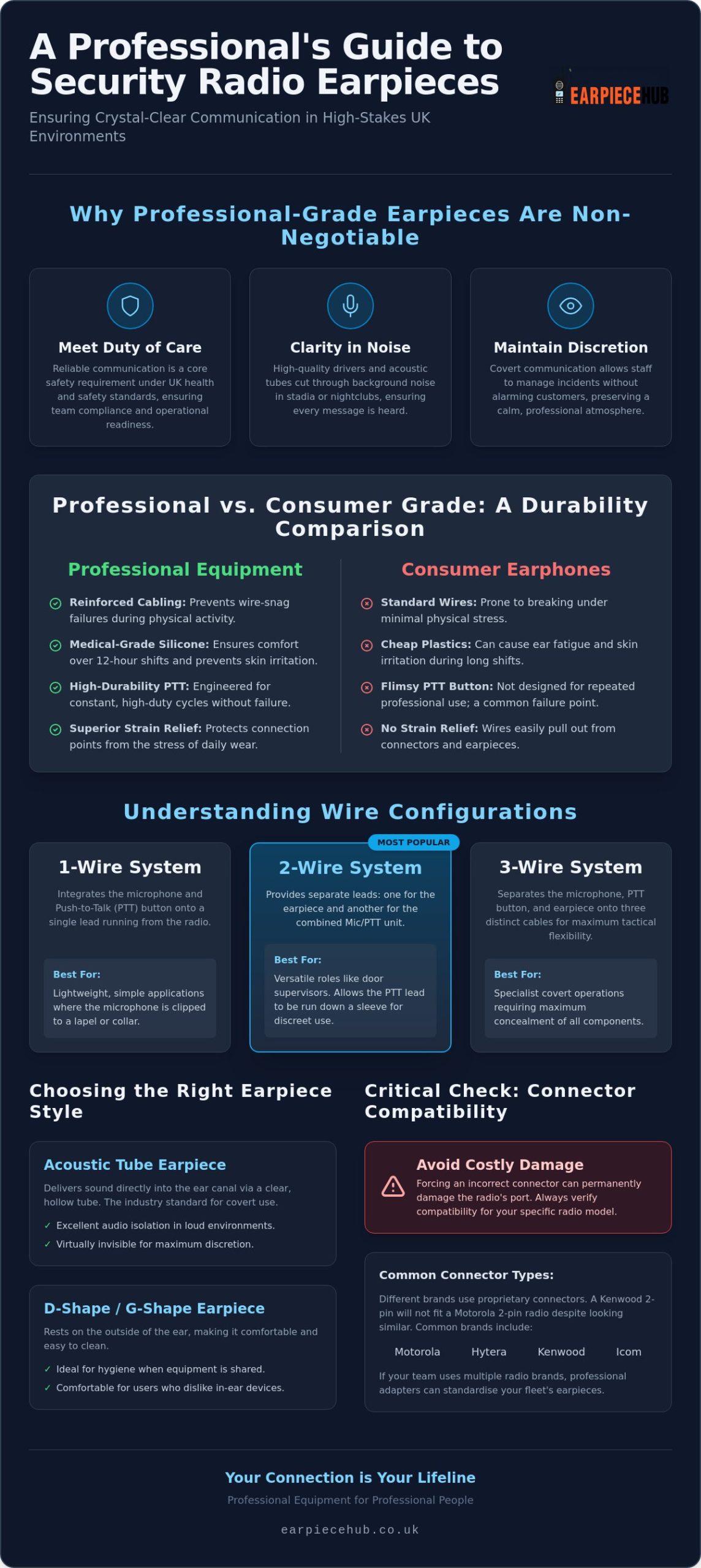
A professional security radio earpiece UK is a specialised audio interface. It is engineered specifically for durability and clarity whilst handling high-duty cycles. The two-way radio is the essential foundation of site coordination, but the earpiece is the critical point of contact. Standard consumer earphones simply cannot handle the constant stress of a professional security environment. Professional units offer superior strain relief and PTT (Push-to-Talk) durability that keeps teams connected during every minute of their shift.
Duty of care is a primary concern for UK businesses. Reliable communication is a safety requirement under national health and safety standards; it is not a luxury. If a device fails during a critical incident in a crowded venue, the operational consequences are severe. Using a high-quality security radio earpiece UK ensures that your team remains compliant with these safety standards. In retail and hospitality, covert communication is also vital. It allows staff to manage incidents discreetly amongst customers, maintaining a calm and professional atmosphere.
The Role of Clear Audio in High-Stakes Environments
Background noise in UK stadia or nightclubs can easily drown out standard audio signals. High-quality drivers are essential for maintaining clarity in these loud environments. Acoustic tube technology is the industry standard for this reason. It uses a clear, hollow tube to deliver sound directly into the ear canal. This design provides excellent audio isolation whilst remaining virtually invisible to the public, which is essential for covert operations. Similarly, audiophiles seeking peak performance in their home setups often prioritise stability, using a HiFi Rack to ensure their equipment is properly supported for optimal sound reproduction.
Durability Standards for Professional Use
Professional shifts often involve physical activity that puts significant stress on equipment. Reinforced cabling is a necessity to prevent wire-snag failures. Unlike consumer gear, professional earpieces use medical-grade silicone for ear tips. This material ensures comfort over 12-hour shifts and resists the skin irritation often caused by cheaper plastics. Investing in professional-grade peripherals ensures your equipment survives the daily grind of professional use.
Understanding Technical Specifications: 1-Wire, 2-Wire, and Connector Types
The technical configuration of a security radio earpiece UK professionals rely on determines how effectively they can communicate. Wiring systems are categorised by the number of leads running from the radio connector. A 1-wire system integrates the microphone and Push-to-Talk (PTT) button onto a single lead. It’s an ideal choice for lightweight, simple applications where the microphone is clipped to a lapel or collar.
For more demanding roles, 2-wire systems provide separate leads for the earpiece and the Mic/PTT unit. This allows the user to run the PTT lead down a sleeve, enabling discreet communication without reaching for the chest. Specialist covert operations often require 3-wire systems. These kits separate the microphone, the PTT button, and the earpiece onto three distinct cables for maximum concealment and tactical flexibility.
Identifying your connector type is the most common hurdle when purchasing a new security radio earpiece UK. Motorola 2-pin connectors are standard for many entry-level models, whilst the Motorola DP1400 requires a specific multi-pin side attachment. Kenwood 2-pin connectors look similar but use different spacing. Beyond physical fit, ensuring your equipment aligns with Ofcom licensing for professional radios is essential for maintaining a legal and functional communication network.
Choosing Your Wire Configuration
The 2-wire kit is the most popular choice for UK door supervisors due to its versatility and ease of concealment. Use a 2-wire configuration for under-arm PTT placement, whilst 1-wire setups remain the standard for simple lapel microphone use.
Connector Compatibility and Adapters
Radios from different manufacturers often feature proprietary pin-outs, meaning accessories aren’t cross-compatible by default. Attempting to force an incorrect fit can lead to permanent hardware damage. If your team uses a variety of brands, you can find professional earpiece adapters for any radios to ensure your fleet remains fully integrated without replacing every handset.
Choosing the Right Earpiece Style for Your Environment
Selecting a security radio earpiece UK professionals can rely on requires matching the physical design to the specific working environment. The setting dictates whether you need maximum concealment, high hygiene standards, or extreme physical security. Acoustic tube earpieces remain the gold standard for security and covert work. Their clear tube aesthetic is discreet, whilst the design provides superior audio isolation by delivering sound directly into the ear canal.
In contrast, D-shape earpieces are the preferred choice for shared equipment environments. Because the speaker sits comfortably outside the ear canal, they are far more hygienic for staff members who share handsets throughout a 24-hour cycle. For active roles such as warehouse logistics or outdoor event stewarding, G-shape earpieces offer a highly secure fit. The rubberised loop wraps around the ear, ensuring the device stays in place during rapid movement or physical exertion. When noise levels exceed safe limits, such as in construction or at live music venues, transitioning to a noise-cancelling overhead headset is necessary to protect hearing and maintain communication.
Style Comparison for UK Industry Sectors
Retail and hospitality teams often favour G-shape or D-shape models. These provide all-day comfort and are easy to clean amongst different staff members. Security and close protection officers should always opt for the acoustic tube. It offers the most discreet profile and ensures that sensitive transmissions aren’t overheard by the public.
The Importance of PTT (Push-to-Talk) Design
The physical PTT button is just as important as the earpiece style. Inline PTT units are sleek and hide easily under suits, but large button PTTs are essential if you’re wearing gloves or heavy outdoor clothing. For emergency services or those in extreme environments, a Remote Speaker Microphone (RSM) serves as a rugged alternative that mounts directly to the shoulder. Whatever your sector, you can shop now for specialist radio earpieces to find the exact match for your operational needs.
Maximising Lifespan: Maintenance and Professional Support in the UK
Maintaining your security radio earpiece UK kit is essential for operational readiness. A common technical issue is moisture build-up inside the acoustic tube, which leads to muffled audio or total silence. Regular cleaning prevents condensation from blocking the sound path. You should detach the tube and use compressed air or a specialised cleaning wire to clear any obstructions. This simple routine prevents the “underwater” sound quality that often plagues neglected equipment.
To maintain peak audio performance and hygiene, replace your ear tips and acoustic tubes every 3-6 months. Over time, the silicone degrades and the tube becomes less flexible, affecting both comfort and sound conduction. Don’t overlook your power source, either. A high-quality security radio earpiece UK setup is useless if the handset dies mid-shift. Investing in a replacement battery for Motorola DP1400 radios ensures your full unit remains operational during extended duties and high-pressure events.
Hygiene and Replacement Parts
Acoustic tubes should be replaced immediately if they become discoloured or brittle. Keeping a professional spares kit on-site is the best way to avoid equipment downtime during a shift.
- Replacement acoustic tubes and ear tips
- Spare clothing clips to prevent wire strain
- Replacement ear moulds for improved long-term comfort
Why a Specialist Hub Matters
Future-Proof Your Professional Communication
Clear, reliable communication is the backbone of safe UK security operations. You now understand that selecting the right security radio earpiece UK involves more than just picking a brand; it requires a precise match between your wire configuration, connector type, and physical environment. Whether you opt for the discreet profile of an acoustic tube or the hygienic benefits of a D-shape speaker, your choice directly impacts team safety and performance. Consistent maintenance and the timely replacement of parts like the Motorola DP1400 battery will ensure your gear stays operational when it matters most.
Don’t let audio failure or incompatible hardware compromise your next shift. Founded in 2015, Earpiece Hub is your specialist partner for professional-grade peripherals. We provide expert 24/7 technical support for all major radio brands and offer next-day UK shipping to keep your team mission-ready. Shop the UK’s leading range of professional radio earpieces at Earpiece Hub and equip your fleet with gear designed for the daily professional grind. Secure your communications today.
Frequently Asked Questions
How do I know which connector my two-way radio uses?
Identify your connector by checking the accessory port on the side of your handset. You’ll typically find a 2-pin, multi-pin, or threaded single-pin port. Match the radio model number, such as a Motorola DP1400 or Kenwood TK series, to the specific connector layout. If you’re unsure, consulting the manufacturer’s manual or a specialist retailer is the fastest way to avoid purchasing incompatible equipment for your fleet.
What is the difference between an acoustic tube and a D-shape earpiece?
Acoustic tube earpieces use a clear, hollow tube to deliver audio directly into the ear canal, offering maximum discretion and sound isolation. D-shape earpieces feature a speaker that sits on the outside of the ear, held by a curved loop. This makes the D-shape a more hygienic option for shared equipment environments, whilst the acoustic tube remains the preferred security radio earpiece UK professionals use for covert operations.
Can I use a Motorola earpiece with a Kenwood radio?
You cannot use a standard Motorola earpiece with a Kenwood radio because the pin spacing and internal wiring configurations are different. Even if the pins appear to fit, the radio won’t transmit or receive audio correctly. To resolve this in a mixed-fleet environment, you must use a dedicated earpiece adapter. These tools allow you to bridge the gap between different brands without needing to replace your entire inventory of audio peripherals.
How often should I replace the ear tips on my radio earpiece?
Replace your ear tips every three to six months to maintain high standards of hygiene and audio performance. Over time, the medical-grade silicone can harden or collect debris, which affects comfort and clarity. If you work in a high-intensity environment with long shifts, you might need to replace them more frequently. Keeping a stock of replacement ear tips ensures your equipment remains comfortable and functional throughout the year.
Why is the audio in my acoustic tube earpiece sounding muffled?
Muffled audio is usually caused by moisture build-up or debris blocking the clear tube. Condensation from the ear can trap air bubbles inside the hollow lead, which prevents sound waves from travelling clearly. To fix this, detach the tube and clear it with compressed air or a cleaning wire. If the tube has become discoloured or brittle, it’s time to install a replacement acoustic tube to restore crystal-clear communication during your shift.
Are two-way radio earpieces compatible with all walkie-talkies?
Earpieces are not universally compatible with all walkie-talkies. Compatibility depends on the physical connector type and the radio’s internal circuitry. Whilst many professional radios share common 2-pin standards, consumer-grade PMR446 radios often use different ports. Always verify that your chosen security radio earpiece UK matches the specific model of your handset to ensure the Push-to-Talk (PTT) and microphone functions operate correctly without damaging the radio’s accessory port.
